



My last op-ed on energy policy has Minnesotans talking. When New DFL politicians passed their sweeping clean-energy legislation three years ago, they established a 100% carbon-free electricity standard by 2040 but conveniently failed to warn the public of the mandate’s true costs. Over the past month, I have been encouraged by your in-person and online engagement surrounding this mandate. Many express the same concerns as I do, while some remain skeptical of the high-cost estimates that I provided for wind and solar compared with those of coal and natural gas.
A closer look at the figures from my last op-ed
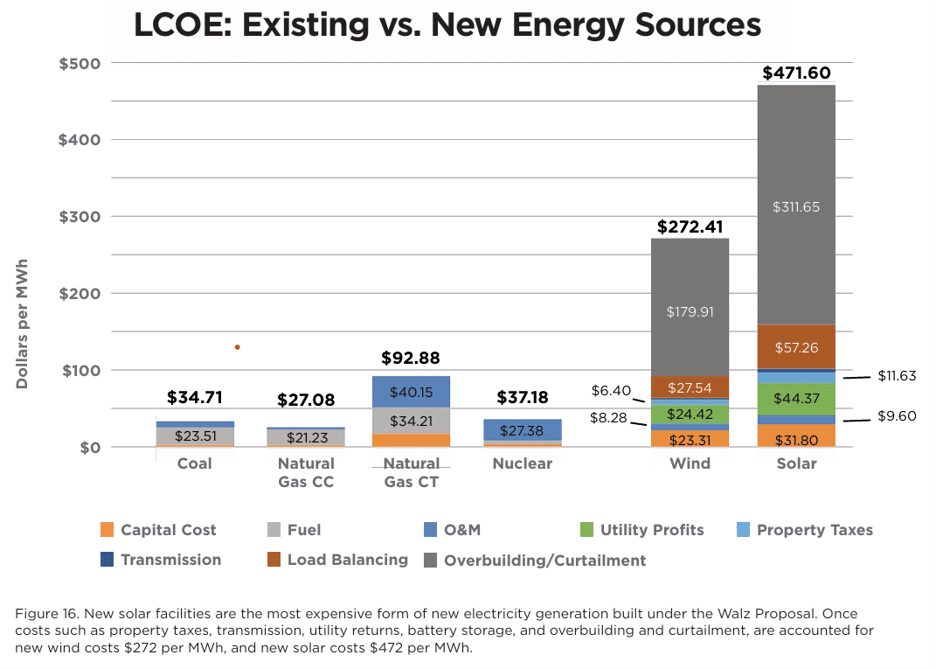
The $272/MWh (wind) and $472/MWh (solar) figures that I cited in my last op-ed come from a September 2022 Center of the American Experiment report by Isaac Orr, Mitch Rolling, and John Phelan, titled “The High Cost of 100 Percent Carbon-Free Electricity by 2040.” They are the “all-in” levelized costs for serving Minnesota load under a wind, solar, and battery pathway to a 100% carbon-free grid, not plant-gate generation costs.
Below are some visuals of their cost projections, as found on page 30 of their report:
New York and California face energy sticker shock
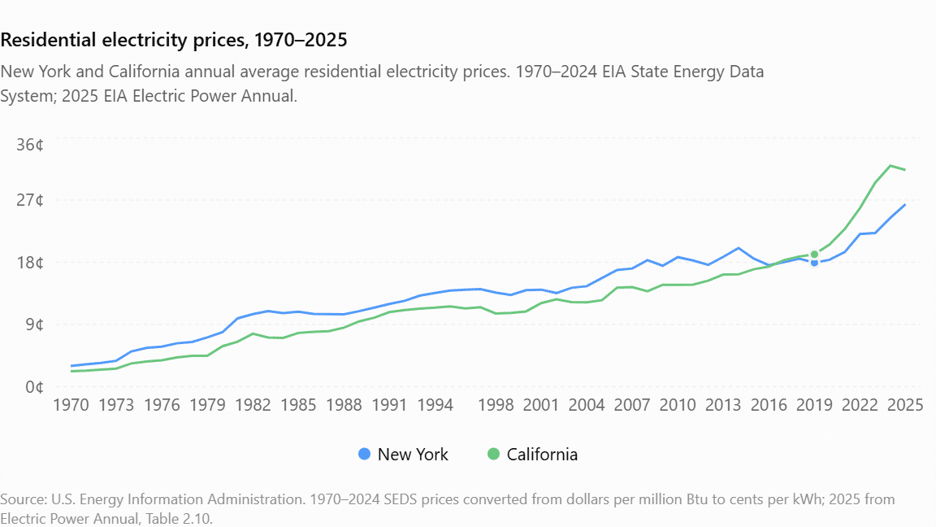
Although correlation does not necessarily equate to causation, it is important that we also look at energy price increases in states that have implemented similar mandates. New York passed a comparable 100% clean-energy mandate in 2019, while California’s was a year earlier in 2018. Both states have experienced substantial increases in residential electricity prices since their mandates were enacted. While New Yorkers paid 18.52¢/kWh in 2018, their rates increased to 26.39¢/kWh by 2025. In California, the increase has been even more dramatic. While Californians paid 18.84¢/kWh, their rates reached 31.35¢/kWh during the same timeframe.
These figures represent residential electricity price increases of 42.5% and 66.4%, respectively, in just seven years!
The point is not to bash all forms of carbon-free energy or even the notion of reducing carbon emissions. For instance, I am fully in favor of repealing Minnesota’s moratorium on the construction of new nuclear power plants. Likewise, Washington State has adopted a clean-electricity mandate, but its existing, robust hydroelectric infrastructure gives it a significant advantage over states that must rely much more heavily on wind and solar to meet their carbon-free energy goals. The point here is to highlight how the New DFL, which is far more radical and ideologically captured than the DFL of merely a decade ago, passed this feel-good mandate without considering how it will impact regular, working Minnesotans.
We must not eliminate our current sources of cheap power
Under the current mandate, Minnesota utilities will have to substantially change their electricity portfolios by 2040. As utilities work toward compliance, existing coal and natural gas plants will face increasing pressure to retire or operate less frequently, while utilities become increasingly reliant on wind and solar. Coal and natural gas plants that have cheaply and reliably powered Minnesota for generations are likely to be shut down within a relatively short period of time. As a result, our grid will become increasingly reliant on intermittent wind and solar, along with the additional infrastructure needed to support them.
If we follow this mandate to strip away Minnesota’s options for cheap power, our utility bills have nowhere to go but up.
Overlooked retail consequences
Another factor that wind and solar advocates failed to address is how heightened energy costs have the potential to translate into higher consumer prices, especially at the grocery store. Given that Minnesota is home to some of the most productive farmland in the world, converting farms to utility-scale wind and solar installations means less agricultural production in our state. In turn, this lower supply of goods means higher prices at the store.
Trading our farms for wind and solar installations is a raw deal for consumers.
The takeaway
The New DFL has lost all sense of pragmatism on energy and many other issues. Instead of having an effective conversation about a hybrid solution that could continue to supply cheap and reliable power, they chose to use their recent trifecta to ram through their feel-good 100% carbon-free mandate, which is likely to substantially increase our utility bills.
The ideologues in the New DFL govern via emotion. It is up to regular, working Minnesotans to bring some common sense back into the discussion.

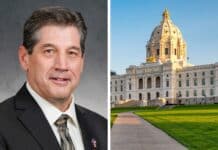
Tom Murphy
Tom Murphy is a Republican state representative who represents District 9B in the Minnesota House.