



Half a century ago, 29 mariners perished when the SS Edmund Fitzgerald sank in Lake Superior during a violent storm. Today, on the anniversary of that fateful day in 1975, the Minnesota Historical Society will host its annual memorial and beacon lighting at Split Rock Lighthouse, Two Harbors, Minn.
According to MNHS, “This reverent annual tradition pays homage to the brave crew of the Edmund Fitzgerald and all those lost within Lake Superior’s waters. The lighthouse will temporarily close for a rendition of the naval hymn, followed by the names of the 29 crew members read aloud to the tolling of a ship’s bell. After the ceremony, the beacon will be lit in their honor. As part of the ceremony, former Split Rock Lighthouse Site Manager Lee Radzak will be onsite to discuss why he started the annual memorial 40 years ago.”
Throughout the day from 10 a.m. to 6 p.m., guests can explore the lighthouse, fog signal building and visitor center. Guided tours and a brief film will be available that share the story of the Edmund Fitzgerald and her final voyage. At 4 p.m., the Lighthouse will temporarily close for the beacon lighting ceremony. Tickets to the in-person memorial and the beacon lighting ceremony are sold out, but a virtual livestream of the event will be available on the MNHS website. Following the ceremony and beacon lighting, the lighthouse tower will reopen to visitors until 6 p.m.
Crew Members lost on Nov. 10, 1975
McSorley, Ernest M., Master
McCarthy, John H., 1st Mate
Pratt, James A., 2nd Mate
Armagost, Michael E., 3rd Mate
Holl, George J., Chief Engineer
Bindon, Edward F., 1st Asst. Engineer
Edwards, Thomas E., 2nd Asst. Engineer
Haskell, Russell G., 2nd Asst. Engineer
Champeau, Oliver J., 3rd Asst. Engineer
Beetcher, Frederick J., Porter
Bentsen, Thomas, Oiler
Borgeson, Thomas D., AB Maint. Man
Church, Nolan F., Porter
Cundy, Ransom E., Watchman
Hudson, Bruce L., Deckhand
Kalmon, Allen G., 2nd Cook
MacLellan, Gordon F., Wiper
Mazes, Joseph W., Spec. Maint. Man
O’Brien, Eugene W., Wheelsman
Peckol, Karl A., Watchman
Poviach, John J., Wheelsman
Rafferty, Robert C., Steward
Riippa, Paul M., Deckhand
Simmons, John D., Wheelsman
Spengler, William J., Watchman
Thomas, Mark A., Deckhand
Walton, Ralph G., Oiler
Weiss, David E., Cadet (Deck)
Wilhelm, Blaine H., Oiler
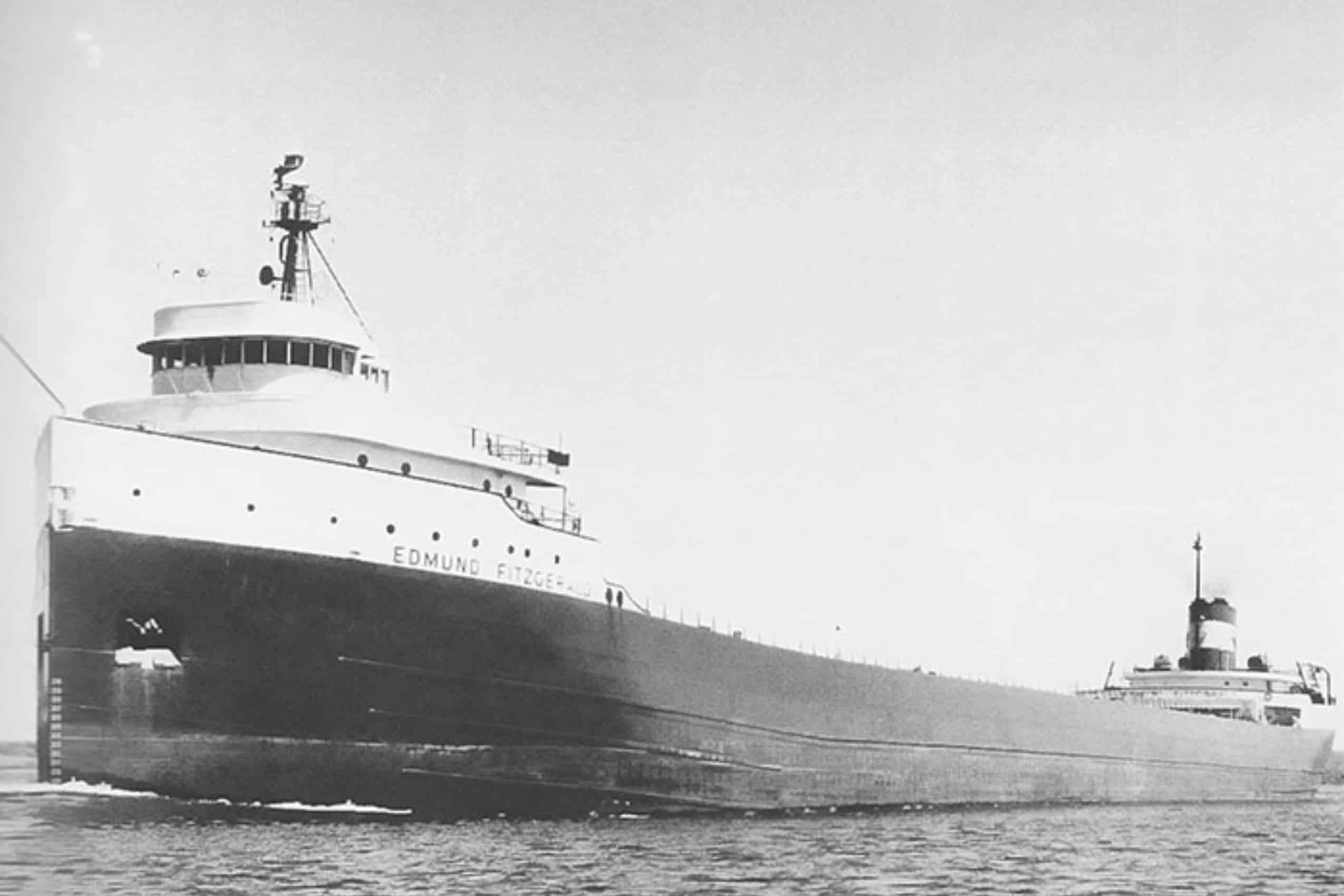
Interested in learning more about the wreck of the Edmund Fitzgerald?
On Nov. 20, the Minnesota History Center will host “The Enduring Story of the Edmund Fitzgerald,” a free panel discussion exploring the legacy of the freighter. The event is from 6:30-8 p.m. and will be livestreamed via YouTube. Click here to register for the virtual livestream.
Panelists include Split Rock Lighthouse Site Manager Hayes Scriven; author John U. Bacon; Executive Director of the Great Lakes Shipwreck Museum, Bruce Lynn; and former Split Rock Lighthouse Site Manager, Lee Radzak. The event will also be streamed live on YouTube.
For a comprehensive look at the history of the Edmund Fitzgerald, check out the Great Lakes Shipwreck Museum. It is also hosting a livestreamed ceremony at 7 p.m. EST.
Other notable shipwrecks
According to MNHS, “Lake Superior is the resting place of 350 ships, at least half of which lay undiscovered to this day. Throughout the years of the Industrial Revolution, the Great Lakes provided a key means of transportation for the valuable resources produced inland. Ships carrying iron ore, lumber, fish, and grain traversed these waters often, but when tumultuous weather hit, the results were often disastrous.
“Of the estimated 10,000 shipwrecks in the Great Lakes region, only about 350 of them are located in Lake Superior. Of those, about 50 wrecks are presumed to be within Minnesota waters. Most of Minnesota’s shipwreck history can be found in Lake Superior. Many wrecks have been located, but at least half lay undiscovered.
“In an effort to aid in the safe navigation of the often-treacherous waters, the U.S. Lighthouse Service erected lighthouses in key locations throughout the Great Lakes region. Split Rock Lighthouse was built in response to the great winter gale of November 1905 that claimed 36 lives and disabled or destroyed 29 ships.”
To learn more, see: mnhs.org/splitrock/learn/shipwrecks#edmundfitzgerald.