



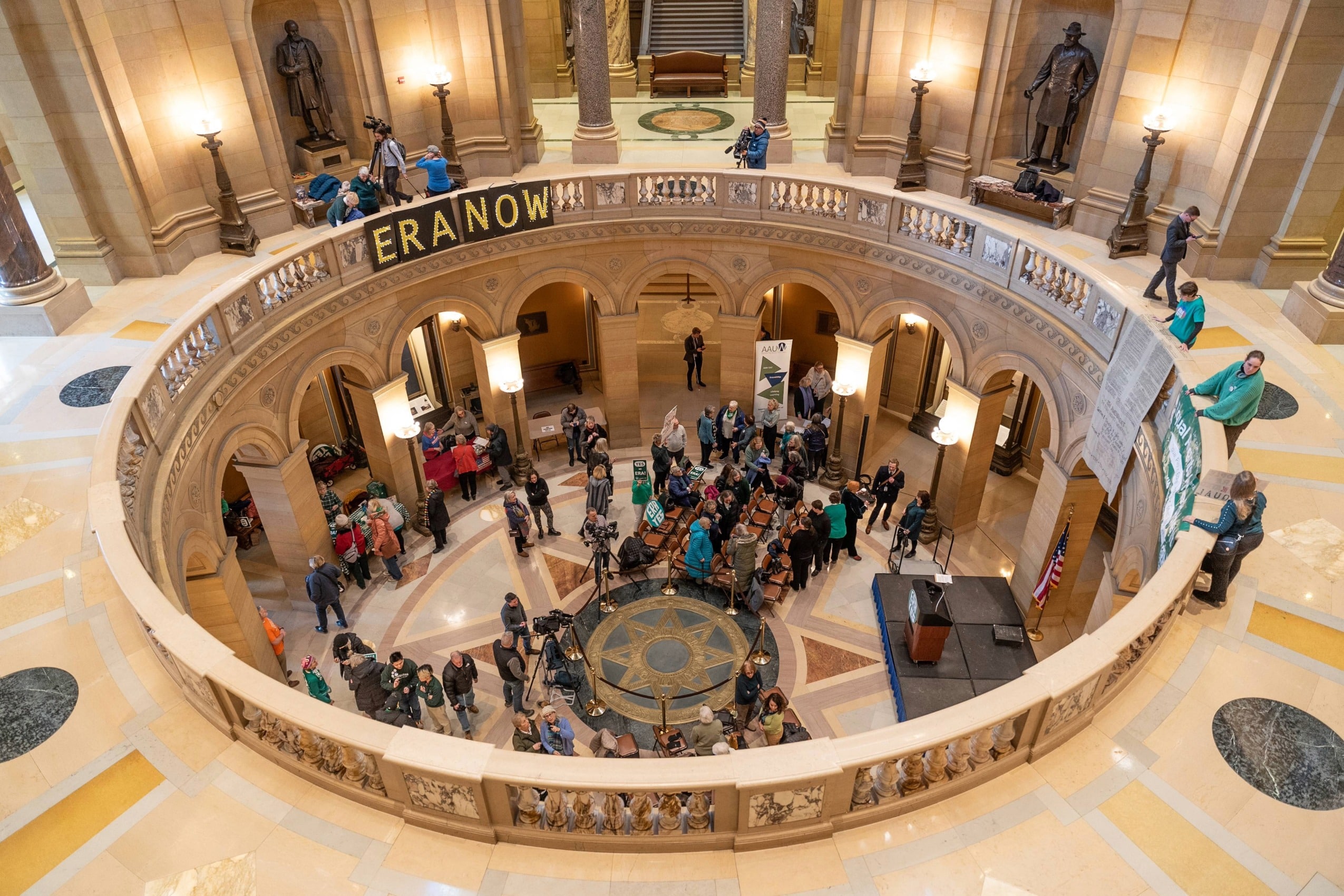
Democrats in the Minnesota Senate advanced the so-called Equal Rights Amendment (ERA) after an extended discussion about what the proposed constitutional amendment would do and how it would affect Minnesotans.
While many people associate the ERA with the 1970s effort to amend the U.S. Constitution to prohibit sex discrimination, the proposed ERA in Minnesota is entirely different.
The ERA being considered today would insert language into the Minnesota Constitution that prohibits Minnesota state government and local governments from discriminating based on race, color, national origin, ancestry, sex, gender identity, and sexual orientation.
Specifically, the ERA says the state shall not discriminate against protected categories “in intent or effect.” This language appears to prohibit state policy decisions that inadvertently discriminate even if the intent of those decisions is not discriminatory at all.
Further, the ERA includes a carve-out which says the amendment will not invalidate laws or state programs “designed to prevent or remedy discrimination.” The ERA would also place a constitutional right to an abortion in the Minnesota Constitution.
On Monday, the Senate Judiciary Committee discussed the proposed ERA. That legislation, SF 473, is authored by DFL State Sen. Mary Kunesh and DFL State Rep. Leigh Finke. Finke is a transgender lawmaker who identifies as a woman.
Under Minnesota law, amendments to the state constitution must be passed by the Senate and the Minnesota House of Representatives; the governor’s signature is not required. After being passed by both chambers, the amendment would be sent to voters for approval.
SF 473 would place the ERA on the 2026 general election ballot in the form of a question. If voters approve that question, the ERA would be placed in the Minnesota Constitution.
However, the actual question that would be posed to voters under SF 473 does not mention the “intent or effect” language, the enshrinement of abortion in the Minnesota Constitution, or the statement about the ERA preserving laws that “remedy discrimination.”
At Monday’s hearing, critics of the ERA noted that religion is not among the list of protected categories. Opponents also expressed concern that the ERA would enshrine transgenderism and abortion in the Minnesota Constitution.
“There are so many issues with this so-called Equal Rights Amendment,” Caryn Addante testified. “It’s more like a wolf in sheep’s clothing because while it promises equal rights for all, that couldn’t be further from the truth.”
Meanwhile, ERA proponents said religion is already protected by the U.S. Constitution and the ERA is “long overdue.” Describing the language of the ERA as “inclusive,” a former DFL state representative testified that the amendment created a “framework for progress.”
Monday’s public testifiers featured more opponents of the ERA than supporters. After public testimony concluded, state lawmakers on the Senate Judiciary Committee questioned the bill’s author and expressed their thoughts on the ERA.
“I support equal rights for women, of course, absolutely, but this isn’t your grandmother’s ERA,” GOP Sen. Michael Kreun said. “[This is] inserting hot-button issues of the day that nowhere near have consensus by the people, and we’re enshrining it into our Constitution and handing it over to the courts rather than letting the democratic process play out on those issues through the legislative process.”
Another GOP lawmaker, Sen. Michael Holmstrom tried to amend the proposed ERA to remove the sections that would enshrine abortion and gender identity in the Minnesota Constitution. However, those amendments failed along party lines.
Ultimately, the committee voted 6-4 to recommend passage of SF 473 and send the bill to the Senate Rules Committee, one of the last stops before a vote of the full Senate. That vote was also along party lines.
At present, the Senate has a one-seat DFL majority. However, the House is evenly split with 67 Republicans and 67 DFLers. As such, no DFL legislation can pass this year unless it has at least one GOP vote in the House.
In 2024, the Democrats tried to pass the ERA and send it to the voters for consideration. Despite having a majority in both chambers in 2024, that DFL effort failed.

Luke Sprinkel
Luke Sprinkel previously worked as a Legislative Assistant at the Minnesota House of Representatives. He grew up as a Missionary Kid (MK) living in England, Thailand, Tanzania, and the Middle East. Luke graduated from Regent University in 2018.