


Every Minnesotan knows the arrival of summer means the return of road construction.
But as orange cones line the roads and traffic slows to a crawl, what many may not realize is that Minnesota requires contractors to submit documents which set diversity, equity, and inclusion (DEI) goals before those contractors can begin work on publicly-funded projects.
According to the Minnesota Department of Human Rights (MDHR), contractors who work on state projects must fill out “preconstruction packets” issued by MDHR. Those packets list a series of “workforce goals” that are outlined by the department.
“Minnesota thrives when state investments are used to intentionally undo racial and gender disparities and inequities,” one packet says. “That’s why [MDHR] sets Workforce Goals for women, people of color, and Indigenous people (POCI) on state construction projects.”
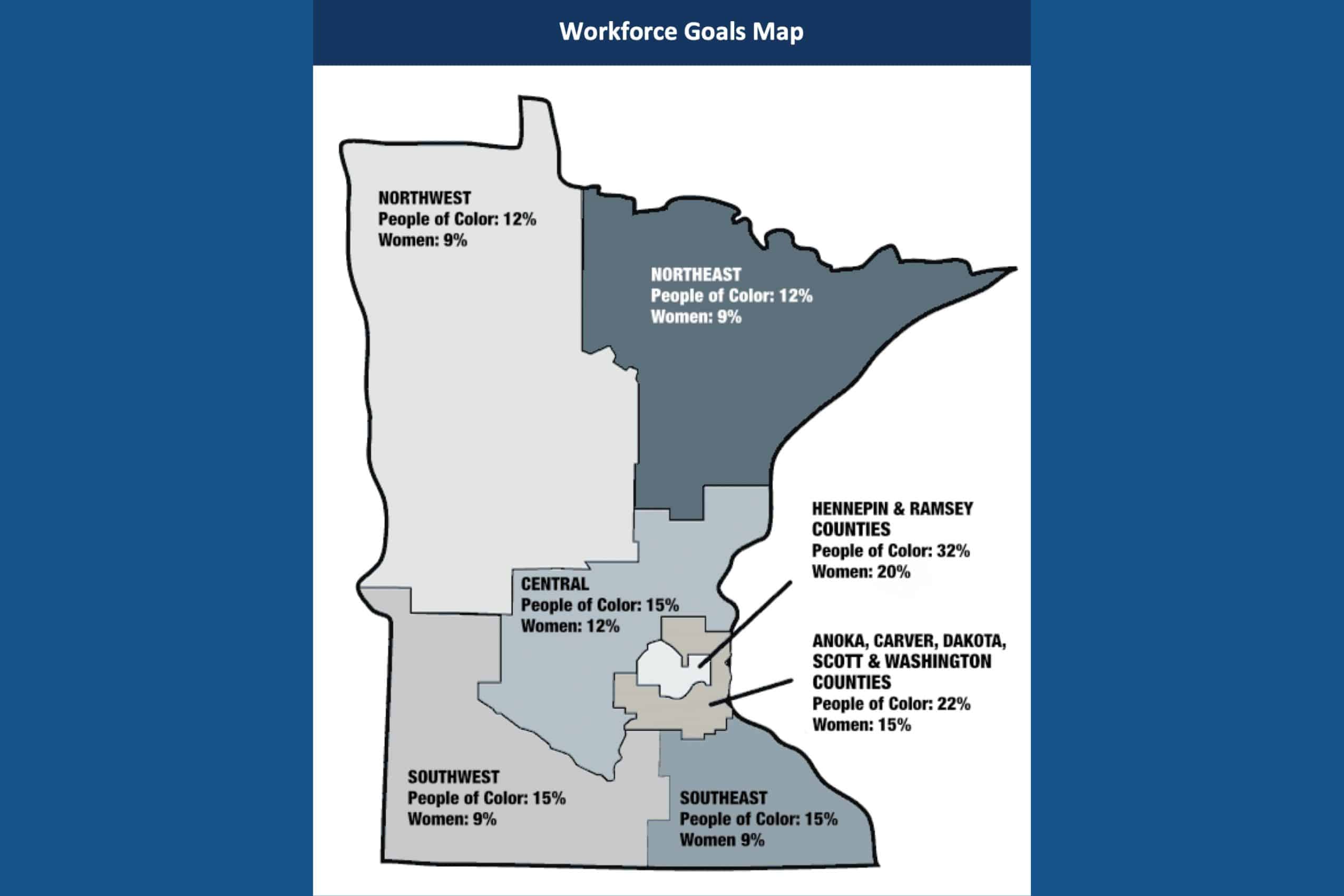
Those workforce goals vary by location. For example, if a project is in Hennepin or Ramsey counties, then MDHR wants 32% of all project work hours to be performed by “people of color,” and 20% of all project work hours performed by women.
MDHR’s workforce goals vary between different regions of the state.
In turn, contractors are required to fill out documents which ask for a project’s estimated total work hours for women and “people of color.” The documents also ask contractors to outline their recruitment strategies for hiring women and “people of color.”
MDHR gives few answers on how its goals work
According to MDHR, the workforce goals are just that — goals. In a statement to Alpha News, the department said “workforce goals are only goals. Construction companies set their own goals and make good faith efforts to implement them.”
As such, construction companies are not required to meet the percentages listed in MDHR’s workforce goals maps. However, information submitted in the preconstruction packets will be used to determine a company’s compliance with the Minnesota Human Rights Act.
Under that law, companies that enter into government contracts valued at more than $100,000 and have 40 or more employees must get a workforce certificate from MDHR. That certificate confirms a company maintains “a workplace free from discrimination.”
If a construction company does not fill out a preconstruction packet with the necessary information, then MDHR could suspend or revoke a company’s workforce certificate.
“This may impact your company’s ability to execute contracts with the State of Minnesota, metropolitan agencies, cities, counties, other political subdivisions, and the University of Minnesota,” MDHR notes.
Alpha News sent MDHR detailed follow-up questions about the compliance process and the DEI workforce goals. Among other things, the agency was asked if a workforce certificate could be revoked if a company did not submit an acceptable DEI workforce goal.
However, the agency did not provide specific answers. Instead, MDHR responded with a three-sentence statement that lacked any further clarifying information.
“Companies that are awarded a state contract complete their workforce and equal pay applications to affirm that they will maintain a discrimination-free workplace and pay men and women the same amount for the same job,” MDHR said.
“Each company awarded a state contract sets its own goals,” the agency added. “These goals are only goals.”
MDHR was also asked what companies are required to submit DEI goals. While the agency did not answer that either, it appears only companies that enter into government contracts valued at more than $100,000 and have 40 or more employees are affected.

Jenna Gloeb
Jenna Gloeb is an Edward R. Murrow Award-winning journalist, media producer, public speaker, and screenwriter. Most recently, she worked as a reporter and on-air host for CCX Media. Jenna is a Minnesota native and resides in the Twin Cities with her husband, son, daughter, and two dogs.

Luke Sprinkel
Luke Sprinkel previously worked as a Legislative Assistant at the Minnesota House of Representatives. He grew up as a Missionary Kid (MK) living in England, Thailand, Tanzania, and the Middle East. Luke graduated from Regent University in 2018.