



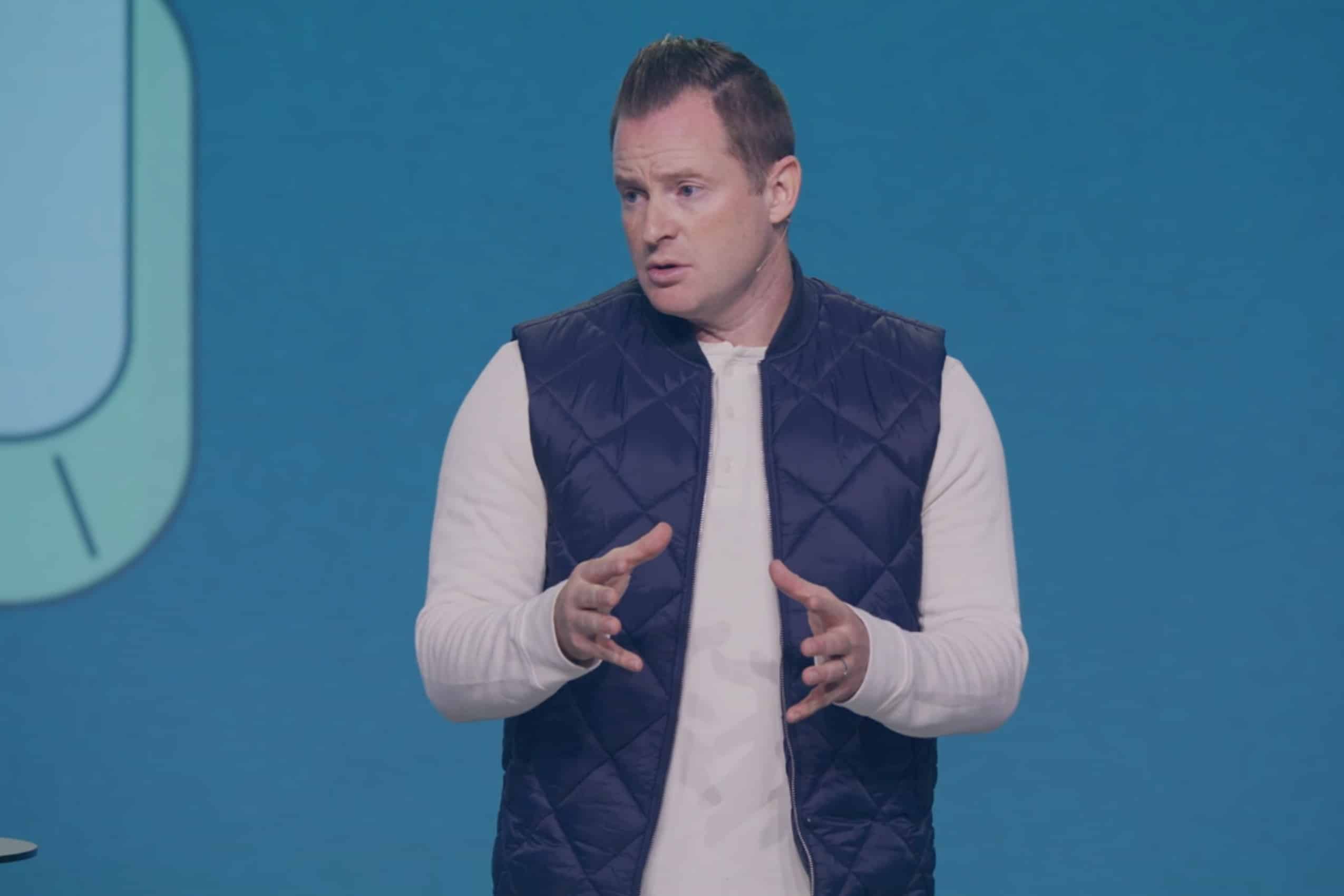
Just two days before Minnesota’s Nov. 3 general election, Jason Strand, senior pastor of Eagle Brook Church, delivered a message on how Christians should engage in politics.
Eagle Brook is one of Minnesota’s largest churches and operates 14 physical campuses across the state.
Strand’s Nov. 1 message, titled “How Should Christians Engage In Politics?” launched the church’s “Questions AI Can’t Answer” series.
Strand laid out three ways he believes Christians should approach politics.
“We shouldn’t make politics an idol,” Strand said. “We should not treat people the way the world of politics treats them. And we shouldn’t shy away from political issues that the Bible speaks clearly on.”
Strand argued that some Christians have allowed their political identity to take precedence over their faith.
“There are a lot of people today, especially who I see on social media, they are capital R Republican, lowercase C Christian. Capital D Democrat, lowercase C Christian,” he said.
“Is your allegiance to Christ above your allegiance to your political party?” Strand asked.
He later summarized the point with a line he said he has heard other pastors use.
“Our allegiance isn’t to the donkey. It’s not to the elephant. It’s to the lamb,” Strand said.
‘Politics is getting more theological’
Strand rejected the idea that churches should avoid subjects simply because they have become political.
“It’s not that the church and pastors are getting more political,” Strand said. “It’s that politics is getting more theological.”
He argued that pastors have an obligation to address issues when they believe Scripture speaks clearly about them.
“If I don’t teach on abortion, I’m not doing my duty as a teacher of the Bible,” Strand said. “I can’t pretend the Bible doesn’t say what the Bible says.”
Strand discussed abortion, racism, and transgender issues as examples of subjects he considers moral rather than merely partisan political questions.
“They’re not Republican or Democrat issues,” he said. “They are human issues. They are moral issues.”
Strand urged Christians to study Scripture for themselves rather than relying solely on pastors, politicians or other public voices to tell them what it says.
“Don’t just take my word for it. Don’t take a podcaster’s word for it. Don’t take a politician’s word for it,” Strand said. “Get into the word of God every day and say, ‘Is that what it says?’”
Strand argued that government itself has increasingly entered debates over moral questions, saying it has moved beyond functions such as “teaching math, building roads, issuing licenses” into matters including marriage and what schools teach.
He also addressed the separation of church and state, rejecting the idea that it means pastors and churches cannot speak about issues considered political.
“It also doesn’t mean that pastors or churches should never talk about issues that have been labeled as political,” Strand said.
Strand said he understands the principle to mean that government should not control the church, rather than that Christians should remain outside politics. He pointed to biblical figures including Daniel, Esther, Nehemiah, Nathan, Moses and John the Baptist as examples of people who engaged with political leaders or public affairs.
What Strand says the Bible teaches about abortion
While discussing abortion, Strand cited Psalm 139, in which David speaks of God forming him in his mother’s womb.
Psalm 139:13-14 (NIV) reads, “For you created my inmost being; you knit me together in my mother’s womb. I praise you because I am fearfully and wonderfully made; your works are wonderful, I know that full well.”
“Where are we knit together by God?” Strand asked. “In the womb.”
Strand argued that the fact that the Bible does not use the modern word “abortion” does not mean it lacks a moral teaching on the issue.
“The absence of a modern term does not mean the absence of a moral vision,” Strand said.
Addressing the “my body, my choice” argument, Strand said, “In your body is another body. That’s the moral dilemma. It’s not just your body.”
He told the congregation that unborn human life is created by God and abortion is therefore sinful, while emphasizing forgiveness for women who have had abortions.
“To take that person’s life, to take that person’s opportunity to live the life that we have is a sin,” Strand said. “A sin that can be forgiven and hope that can be found.”
Strand addresses transgender issues and Minnesota law
Strand also addressed transgender issues, pointing to the biblical creation account as the foundation for his view of sex and gender.
Pointing to Genesis 1:27, which says God created humanity “male and female,” Strand said, “The Bible says God created them, man and woman.”
Strand then directly addressed young people who may be questioning their gender.
“God loves you,” he said. “God deeply loves you. God created you. Your identity is not in your sexuality. It is not in your gender. It is in Christ.”
“God did not make a mistake,” Strand continued, saying he was speaking “with no condemnation” but “with love.”
Strand also referenced Minnesota’s so-called “trans refuge” law. Among other things, the law makes it easier for inter-state child custody disputes to be decided in Minnesota if so-called “gender-affirming health care” is a factor in the case. Additionally, the law shields individuals from being subpoenaed or extradited for violating another state’s laws against “gender-affirming health care.”
Strand said he had spent a year studying the subject for a previous Eagle Brook series and argued that, apart from his biblical objections, such treatments carry medical risks.
“Gender transition surgeries, puberty blockers, hormone[s] — they have dangerous side effects,” Strand said, specifically referencing mental health and suicide.
“Studies show when you mess with your hormones, it has a devastating effect later in your life,” Strand said.
“Some people call Minnesota a refuge state for transgender care,” Strand continued. “You’re not a refuge state if what you’re legislating and recommending harms kids years later down the road.”
Created in God’s image
Strand also addressed racism, calling it a sin and rejecting the idea that condemning racism is inherently associated with one political party.
“Racism is a sin,” Strand said.
He grounded that position in the biblical teaching that human beings are created in God’s image.
“Every single person is created in God’s image,” Strand said.
Despite encouraging Christians to speak about moral issues, Strand warned against adopting the hostility often seen in political discourse.
“Every person we label is a person God loves,” Strand said. “They are a person that God sent his son Jesus Christ to die for.”
“Just because we’re behind a computer screen, a phone, a Facebook account, an X account doesn’t give us the right to be rude or malicious,” he added.
Strand said Eagle Brook does not intend to respond to every political controversy and maintained that politics is not the church’s primary mission.
“We teach the Bible and Jesus Christ,” he said. “And that means that we might address a political issue, but don’t expect it to be every week.”
‘Research, pray, and vote’
Strand closed the message by urging Christians to participate in elections even when they cannot find a candidate who perfectly represents their beliefs.
“I believe that each of us should exercise our duty to vote,” he said.
Strand expressed concern that many Christians do not vote and asked what that means for future generations.
“Does God want all the Christians just to sit out and then everybody else can decide what the world’s going to look like for our kids and for our grandkids?” he asked.
Strand said Christians should evaluate candidates based on which policies they believe most closely align with Scripture and promote what he called the “greatest public good.”
“We’re not voting for our savior,” Strand said. “We’re voting on who, among the imperfect choices we have, is going to put into place policies that align with God’s word and bring about the greatest public good.”
He also urged Christians to pray for elected officials, including candidates they did not support.
“Would you be willing to pray for someone you didn’t vote for?” Strand asked.
His final assignment to the congregation, delivered the Sunday before Election Day, was simple.
“Research, pray, and vote,” Strand said. “Even at, like, the county level, research, pray, ask God for wisdom, and then vote.”

Symone Harms
Symone Harms is a Media Production and Business Marketing student at Bethel University. She is actively involved in The Royals Investment Fund, The 25, theatre, and other leadership positions. She also cohosts Rooted, a podcast dedicated to being rooted in truth, growing in freedom, and prospering in life. A Minnesota native with a passion for storytelling and digital media, she aspires to a career in broadcasting as a news anchor and reporter.