


The Minnesota Department of Public Safety (DPS) is responding to Ramsey County Sheriff Bob Fletcher’s characterization of how law enforcement responded to the shootings that killed one Minnesota lawmaker and injured another.
Around 2 a.m. on June 14, Sen. John Hoffman and his wife, Yvette, were shot multiple times in their home. Roughly 90 minutes later, Speaker Emerita Melissa Hortman and her husband, Mark, were assassinated in their home. The suspect in those shootings, Vance Boelter, was arrested after a 43-hour manhunt and charged with murder.
Since the shootings, Sheriff Fletcher has sought answers about how authorities responded to those shootings and how other state legislators were first notified that there was a killer at large with a “hit list” of public officials.
“There’s no reason to explain that hour and a half delay,” said Fletcher in a recent Alpha News story. “And I know that some people like to say, ‘didn’t we do a great job?’ The fact of the matter is we would have done a great job if Melissa was alive—and we had an hour and a half to provide some form of security there. And that should be troubling to all of us.”
In the same interview, Sheriff Fletcher said other legislators were not notified about the shootings for three hours, and the Ramsey County Sheriff’s Office was not notified until 7 a.m. that morning.
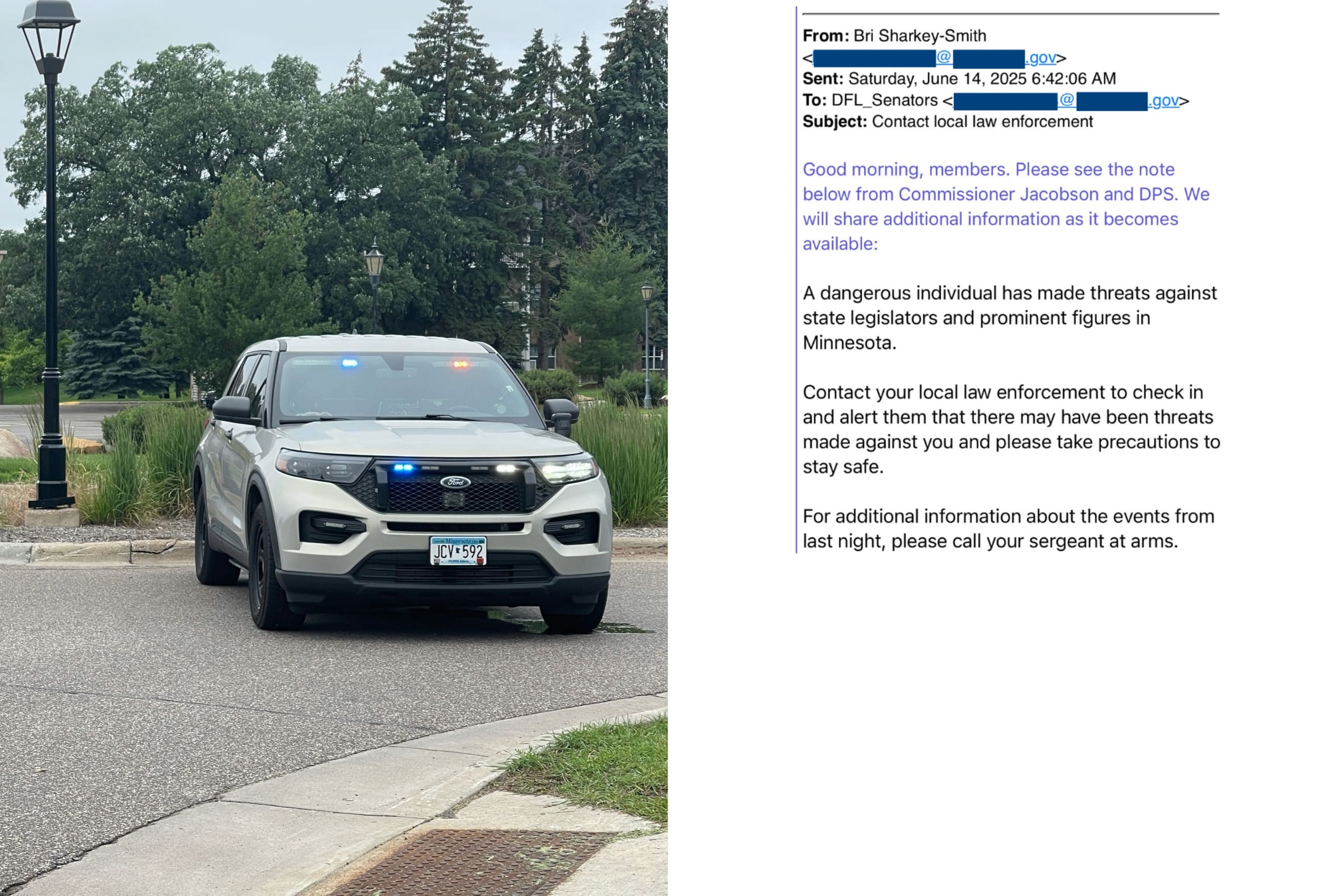
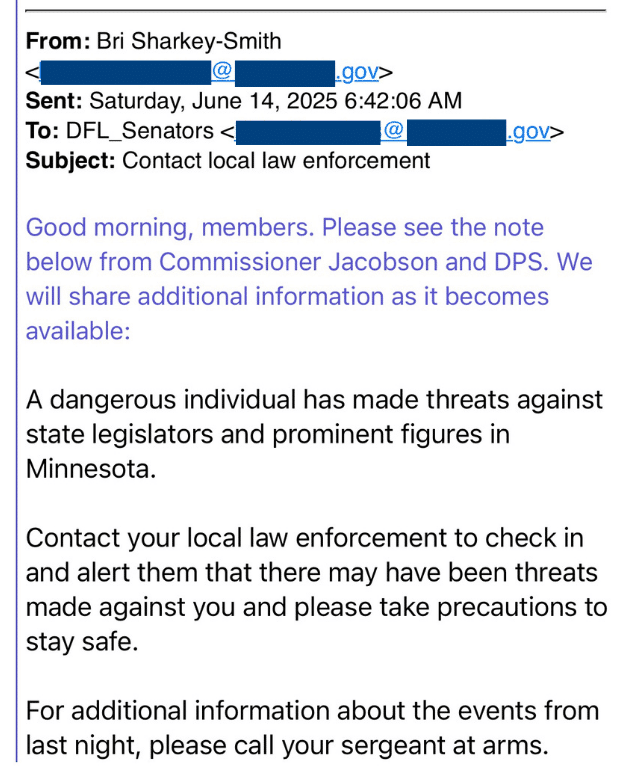
Senate DFL Caucus Chief of Staff Bri Sharkey-Smith sent an email at 6:42 a.m. on the day of the shootings to all DFL senators with the following note from DPS Commissioner Bob Jacobson:
Sheriff Fletcher also shared an email he received at 7:57 a.m. from the House sergeant-at-arms. He told Alpha News this was the first communication he received from the state with legislators’ names and addresses, despite that information, according to court documents, being discovered hours earlier in Boelter’s vehicle at Hortman’s home.
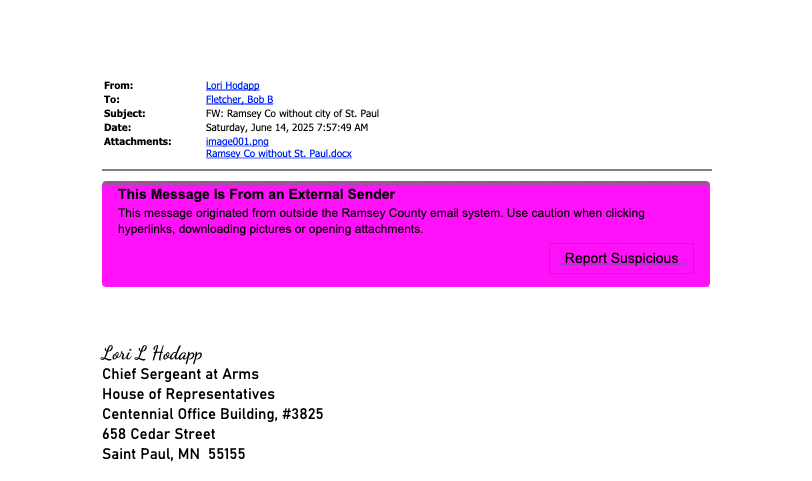
Earlier this week, the sheriff sent a letter to the chief sergeant-at-arms of the Minnesota House of Representatives and the captain of the Minnesota State Patrol’s Capitol Security Division seeking answers. Nearly a dozen politicians and public safety officials were copied on the letter.
Speaking about the events of June 14 in his letter, Fletcher said: “A detailed review of the late night and early morning timeline reveals a striking breakdown in the communication to potential victims that were on the suspect’s ‘hit list’ and a failure to notify law enforcement agencies that serve their areas of residency.”
In turn, the sheriff asked which individuals or agencies are responsible to “notify legislators quickly that they are potential victims of a violent criminal stalking them.” Fletcher also asked which agencies or individuals are responsible to “notify law enforcement agencies in a timely fashion that legislators in their jurisdiction are in potential immediate danger.”
That letter was sent on Monday, and the sheriff informed Alpha News on Friday that he has not yet received a response. Alpha News reached out to the House sergeant-at-arms and DPS for this story.
DPS Commissioner Bob Jacobson, who oversees the State Patrol, told Alpha News that Fletcher’s letter “does not accurately represent the manner in which law enforcement responded to the tragic events of June 14.”
“Notifications were sent to the proper parties early that morning. We’ll be discussing that in greater detail with the sheriff and the others as the investigation continues,” added the commissioner.
In an interview with the Minnesota Reformer, Jacobson said “It’s just one of those things that, you know … wasn’t necessarily in the playbook” when responding to questions about how the investigation played out.
Meanwhile, the House sergeant-at-arms did not offer comment.

Liz Collin
Liz Collin is a multi-Emmy-Award-winning investigative reporter, news anchor, and producer who cares about Minnesota. She is the producer of The Fall of Minneapolis and Minnesota v We the People documentary films, and author of the Amazon best-selling book, They’re Lying: The Media, the Left, and The Death of George Floyd. Her work has prompted important state laws. Yet perhaps most of all, Liz has been giving a voice to the truth—and helping others tell their stories—for more than 20 years.