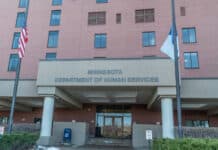



Internal messages from the Minnesota Department of Human Services (DHS) show agency leaders scrambling to deal with serious financial management issues in 2022.
The messages, shared with Alpha News by a DHS employee who requested anonymity due to fear of retaliation, reveal that the agency finance chief was concerned DHS would miss a reimbursement deadline to receive federal grant dollars.
A missed deadline could mean Minnesota taxpayers covering the costs of behavioral health services that should have been paid with federal funds. While DHS claims no “federal draws” were missed, the internal messages obtained by Alpha News appear to suggest otherwise.
DHS CFO calls out ‘critical’ situation regarding federal grant dollars
The largest agency in state government, DHS is responsible for distributing federal grant funds to “sub-grantees” such as counties, nonprofits, and tribes throughout Minnesota.
Those sub-grantees perform various services, bill DHS for the services, and DHS draws upon federal grant dollars to pay invoices submitted by the sub-grantees.
In a December 2022 message, DHS Chief Financial Officer Dave Greeman discussed a “critical” situation with his colleagues that involved the agency’s behavioral health division and federal grant dollars that would no longer be available.
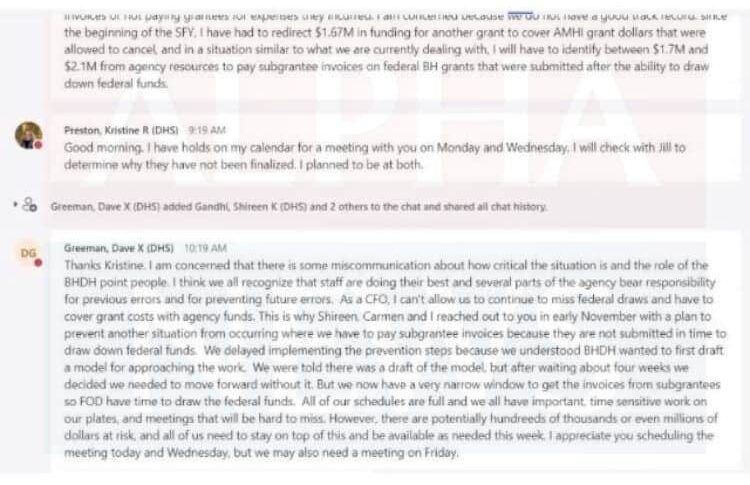
According to the message, DHS found itself in a situation where the agency had “a very narrow window” to draw upon federal funds and pay behavioral health-related invoices submitted by sub-grantees.
Greeman said he was “concerned that there is some miscommunication about how critical the situation is” and “there are potentially hundreds of thousands or even millions of dollars at risk, and all of us need to stay on top of this and be available as needed this week.”
His message, which appeared to place blame on the agency’s behavioral health division, also said, “As a CFO, I can’t allow us to continue to miss federal draws and have to cover grant costs with agency funds.”
The same DHS message chain shows part of another message in which the sender says he is facing a “similar” situation where he “will have to identify between $1.7 [million] and $2.1 [million] from agency resources to pay subgrantee invoices on federal [behavioral health] grants that were submitted after the ability to draw down federal funds.”
An Alpha News source identified the sender of this message as Greeman.
DHS says no federal draws were missed
Given the messages, Alpha News was left to wonder whether Minnesota taxpayer dollars were being redirected to cover mistakes at DHS. As such, Alpha News reached out to DHS to ask if the agency had experienced repeated problems with missing federal draws.
In response to questions about this situation, DHS said it has “strong internal controls in place to prevent the agency from missing federal draws” and the agency is “not aware of any missed federal draws.”
DHS explained that the federal fiscal year requires sub-grantees to submit their invoices “well in advance” of a Dec. 30 deadline in order for DHS to have enough time to process payments and finalize reporting.
Regarding the 2022 messages, DHS said it “observed that there was some significant underspending by grantees” when conducting routine federal grant analysis near the end of that year.
“We speculated that the grantees had done the work but had not invoiced DHS yet,” said a DHS spokesperson. “If grantees didn’t send invoices to DHS before the federal award expired at the end of December, DHS would no longer have access to the federal dollars to reimburse the grantees.
“We had conversations at the time that if a grantee submitted an invoice after the deadline, DHS did not have access to alternative funding sources and would not be able to pay the grantee,” added the spokesperson.
Additionally, the agency told Alpha News that DHS’ behavioral health division “executed a proactive plan to communicate an invoice submission deadline to grantees and the consequence of not meeting that deadline.”
When asked about the $1.7 million to $2.1 million of DHS resources that were referenced, the agency offered no explanation other than to say “the December 2022 screenshots do not contain enough information to determine the context of the comments at that moment or how the situation was ultimately resolved.”

Jenna Gloeb
Jenna Gloeb is an Edward R. Murrow Award-winning journalist, media producer, public speaker, and screenwriter. Most recently, she worked as a reporter and on-air host for CCX Media. Jenna is a Minnesota native and resides in the Twin Cities with her husband, son, daughter, and two dogs.