


Minnesota’s economy wasn’t built by accident. It was built by employers — from manufacturers in St. Cloud to small businesses in Rochester to global companies in the Twin Cities — who made this state one of the most competitive in the Midwest.
But that foundation is being tested. In recent years, rapid growth in government and an increasingly predatory tax and regulatory climate have put new pressure on the businesses that drive Minnesota’s economy — and the warning signs are no longer subtle.
Last month, the Minnesota Private Business Council filed a lawsuit challenging key elements of the DFL Legislature’s 2024 omnibus bill — a 1,400-page legislative monstrosity that manages to touch nearly everything under the sun while making life harder for the businesses that keep the lights on.
Consider what happened in St. Paul in May 2024. In the span of roughly ten minutes, a 148-page bill ballooned to more than 1,400 pages as lawmakers jammed nine separate omnibus bills into a single package. Tucked inside: new taxes and mandates on employers, revisions to paid family and medical leave (PFML) and earned sick and safe time, and sweeping changes to independent contractor rules. The whole thing was rushed through both chambers and signed into law before anyone — lawmakers included — could fully evaluate, or even read, what they were voting on.
The Minnesota Constitution is explicit: every law must address only one subject. A Ramsey County judge has already found this bill unconstitutional on exactly those grounds, writing that “at best, [the bill] contains many non-germane parts, and at worst, has no identifiable common theme.” The court predicted the ruling would trigger hundreds of legal challenges as courts strip away the bill’s unconstitutional provisions one by one. That process is now underway — at the Court of Appeals and, with our lawsuit, back in Ramsey County District Court.
Minnesota’s founders included the single-subject rule for a reason: to prevent exactly this kind of legislative logrolling, where unrelated policies are crammed into one massive bill so lawmakers are forced to vote for everything or nothing. What happened in 2024 wasn’t subtle. These mandates weren’t debated on their merits — they were buried.
Minnesota’s PFML program is a case study in why that matters. It is difficult to overstate how poorly constructed and damaging to Minnesota’s economy the PFML program is. It starts with yet another new tax, a payroll tax hitting both employers and employees. For small businesses and families operating on thin margins, that cost is anything but theoretical. Alongside that is the reality that at any moment a business could lose an employee for 12 weeks, sometimes with the thinnest of excuses. The result is a program that makes Minnesota dramatically less competitive, not more.
And in the competition for businesses and talent, Minnesota is already slipping. According to the Tax Foundation’s 2026 State Business Tax Climate Index, Minnesota ranks 44th out of 50 states. South Dakota ranks 2nd. North Dakota, 9th. Iowa, 17th. Wisconsin, 32nd. Even CNBC — which praised Minnesota’s workforce and quality of life — ranked the state 35th in cost of doing business in 2025, before PFML was fully operational.
Then there’s the question lawmakers seem least interested in asking: what could possibly go wrong?
Minnesota has a well-documented history of catastrophic fraud in government programs. The Feeding Our Future scandal — nearly $250 million stolen from a program meant to feed hungry children — is the largest pandemic fraud case in the country, with 63 convictions and counting. A Legislative Auditor review found that just 15 employees were overseeing a program that ballooned to $336 million in a single year — and that, at one point, the state asked Feeding Our Future to investigate complaints about itself. That’s not oversight; that’s outsourcing common sense.
Paid leave programs are inherently vulnerable to this kind of abuse. They depend on verifying medical claims and family situations across thousands of employers and hundreds of thousands of workers. If the state that gave us Feeding Our Future hasn’t answered the basic question of how it will prevent fraud here, taxpayers have every reason to be skeptical. So far, there’s been no credible answer.
Minnesota workers deserve to be protected. Minnesota employers deserve a competitive environment. Right now, that balance has been lost, with state government taking an increasingly adversarial posture toward the businesses it depends on.
That’s why we brought this lawsuit. Not to obstruct, but to insist on something basic: that policies with sweeping economic consequences be debated in the open, on their merits, with the transparency the Minnesota Constitution requires.
When a 1,400-page bill is passed in the dark of night, the damage isn’t limited to economic policy. It erodes something more fundamental — the idea that laws should be understood before they are passed, and debated before they are imposed.
Minnesotans deserve better. And we’re confident the courts — and the public — will agree.
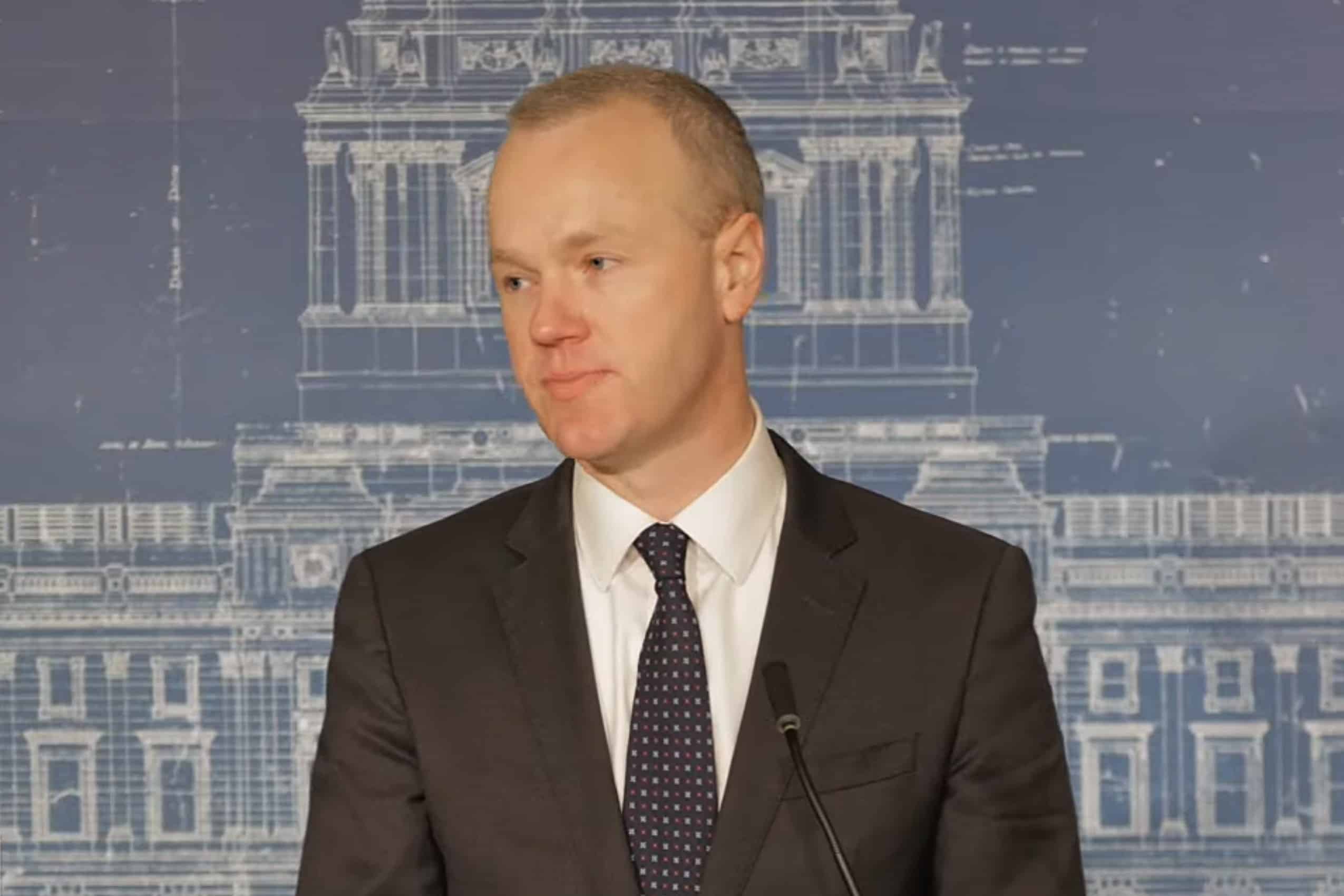
Jim Schultz is the president and CEO of the Minnesota Private Business Council .
This article first appeared in the Rochester Post Bulletin.
The views and opinions expressed in this commentary are those of the author and do not represent an official position of Alpha News.

Jim Schultz
Jim Schultz is the President of the Minnesota Private Business Council and was the 2022 Republican nominee for Attorney General.