


DFL Gov.-elect Amy Klobuchar told reporters last week she believes a sweeping gun control bill will pass in Minnesota. That bill, should it become law, would be one of the most wide-reaching gun control statutes in the nation.
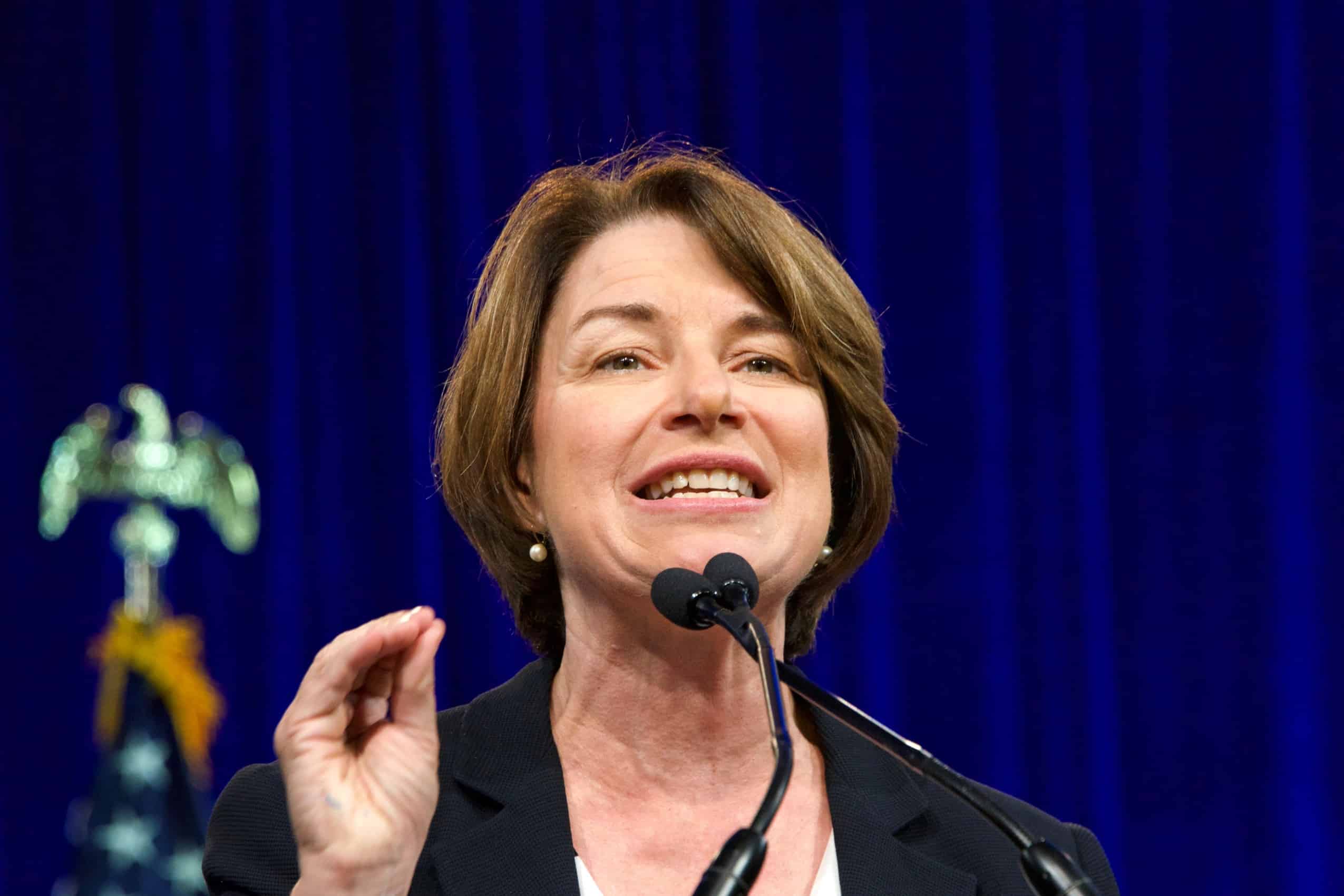
At her first press conference since winning Minnesota’s governorship, Klobuchar unveiled her transition team responsible for handling the changeover between the outgoing Walz administration and her incoming administration.
In her remarks, Klobuchar emphasized her intent to embark on a top-to-bottom audit of state government, one of her campaign promises, and make Minnesota a more business-friendly state. Among other things, Klobuchar has pledged not to raise taxes.
Additionally, Klobuchar struck a bipartisan tone, touting the value of bipartisanship and telling the gathered press that, “I am committed as ever to moving our state forward, not moving our state to the left or to the right, but moving our state forward.”
The incoming governor’s appeals to bipartisanship may come as a surprise to some given the large majorities the DFL just won in the state legislature, but Klobuchar said working in a bipartisan way would be a “huge priority” for her.
Despite Klobuchar’s desire for cooperation, bipartisanship is unlikely on what is poised to be one of the biggest topics of the upcoming legislative session: a major gun control bill.
Earlier this year, Democrats in the Minnesota Senate passed a sweeping gun control bill, SF 4067, in response to the 2025 shooting at Annunciation Catholic Church and School and the murders of former Minnesota House Speaker Melissa Hortman and her husband, Mark.
That bill, passed in a 34-33 party-line vote, included funds for mental health services, anonymous threat reporting systems for schools, and other items. However, the thrust of the bill was restrictions on so-called “semiautomatic military-style assault weapon[s].”
SF 4067 would have banned gun stores from selling a wide swath of firearms, including the AR-15, the most popular firearm in America. The bill also would have banned gun stores from selling firearm magazines with more than 17 rounds.
Under the bill, private transfers of the restricted semiautomatic firearms would be allowed as long as certain requirements are met.
However, one of the most significant parts of the bill is its creation of a gun registry. Under SF 4067, people who own one of the restricted semiautomatic firearms would be required to tell the Minnesota Bureau of Criminal Apprehension (BCA) that they own one of those guns.
Those gun owners would need to obtain a “certification of ownership” from the BCA and renew it every three years. Failure to obtain a certificate of ownership would result in a misdemeanor, a second violation would be a felony.
Additionally, the bill would reestablish the so-called “binary trigger ban” and the prohibition on “ghost guns” that lack a serial number.
While SF 4067 passed in the DFL-controlled Senate with no Republican votes, the bill never came up for a vote in the Minnesota House of Representatives, which was evenly tied with 67 Republicans and 67 Democrats.
During the 2026 gubernatorial election, Klobuchar slammed her GOP opponent, Minnesota House Speaker Lisa Demuth, for allegedly breaking a promise to an Annunciation family that she would hold a vote on gun control legislation.
Demuth rejected that claim and said she told Annunciation families that bills would be introduced and go through the legislative process. She said votes were taken but did not have enough support to advance.
Klobuchar campaigned on signing the Senate bill into law.
At her Wednesday press conference following her election, Klobuchar referenced the bill, saying, “The gun safety bill is going to get passed, and I am so excited to be working with the leaders on this, and it certainly should be one of our top priorities.”
However, she added that, “I think that bill makes a lot of sense. I’m sure that we’ll make some changes … but the basics of that bill I hope will remain in place.”
Alpha News contacted the Klobuchar transition team to ask if the governor-elect would be able to provide details about the provisions of the bill she favors and opposes. The transition team did not provide a response prior to publication.

Luke Sprinkel
Luke Sprinkel previously worked as a Legislative Assistant at the Minnesota House of Representatives. He grew up as a Missionary Kid (MK) living in England, Thailand, Tanzania, and the Middle East. Luke graduated from Regent University in 2018.