



A new report from the Minnesota Chamber of Commerce shows Minnesota ranked 49th in GDP growth per capita between 2019 and 2025. That figure, found in the Chamber’s annual Business Benchmarks Report, paints a dire picture for Minnesota’s economy.
According to Minnesota Chamber of Commerce CEO Doug Loon, “GDP per capita measures total growth in the economy on a per person basis. Growth in per capita GDP is a key driver of growth in average incomes and overall success.”
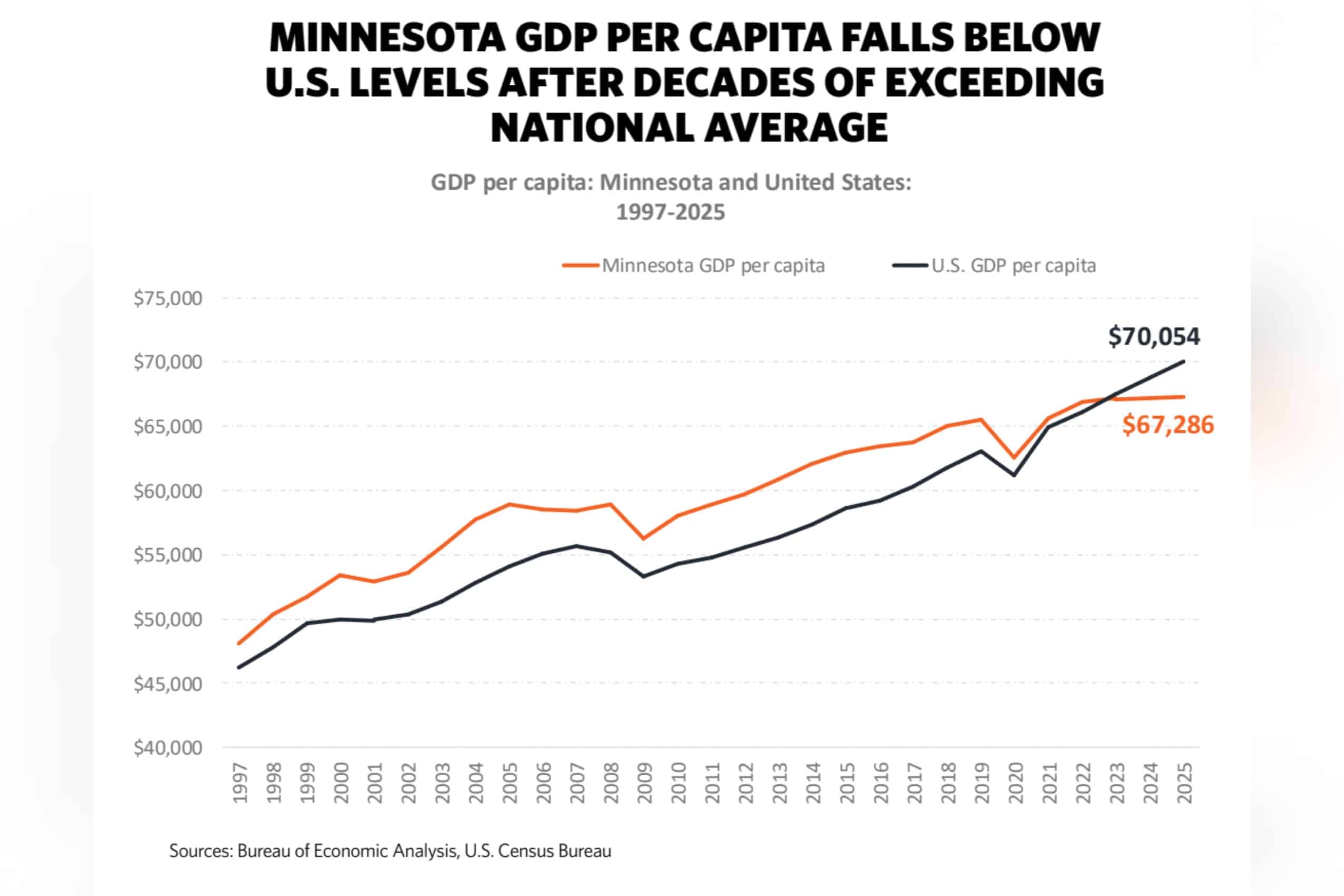
In its new report, the Chamber says Minnesota’s GDP per capita was higher than the national GDP per capita between 1997 and 2022. However, the growth rate of Minnesota’s GDP per capita began to stagnate in the 2020s and resulted in Minnesota falling behind.
Between 2019 and 2025, Minnesota’s GDP per capita only grew at a rate of 0.4% annually while the national GDP per capita growth rate was 1.8%. As a result, Minnesota ranked 49th in GDP growth per capita during that period.
In 2025, the United States’ GDP per capita was $70,054 while Minnesota’s was $67,286.
“As Minnesota’s economic growth has lagged the U.S. average and other states, so too has its per capita income and wage growth,” the report noted.
According to the report, Minnesota ranked 33rd in total labor growth, 47th in real median household income growth, 49th in annual per capita consumption growth, and 45th in total export growth between 2019 and 2025 when compared with the other 49 states.
Additionally, the Business Benchmarks Report examined migration in and out of Minnesota.
Since 2020, Minnesota ranked 41st in domestic migration, which is the number of people within the United States that migrate to or from Minnesota. Between 2020 and 2025, Minnesota experienced a net loss of 37,202 people due to domestic migration.
Since 2001, there have only been five years where Minnesota actually gained more people from domestic migration than it lost. Those years are 2001, 2017, 2018, 2019, and 2025. In 2025, Minnesota saw a net increase of 8,300 people due to domestic migration.
Meanwhile, Minnesota experienced a net increase of 96,812 people due to international migration between 2020 and 2025, and the report noted that “international migration was the leading component of population change since 2020.”
Natural population growth, which is the number of births minus the number of deaths, led to a net increase of 63,075 people in Minnesota. However, the report included a foreboding prediction about the state of natural population growth in Minnesota.
According to the Chamber’s report, the Minnesota State Demographer projects that deaths will outpace births by 2065, “leaving the state entirely dependent on migration to sustain population growth.”
The report said, “Minnesota’s ability to grow the population would be enhanced by combining both positive domestic and international migration. This will be increasingly important to offset further expected declines in natural population growth in coming years.”
Regarding the state of Minnesota’s economy, Loon said “changing course will take deliberate effort” and the Chamber will push for a review of the tax system, stronger ties between employers and schools, and making it easier for businesses to expand in Minnesota.
For months, Minnesota’s economic productivity was one of the main themes of the recent 2026 gubernatorial election. The winner of that contest, Gov.-elect Amy Klobuchar, made revitalizing Minnesota’s economy the centerpiece of her campaign.
Klobuchar campaigned on streamlining permits for businesses, expanding Minnesota’s labor force by adding 10,000 apprenticeships, and building 100,000 new homes. She also pledged not to raise taxes, a key component of her plan to grow Minnesota’s economy.
Now, with the Chamber’s new report, Klobuchar appears to have her work cut out for her as she takes office in January. However, she will have to contend with massive DFL majorities in the Minnesota Legislature that may not be as business-friendly as herself.
Alpha News contacted the governor-elect’s office for this story but did not hear back.
Republican state Rep. Harry Niska, the incoming minority leader of the Minnesota House of Representatives, released a statement about the Chamber’s report that slammed outgoing DFL Gov. Tim Walz and Minnesota Democrats.
“Today’s report should be a wake-up call for every Minnesotan,” Niska said. “Years of anti-business, anti-growth policies enacted by Governor Walz during the last Democrat trifecta, combined with the actions of Democratic Socialists on the Minneapolis City Council, have put Minnesota on a dangerous and unsustainable path.”
Warning that Minnesota is approaching a “point of no return,” Niska said, “We need to reverse course immediately, lower taxes, rein in government spending, and make Minnesota a state where businesses want to invest, expand, and create jobs. We’re running out of time to get this right.”
Alpha News contacted Walz’s office for this story but did not hear back.
Klobuchar will take office as Minnesota’s 42nd governor on Jan. 4. Meanwhile, the new DFL majorities in the state legislature will begin the next legislative session on Jan. 12.

Luke Sprinkel
Luke Sprinkel previously worked as a Legislative Assistant at the Minnesota House of Representatives. He grew up as a Missionary Kid (MK) living in England, Thailand, Tanzania, and the Middle East. Luke graduated from Regent University in 2018.