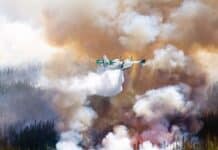





A group of state legislators from Minnesota, Wisconsin, Iowa, and North Dakota are asking federal and international authorities to address Canadian wildfire smoke that has plagued much of the Midwest over the last several years.
“Over 20 million residents in the Midwest have faced restrictions on outdoor activities due to dangerous air quality, with communities reporting burning throats, respiratory issues, and reduced visibility,” wrote the group in reference to the Canadian wildfire smoke.
The lawmakers added, “These conditions have disrupted summer recreation, harmed vulnerable populations, and strained public health resources.”
The letter was authored by State Reps. Elliott Engen, R-Minn., Austin Harris, R-Iowa, Calvin Callahan, R-Wis., and State Sen. Claire Cory, R-N. Dak. Notably, all four legislators are under the age of 30.
In their letter—sent to the Environmental Protection Agency (EPA) and the International Joint Commission (IJC)—the group said wildfire response delays and inadequate forest management are cited amongst the contributing causes of Canada’s wildfires. Describing the wildfires as among the worst on record, the legislators said they are concerned such failures “constitute negligence.”
The group asked the IJC, a commission created by the United States and Canada to resolve transboundary issues, to investigate whether Canada is fulfilling its obligations as required by international agreements.
“Under the Boundary Waters Treaty of 1909, the IJC has a mandate to address transboundary environmental issues, including pollution that causes injury to health or property across the border,” wrote the lawmakers. “We urge the IJC to investigate whether Canada’s wildfire management practices meet the standards of due diligence required to prevent harm to U.S. residents.”
Additionally, the Republicans urged EPA officials to evaluate the environmental and health effects of the smoke, use diplomatic or regulatory means to address the air pollution, and push Canadian government agencies to adopt “stronger wildfire mitigation measures.”
Most recent air quality alert has expired
In recent days, Minnesota has again been under an air quality alert caused by Canadian wildfire smoke traveling east across the northern United States.
The most recent air quality alert began on Sunday and officially expired this morning. According to the Minnesota Pollution Control Agency (MPCA), the air quality in the upper half of the state was considered unhealthy while air quality in the lower half of the state was considered unhealthy for sensitive groups.
In recent years, hazy skies and bad air have plagued Minnesota throughout summertime. The seemingly constant smokiness has become a major frustration for Minnesotans who would like to enjoy the state’s beautiful outdoors but are faced with awful conditions.
Since May, the MPCA has issued or extended air quality alerts over 20 times because of wildfire smoke. In some cases, those alerts pertained to the entire state and lasted for days.

Luke Sprinkel
Luke Sprinkel previously worked as a Legislative Assistant at the Minnesota House of Representatives. He grew up as a Missionary Kid (MK) living in England, Thailand, Tanzania, and the Middle East. Luke graduated from Regent University in 2018.