


Cynthia “Cyndy” Martin, the embattled DFL Party official charged in a fatal hit-and-run, is asking the court to either dismiss her criminal case or throw out key evidence.
Last year, Martin was charged with criminal vehicular homicide (driver who causes collision leaves scene) after she allegedly struck Carter Haithcock as he walked along Highway 169 in Itasca County late at night on July 3, 2024.
According to the criminal complaint, a motorist saw Haithcock lying on the road and pulled over to call police — but while doing so, Haithcock was struck again by another driver. The victim, a 19-year-old, was pronounced dead at the scene.
Since then, the case has progressed slowly. Martin is currently the chair of the DFL’s 8th Congressional District in northern Minnesota and the vice chair of the Itasca County DFL.
Last month, the judge presiding over the case dismissed Martin’s efforts to have the case moved to a different jurisdiction. Attorneys for the DFLer argued that pretrial coverage of the case could taint jurors.
Now, Judge Heidi Chandler is considering the defense’s motion to either have the criminal case against Martin dismissed or throw out evidence that was collected by law enforcement after the crash that killed Haithcock.

Arguing for a dismissal, Martin’s attorney said the DFLer is charged with violating a law which forbids drivers from leaving the scene if the driver reasonably believes they caused injury or death with their vehicle. Martin’s lawyers said their client pulled over after a crash that night, investigated the accident, and believed she hit either an owl or a turkey.
In turn, the defense said Martin had no reason to believe she struck and killed someone and was therefore not required to stay at the scene. Legal briefs submitted by a defense attorney did not appear to concede that Martin hit Haithcock.
Additionally, Martin’s defense team said that the scope of the investigation was improperly expanded and any evidence collected after the expansion should be thrown out. In short, the defense alleges that Minnesota State Trooper Rachel McCabe did not have reasonable suspicion to expand the investigation into impaired driving.
Should the court decide not to grant a dismissal, lawyers for Martin said the judge should exclude evidence collected after law enforcement expanded their investigation.
Meanwhile, prosecutors urged Judge Chandler to reject the defense’s motion. Prosecutors in Itasca County said a jury should decide relevant fact questions about the case such as whether Martin reasonably investigated the collision and whether she should have known she struck a human being.
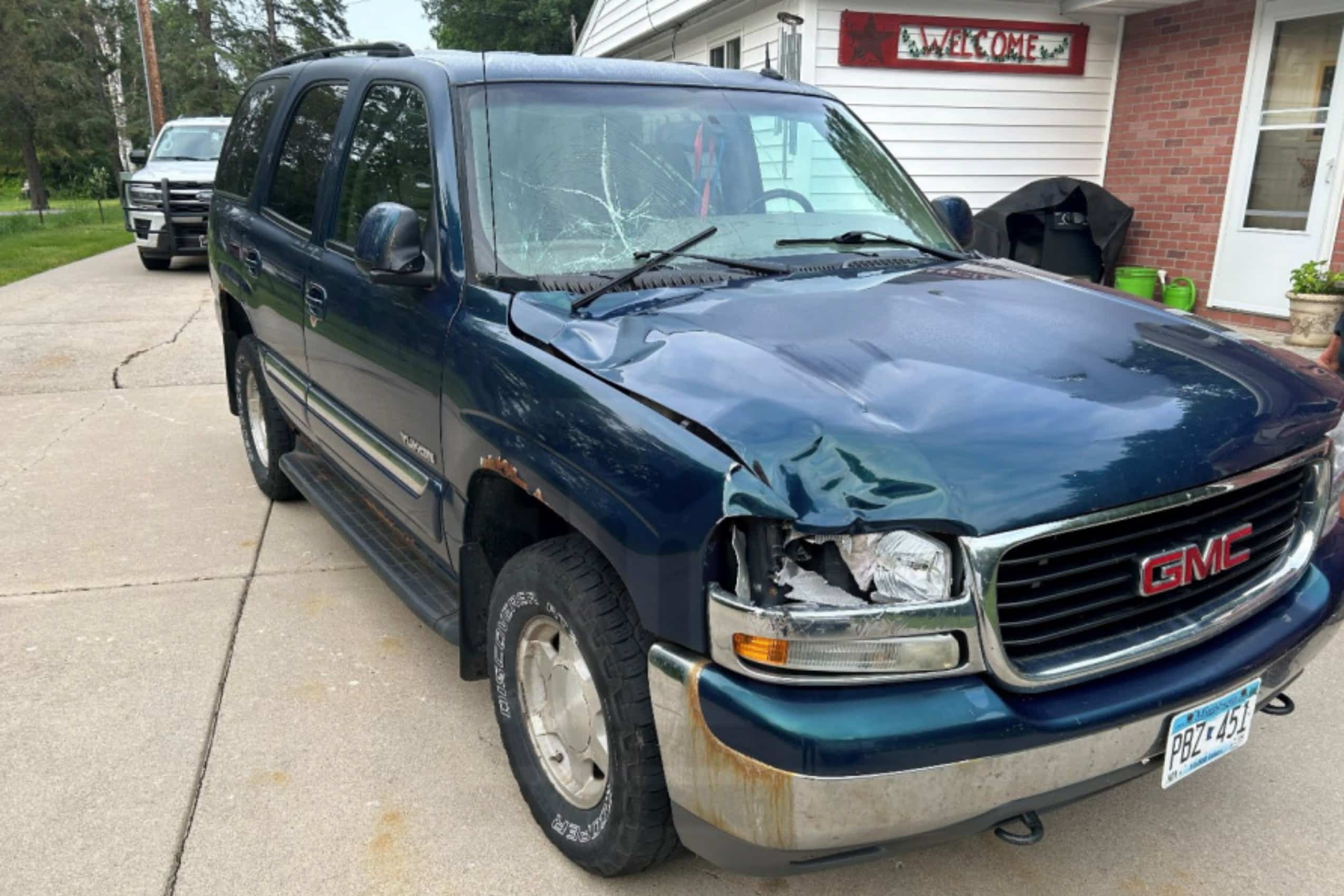
The prosecution said McCabe had reason to investigate Martin for impaired driving given the totality of the circumstances which included Martin admitting to using opiates prior to driving the car and McCabe observed Martin’s damaged car parked crooked when McCabe went to Martin’s home the day after the crash to investigate.
Martin was ultimately not charged with impaired driving. Photos of Martin’s damaged car were published in legal briefs submitted by the Itasca County Attorney’s Office.
With both sides having submitted their arguments, Judge Chandler has taken the matter under advisement and will issue a ruling within 30 days of Sept. 8.
Trooper testifies about Martin’s mood swings and narcotics use
In July of this year, State Trooper McCabe gave testimony about what she observed when she was called to Martin’s home the morning after the crash.
A certified drug recognition evaluator, McCabe went to the house after Martin called 911 that morning to report that she may have been involved the crash. Martin’s defense team said their client called authorities after seeing a news article about the prior night’s crash and thought she might have been the driver involved.
According to a court transcript, McCabe said she arrived at Martin’s home on July 4, 2024 just after 6 a.m. McCabe noticed Martin’s damaged, teal Chevrolet Tahoe parked crooked in the driveway next to another vehicle which was parked straight.
McCabe told the court that the car’s damage included a broken headlight, damage to the hood, and spiderweb crack in the windshield. The State Trooper also said “there was a piece of black fabric stuck in the hood.”
According to McCabe, Martin admitted she drove the Tahoe home the night before and said she had not consumed alcohol in 30 years. However, the DFLer said she took hydrocodone, a narcotic, on the day of the crash. The drug was prescribed to Martin for knee pain.

In her court testimony, McCabe said Martin’s description of her use of hydrocodone on the day of the crash was within the parameters of the prescribed dosage. Additionally, McCabe said Martin experienced mood swings during her interview.
Addressing the court, McCabe said she began a DWI investigation based on what she saw and heard at Martin’s house combined with the fact that Martin did not call 911 that night.
“I thought that was odd. ‘Cause most people do call in if they hit something, unless … in my training and experience, unless they don’t want law enforcement involved at that point. So I thought that was odd for the amount of damage that I was seeing. The mood swings, like I said, stood out to me. And then, also, the — admitting to the hydrocodone use the night prior,” McCabe said.
However, Martin’s defense team said McCabe “neither cited nor observed any objective physical indicators of alcohol or drug use by Ms. Martin to justify initiating an impaired driving investigation.”
Officers took possession of Martin’s cellphone as evidence after the interview. Additionally, law enforcement took a blood sample of Martin to be tested for substances. That test came back negative for the substances tested.

Jenna Gloeb
Jenna Gloeb is an Edward R. Murrow Award-winning journalist, media producer, public speaker, and screenwriter. Most recently, she worked as a reporter and on-air host for CCX Media. Jenna is a Minnesota native and resides in the Twin Cities with her husband, son, daughter, and two dogs.