




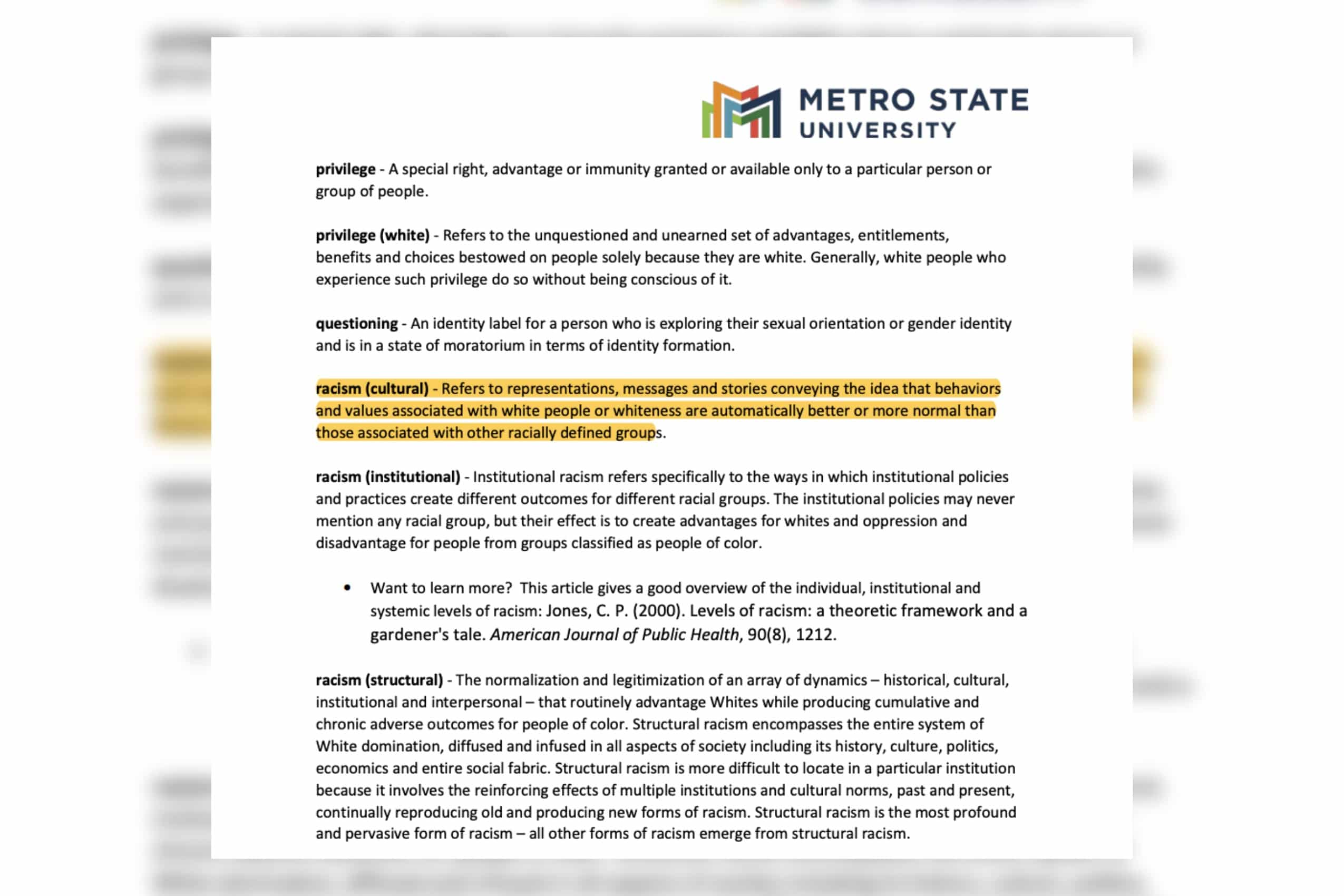
Metro State University sent a glossary of “equity, inclusion, and anti-racism” terms to students last week that details what it means to be racist and promotes the idea of “white fragility.”
According to the glossary, Metro State’s Office of Equity and Inclusion developed the list to encourage efforts toward a more “equity-minded, inclusive, and anti-racist institution.”
“Developing common language is an important step in making sure we put in place the necessary building blocks to live out our university’s anti-racist mission,” says the glossary, which is based on a similar list of terms published by the Minnesota State system.
The glossary includes definitions for several forms of racism, including cultural, structural, institutional and anti-black racism, as well as terms including “white privilege” and “white fragility.”
The definitions generally describe racism and racial inequity through a framework in which white people hold advantages and people of color experience corresponding disadvantages.
Under “cultural racism,” for example, the glossary says the term refers to “representations, messages and stories conveying the idea that behaviors and values associated with white people or whiteness are automatically better or more normal than those associated with other racially defined groups.”
The definition identifies the promotion of “whiteness” over other racial groups as something that is racist, but the inverse is not included in any definition of racism.
The same approach appears in the definition of institutional racism.
The glossary defines institutional racism as policies and practices that, even when they do not explicitly mention race, can “create advantages for whites” while creating oppression for people of color.
Finally, structural racism is defined as the “most profound and pervasive” form of racism and one that “encompasses the entire system of White domination.”
“The normalization and legitimization of an array of dynamics — historical, cultural, institutional and interpersonal — that routinely advantage Whites while producing cumulative and chronic adverse outcomes for people of color,” the definition says.
The glossary also states that there is no such thing as a “non-racist or race-neutral policy,” suggesting that “every policy in every institution in every community in every nation” is contributing to either racial inequity or equity.
Along those lines, the glossary defines equity as the “proportional distribution of desirable outcomes across groups” and says “university policies and practices that are enacted should be cognizant of advancing equity.”
“Racial equity is observed when there is parity in outcomes across all racial categories,” the glossary adds.
It also includes terminology describing white people’s reactions to discussions of race.
Under “white fragility,” the glossary describes a response by white people that includes “discomfort and defensiveness” when “confronted by information about racial inequality.”
The inclusion of the term raises questions about how disagreement with the glossary’s definitions is understood, though Metro State says the glossary is not intended to determine what students should believe.
“The resource was created to encourage learning and conversation, not to prescribe beliefs or limit the discussion of differing viewpoints,” the university said in a statement. “Metro State is committed to academic freedom, open inquiry, and the respectful exchange of diverse perspectives.”
Metro State emphasized that the glossary serves as a “voluntary reference tool to support learning and dialogue for students, faculty or staff.”
The glossary also includes links to various articles and other materials to provide additional context for some of the definitions.
The university said the glossary is not supposed to be exhaustive, comprehensive or an academic source, and that definitions may vary depending on context and audience.
“The glossary of terms was developed by Metro State University’s equity council, with representation from students and employees, as an educational resource to foster a shared understanding of terminology commonly used in equity, inclusion, and anti-racism discussions,” the statement added.

Rachael Van Rossum
Rachael Van Rossum is a journalist and author who studies political science in the Twin Cities. She previously interned with the Illinois House of Representatives and recently published her debut fantasy novel "The Hellburner of Sovi." Rachael is passionate about telling compelling stories and bringing to life the voices of political figures, athletes, and members of her community through engaging writing. She is the Alpha News journalism fellow for the summer of 2026.