





The Minnesota Department of Human Services (DHS) is rolling out a new policy requiring fingerprint-based background checks for employees with access to sensitive FBI data.
The move follows just weeks after Alpha News broke the story about a convicted sex felon—on the state’s predatory offender list—who somehow landed a director-level job in state government.
An internal DHS memo obtained by Alpha News states that all new job applicants and personnel with unescorted access to Criminal Justice Information Services (CJIS) data or physically secure CJIS processing areas will be subject to a fingerprint-based criminal history check. CJIS is one of the most secure criminal information databases in the country.
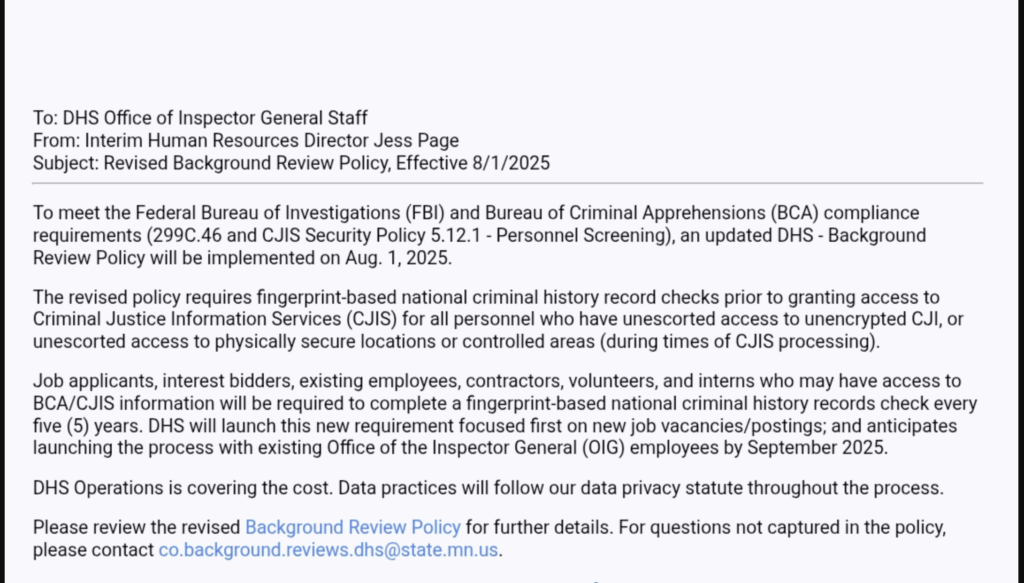
The requirement will also apply to contractors, interns, volunteers, and existing employees with CJIS access — with the background check repeated every five years.
DHS said the rollout will begin with new hires and eventually cover staff working in the Office of the Inspector General (OIG), which oversees the background study division.
DHS also confirmed the change in a statement to Alpha News:
“The department updated its background review policy to meet FBI and BCA compliance requirements for staff who have access to Criminal Justice Information Services,” a DHS spokesperson said.
“DHS routinely updates our policies and procedures to ensure we are in compliance with state and federal requirements. The revised policy applies to new job applicants as of Aug. 1. The department anticipates launching the process with existing staff by September.”
However, DHS said the change does not apply to all agency employees, only to “every individual hired by DHS who may have access to BCA/CJIS information.”
Those individuals must complete a CJIS access study before they are allowed access to that data. DHS said the policy change is being implemented to meet “current BCA/FBI compliance requirements.”
The timing of the update follows just weeks after Alpha News exclusively reported that Wilson Tindi, Kenyan national once in ICE custody, steadily climbed the ladder in state government—despite being a convicted sex felon on the state’s predatory offender list.
Tindi’s story went viral — prompting even the Department of Homeland Security to weigh in. Tindi started at the Minnesota Pollution Control Agency and later landed a director role at the Department of Education.
DHS did not reference the Tindi case in its memo or statements to Alpha News, although the revelations set off a wave of public outrage.
Lawmakers raised alarm over systemic breakdowns, especially in determining who gets access to private data and sensitive decision-making roles inside state government.
DHS has not said how many employees will be affected, or whether any will be reassigned, lose access, or be disqualified under the new policy.

Jenna Gloeb
Jenna Gloeb is an Edward R. Murrow Award-winning journalist, media producer, public speaker, and screenwriter. Most recently, she worked as a reporter and on-air host for CCX Media. Jenna is a Minnesota native and resides in the Twin Cities with her husband, son, daughter, and two dogs.