




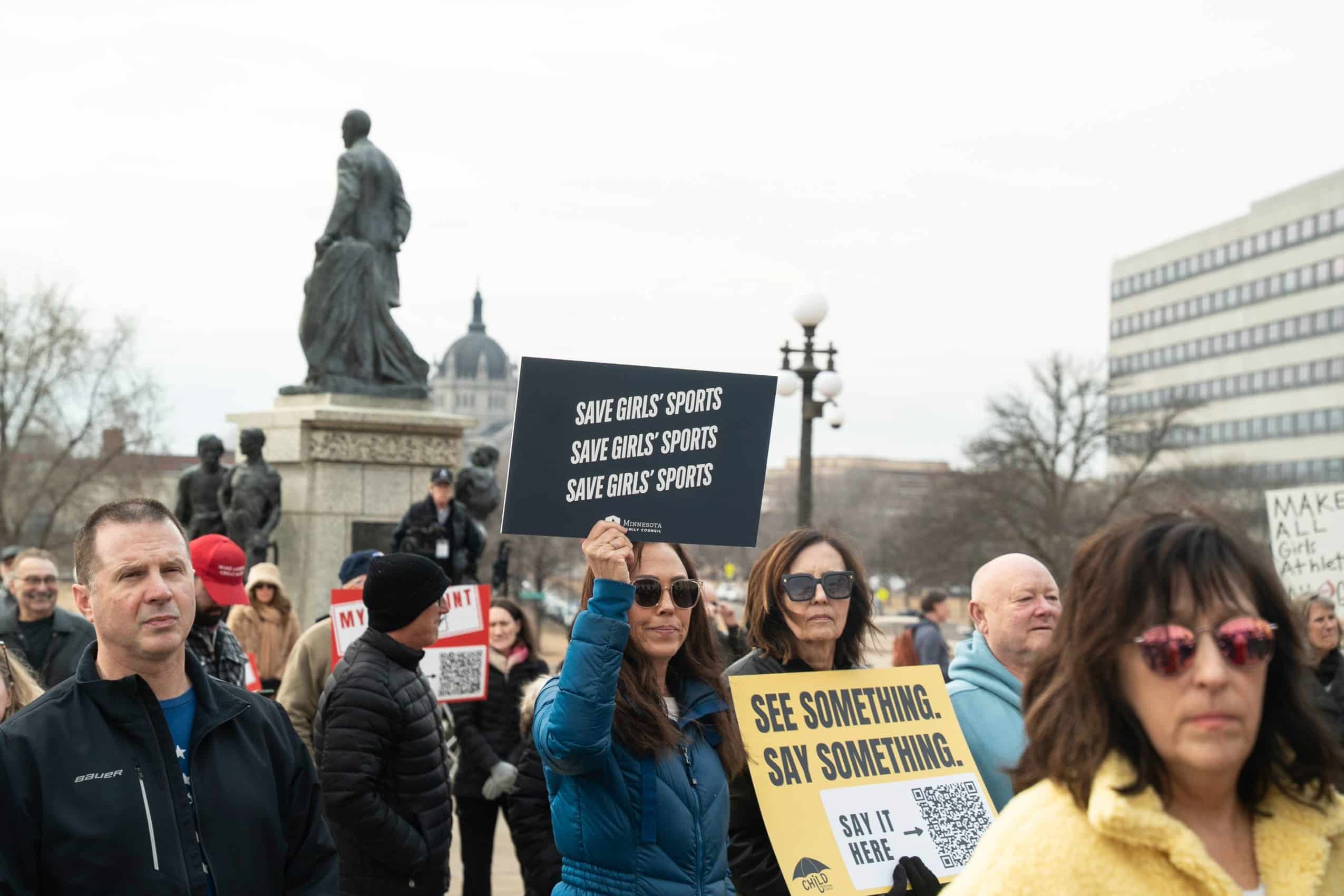
House Speaker Lisa Demuth is among a group of 20 female Minnesota legislators attaching their names to a landmark case headed to the Supreme Court of the United States — one that could decide the constitutionality of laws that prevent biological males from competing in female-only sports.
On Friday, two Minnesota-based law firms announced that they have co-written an amicus brief on behalf of more than 200 female state lawmakers from across the country that asks the Supreme Court to uphold an Idaho state law which bans boys and men from playing girls’ and women’s sports.
All the legislators who signed on to the brief have either “authored, sponsored, introduced, supported, or advocated legislation defining eligibility for women’s sports based on biological criteria,” said Grace Lawrence, a spokeswoman for St. Paul-based True North Legal, which filed the amicus brief this month in the Hecox v. Little case.
Male college student sued Idaho over ‘Fairness in Women’s Sports Act’
In March 2020, the Idaho State Legislature passed into law the “Fairness in Women’s Sports Act,” which its supporters said is intended to protect female athletes from facing unfair competition from biologically male athletes.
Just months following its enactment, a Boise State University student who was born male but identifies as a female sued the state of Idaho claiming the law violated the 14th Amendment’s equal protection clause.
Lindsay Hecox was 20 years old at the time and claimed the “Fairness in Women’s Sports Act” would prevent him from trying out for the women’s track and cross-country teams at the public university.
The case has made its way up through the federal courts, and in 2023 a panel for the 9th Circuit Court of Appeals held that the law was unconstitutional. Now, the Supreme Court has chosen to hear the case on its merits. Hecox has asked for the case to be dismissed, but Idaho’s solicitor general is opposing that motion.
Attorneys with two Minnesota-based law firms, True North Legal and CrossCastle, have co-written the amicus brief on behalf of 206 females state legislators. They are asking the Supreme Court to uphold the Idaho law.
“In most areas of public life, all Americans can participate—and should be able to participate—without any regard either for their biological sex or their gender identity,” the amicus brief argues.
“Exceptions arise in a few areas, including where our culture and laws find it appropriate to reserve separate spaces or opportunities for women. In those select areas, biological sex criteria and gender-identity criteria are mutually exclusive. Since the whole point of the concept of gender identity is that it bears no necessary relationship to biological sex, women’s spaces and opportunities must necessarily be reserved either for those who are female based on biology, or for those who identify as women,” the brief continues.
“The inevitable nature of this choice informs the requirement, under federal law, that women be given educational opportunities equal to men. If that legal requirement turns on biological sex—as it likely does—then education programs and activities receiving federal funding likely are required to adopt biological-sex eligibility requirements for women’s events, at least in many contexts,” the brief concludes.
Minnesota Democrats voted down similar legislation this spring
The Minnesota female legislators who signed on to the amicus brief all sponsored similar legislation or voted in support of its passage during the 2025 session.
In March, the “Preserving Girls’ Sports Act” failed to pass in the state House after all 66 Democratic members voted against it.
In addition to Speaker Demuth, the 19 other female legislators who signed on to the amicus brief, all Republicans, include:
Reps. Pam Altendorf, Patti Anderson, Peggy Bennett, Marj Fogelman, Mary Franson, Dawn Gillman, Krista Knudsen, Patricia Mueller, Bernie Perryman, Marion Rarick, Bobbie Harder, Kristin Robbins, Peggy Scott, Erica Schwartz, Natalie Zeleznikar, and Sens. Julia Coleman, Keri Heintzeman, Karin Housley and Carla Nelson.
“The Court’s decision to hear this case is one step closer to justice for women and girls across the country. It only takes one male participant in a girl’s only event or team to change the outcome of an entire female sporting event. We’ve seen that happen across the country. Female athletes of all ages deserve a level playing field. It’s about fairness, safety, and following the law,” said Renee Carlson, general counsel for True North Legal.
“Even more, allowing males who identify as women to compete in women’s and girls’ sports is hijacking more than podiums and scholarships. It’s taking away opportunities to learn valuable life lessons, develop character, and to build confidence, all of which are the often the additional benefits of many female athletes.”

Hank Long
Hank Long is a journalism and communications professional whose writing career includes coverage of the Minnesota legislature, city and county governments and the commercial real estate industry. Hank received his undergraduate degree at the University of Minnesota, where he studied journalism, and his law degree at the University of St. Thomas. The Minnesota native lives in the Twin Cities with his wife and four children. His dream is to be around when the Vikings win the Super Bowl.