


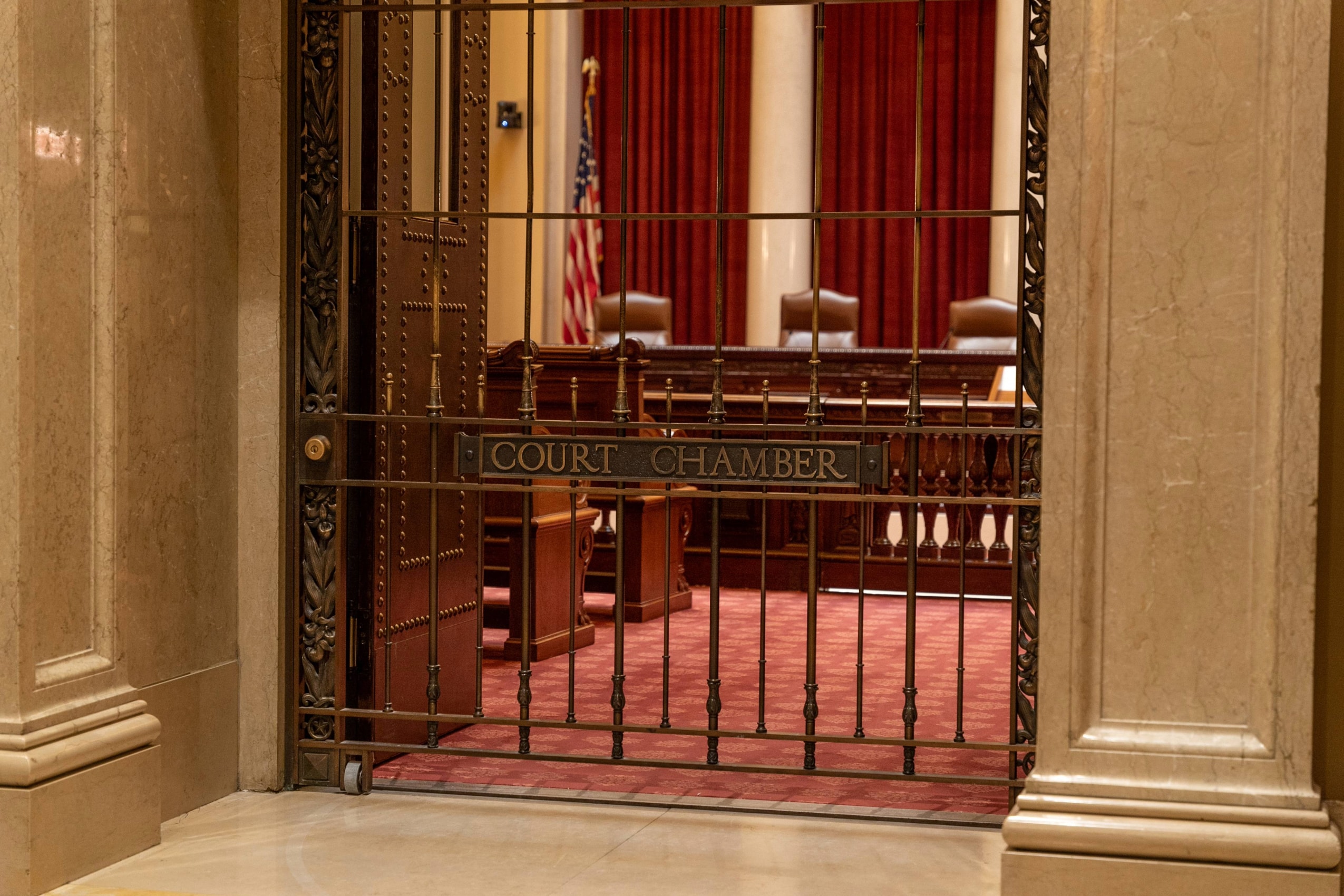
The Minnesota Supreme Court ruled that USA Powerlifting (USAPL) discriminated against a transgender athlete by preventing him from competing in female powerlifting competitions. The ruling, issued Wednesday, is the latest development in a years-long legal saga.
USAPL is a national organization that governs squat, bench press, and deadlift competitions across the country. The group requires athletes to submit to drug tests before competitions and has separate events based on weight class and gender.
In 2018, JayCee Cooper attempted to compete in a pair of female USAPL powerlifting competitions. During the registration process, Cooper asked to be exempted from the group’s no-drugs policy in order to keep taking spironolactone.
Cooper told USAPL he had taken spironolactone since he was first “diagnosed” with gender dysphoria in 2014 at the age of 26. Spironolactone, which reduces testosterone, is barred by the USAPL. Cooper submitted a note from a therapist that said the drug is an essential part of treatment for gender dysphoria.
USAPL ultimately prohibited Cooper from competing in the group’s female division, saying “Male-to-female transgenders are not allowed to compete as females in our static strength sport as it is a direct competitive advantage.”
In 2021, Cooper filed a lawsuit against USAPL which alleged that the organization violated the Minnesota Human Rights Act (MHRA) by illegally discriminating against him on several bases including sex and sexual orientation in business and public accommodations.
During the legal saga, USAPL has argued that it did not exclude Cooper because of his status as a transgender woman. Instead, the group has said it excluded Cooper because he went through puberty as a man and has natural strength and performance advantages.
Initially, a district court sided with Cooper on several of the discrimination claims. Later on, an appeals court reversed much of that ruling, saying the lower court erred in several parts of its decision.
Arguing before the Supreme Court, USAPL said its policy “explains that male to female transgender powerlifters are excluded from the women’s division because of their male physiology; the exclusion is not because of their sex, sexual orientation, gender identity, or any other protected characteristic.”
On Wednesday, the seven-member Minnesota Supreme Court issued a 6-0 ruling that said USAPL had engaged in sexual orientation discrimination in public accommodations against Cooper. Justice Theodora Gaïtas did not take part in the decision.
However, the Minnesota Supreme Court said Cooper’s claims of discrimination in business cannot be resolved at the moment because “there is a genuine dispute of material fact as to whether USA Powerlifting has a legitimate business purpose for excluding transgender women from the women’s division.”
As such, the case was sent back down to the district court for more proceedings consistent with the Supreme Court’s ruling.
Reactions from USAPL, Republicans, and Cooper’s attorney
After the ruling was released, Republicans slammed the Supreme Court’s decision.
“I am so extremely disappointed in today’s decision by the Minnesota Supreme Court,” said Sen. Carla Nelson, R-Rochester. “It is a loss for women and girls across the state. For decades, countless people have fought to give girls real athletic opportunity and strong, respected competition.”
Similarly, House Republican Floor Leader Harry Niska said the decision “has sweeping implications that could effectively eliminate girls’ sports in Minnesota unless we provide statutory clarification.”
All seven member of the Minnesota Supreme Court were appointed by Democrats. Five of the seven were appointed by Gov. Tim Walz.
Meanwhile, an attorney for Cooper said “this ruling sends a clear and powerful message: transgender people have a right to enjoy public spaces in Minnesota like sporting events, restaurants, and movie theaters, free from targeted discrimination. This decision is a historic victory for fairness, equity, and the fundamental rights of all Minnesotans.”
In a lengthy statement, USAPL said they are pleased they have the right to offer their evidence regarding the business discrimination claim, but they are disappointed by the court’s ruling on public accommodation discrimination.
“USAPL acted for legitimate, non-discriminatory reasons to promote fairness in the sport when determining that Ms. Cooper should not compete in the women’s division due to her male physiology,” said the group. “Ms. Cooper was born biologically male and went through puberty as a male.”
“According to unrebutted scientific research, males have up to a 64 percent strength advantage in powerlifting and suppressing testosterone only reduces the advantage by about 10 percent. This difference in outcomes makes it fundamentally unfair for a male-to-female transgender powerlifter to compete in the women’s division,” USAPL added.
Noting that it has established a new “MX division for transgender and nonbinary athletes,” USAPL said it is “committed to serving every athlete with respect and integrity.”
Luke Sprinkel
Luke Sprinkel previously worked as a Legislative Assistant at the Minnesota House of Representatives. He grew up as a Missionary Kid (MK) living in England, Thailand, Tanzania, and the Middle East. Luke graduated from Regent University in 2018.