




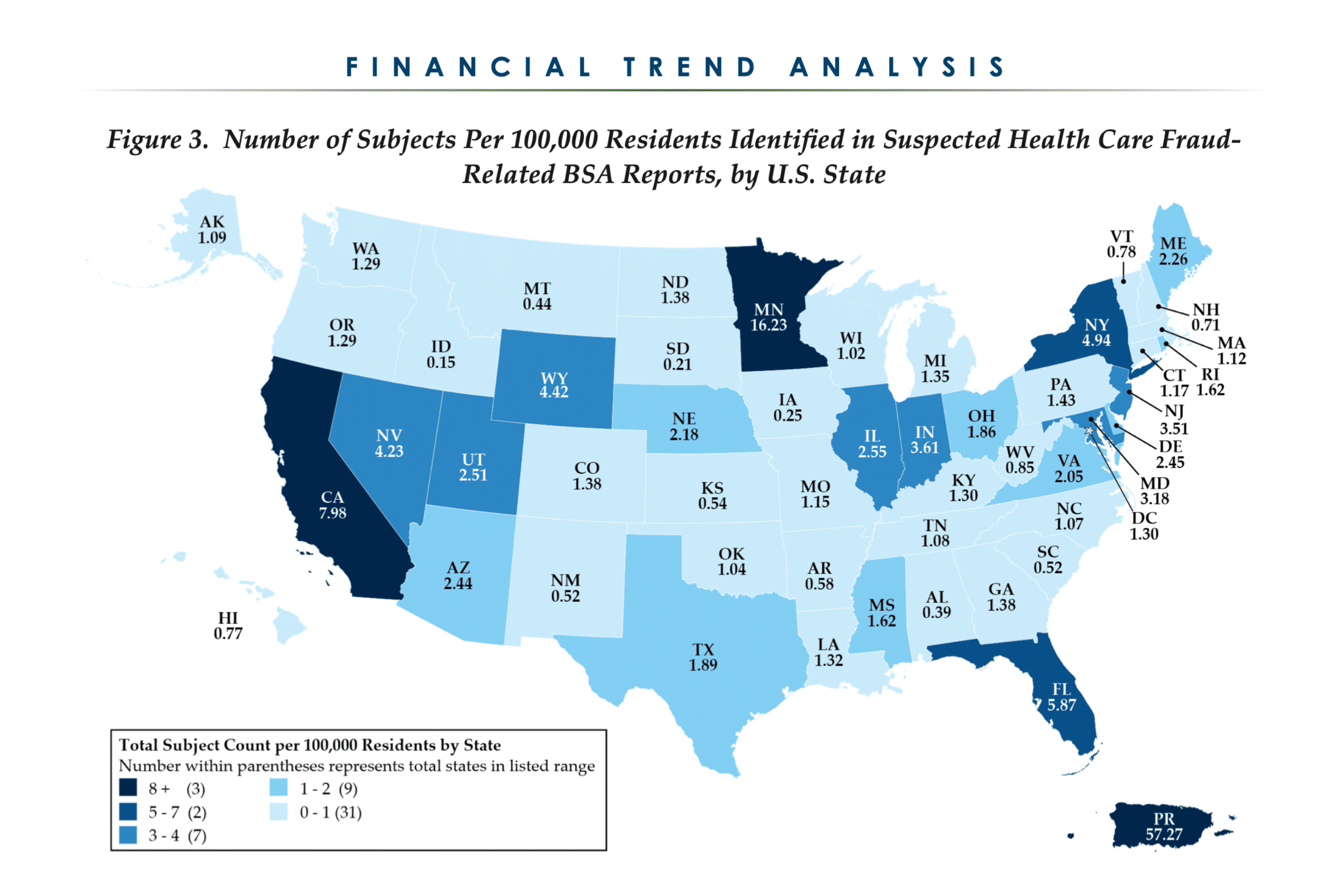
A new federal report puts Minnesota at the top of a list no state wants to be on: the number of subjects per capita identified in suspected healthcare fraud reports.
A new analysis from the U.S. Treasury Department’s Financial Crimes Enforcement Network, known as FinCEN, shows Minnesota had the highest number of subjects per capita identified in bank reports tied to suspected healthcare fraud.
Nationwide, the report identified approximately $17.5 billion in suspicious activity potentially connected to healthcare fraud.
California had the most subjects identified overall, followed by Florida and New York.
Minnesota ranked fourth despite its much smaller population — but when the numbers were adjusted for population, Minnesota jumped to No. 1 in the nation for subjects identified in suspected healthcare fraud-related reports.
Hennepin County was also a national outlier.
It appeared in 300 suspected healthcare fraud-related reports — second only to Los Angeles County’s 777 and ahead of Miami-Dade County’s 247.
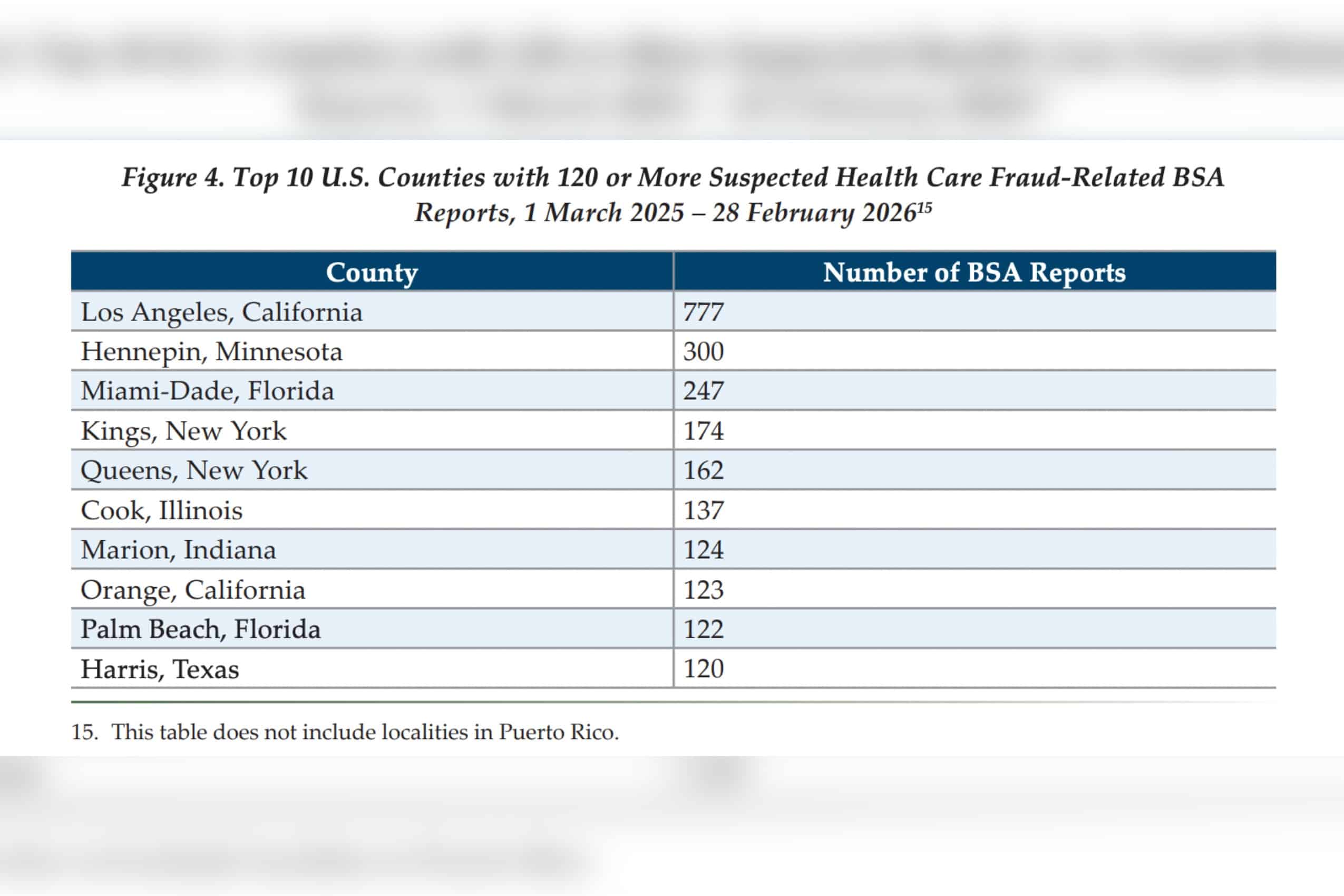
The population difference makes Hennepin County’s ranking even more striking.
Los Angeles County has an estimated 9.7 million residents and Miami-Dade County has 2.8 million, compared with just 1.3 million in Hennepin County, according to the latest U.S. Census Bureau estimates.
Critics have pointed to another demographic parallel: Minnesota is home to the nation’s largest Somali population, with most Somali Minnesotans living in the Minneapolis-St. Paul area, according to the Minnesota Department of Health.
Hennepin County, meanwhile, has the largest Somali population of any county in the country, with 38,588 people identifying as Somali in the 2020 Census.
Congress has also examined the parallel, with a Senate Judiciary subcommittee holding a February hearing titled “Somali Fraud in Minnesota — The Tip of the Iceberg,” featuring testimony from federal officials, including a senior Government Accountability Office official.
‘Shuttered’ daycare received $870,000 in payments
The FinCEN report also highlights a suspected fraud case involving a Minnesota adult daycare reportedly registered at a “shuttered store front.”
A financial institution flagged nearly $870,000 in payments from a state agency and private insurers administering state health plans to the daycare.
“The daycare then sent payments to numerous individuals under the guise of payroll, transferred funds to the business owner’s personal accounts, and sent funds to a likely shell company,” the report states.
Some of the money was ultimately used to write checks to money services businesses specializing in international transfers.
FinCEN did not name the daycare or identify the Minnesota state agency involved.
The Minnesota daycare was just one example contained in FinCEN’s analysis of more than 5,700 Bank Secrecy Act reports filed between March 2025 and February 2026.
Familiar territory in Minnesota
The types of providers appearing most often in FinCEN’s analysis also overlap with areas already under scrutiny in Minnesota.
Home healthcare was the most frequently identified provider type. Other commonly flagged businesses included hospice providers, mental and behavioral health providers, addiction treatment centers, medical equipment providers and adult and child daycares.
“In many cases, proceeds of suspected health care fraud were used for personal expenses and luxury goods, while some funds were sent internationally,” the report states.
The findings come as Minnesota’s Medicaid system is already facing intensifying investigations into fraud and questionable billing.
As Alpha News reported last week, the Minnesota Department of Human Services has 1,702 open program-integrity cases and another 3,266 open intakes.
The agency has classified 14 Medicaid provider types as “high-risk” based on program vulnerabilities, evidence of fraudulent activity and potentially suspicious billing patterns.
In December, then-First Assistant U.S. Attorney Joe Thompson said federal investigators were examining the 14 state-run, Medicaid-funded programs that had spent more than $18 billion since 2018.
Asked how much of that spending could be fraudulent, Thompson said a “significant portion” — potentially “half or more.” That would put suspected fraud at more than $9 billion, though Thompson stressed the investigation was ongoing.

Jenna Gloeb
Jenna Gloeb is an Edward R. Murrow Award-winning journalist, media producer, public speaker, and screenwriter. Most recently, she worked as a reporter and on-air host for CCX Media. Jenna is a Minnesota native and resides in the Twin Cities with her husband, son, daughter, and two dogs.