




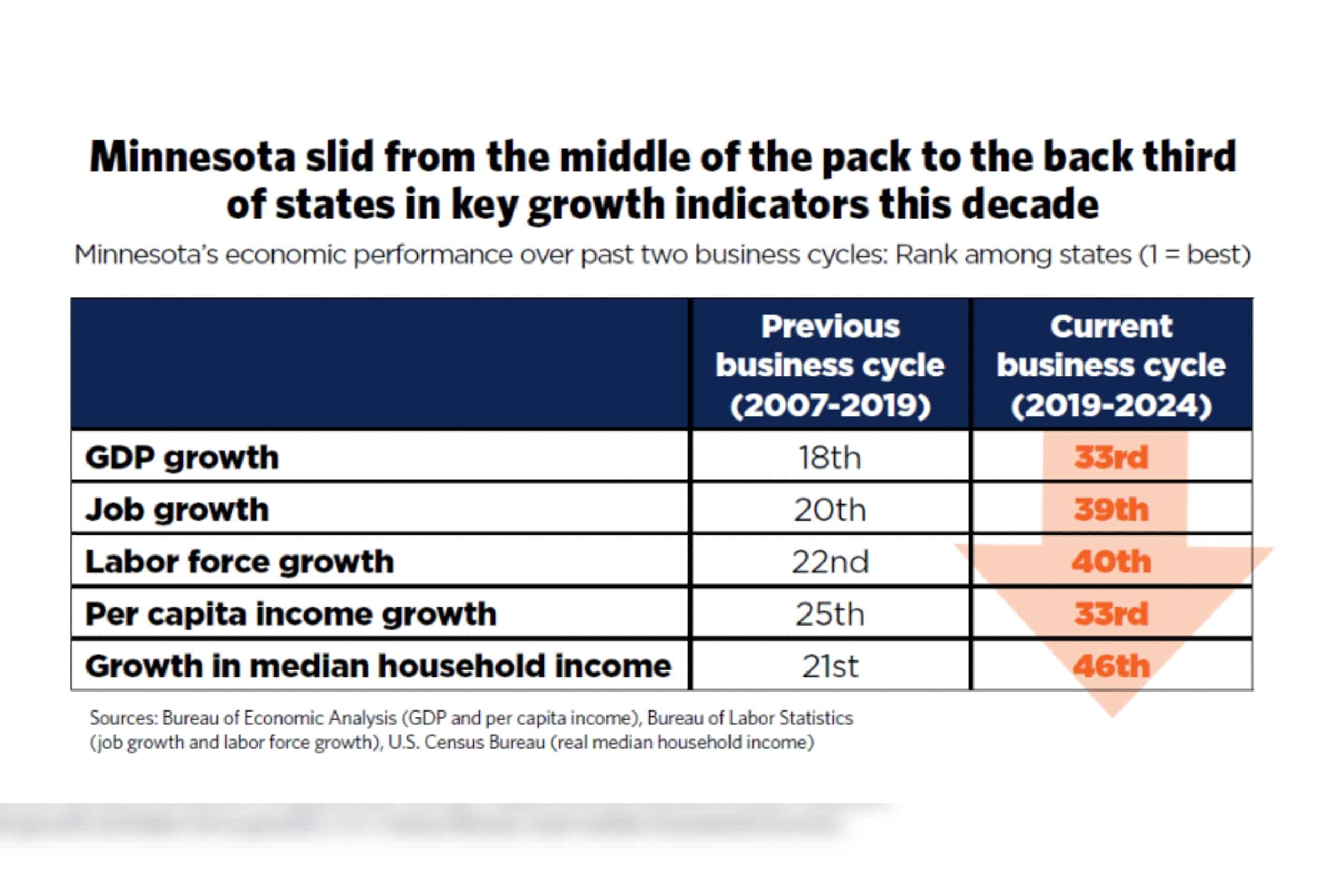
The Minnesota Chamber of Commerce’s 2026 “Business Benchmarks” report was published earlier today and the annual review paints a gloomy picture of Minnesota’s economy.
The report, which used data from the Bureau of Labor Statistics, the U.S. Census Bureau, and other institutions, examined Minnesota’s GDP growth, workforce growth, and domestic migration figures.
“Our state has fallen behind on nearly every measure of growth,” said Doug Loon, the CEO of the Minnesota Chamber of Commerce. “From 2019 to 2024, Minnesota ranked 33rd in GDP growth, 39th in job growth, 40th in labor force growth and 46th in growth of (real median) household income.”
“Meanwhile, more people are leaving our state than moving here,” added Loon.
Minnesota’s GDP has failed to keep pace
According to the report, Minnesota’s real GDP per capita was above the national average for many years. However, Minnesota’s real GDP per capita grew by roughly 1.0% per year from 2014 to 2024 while the national average grew at 1.8%.
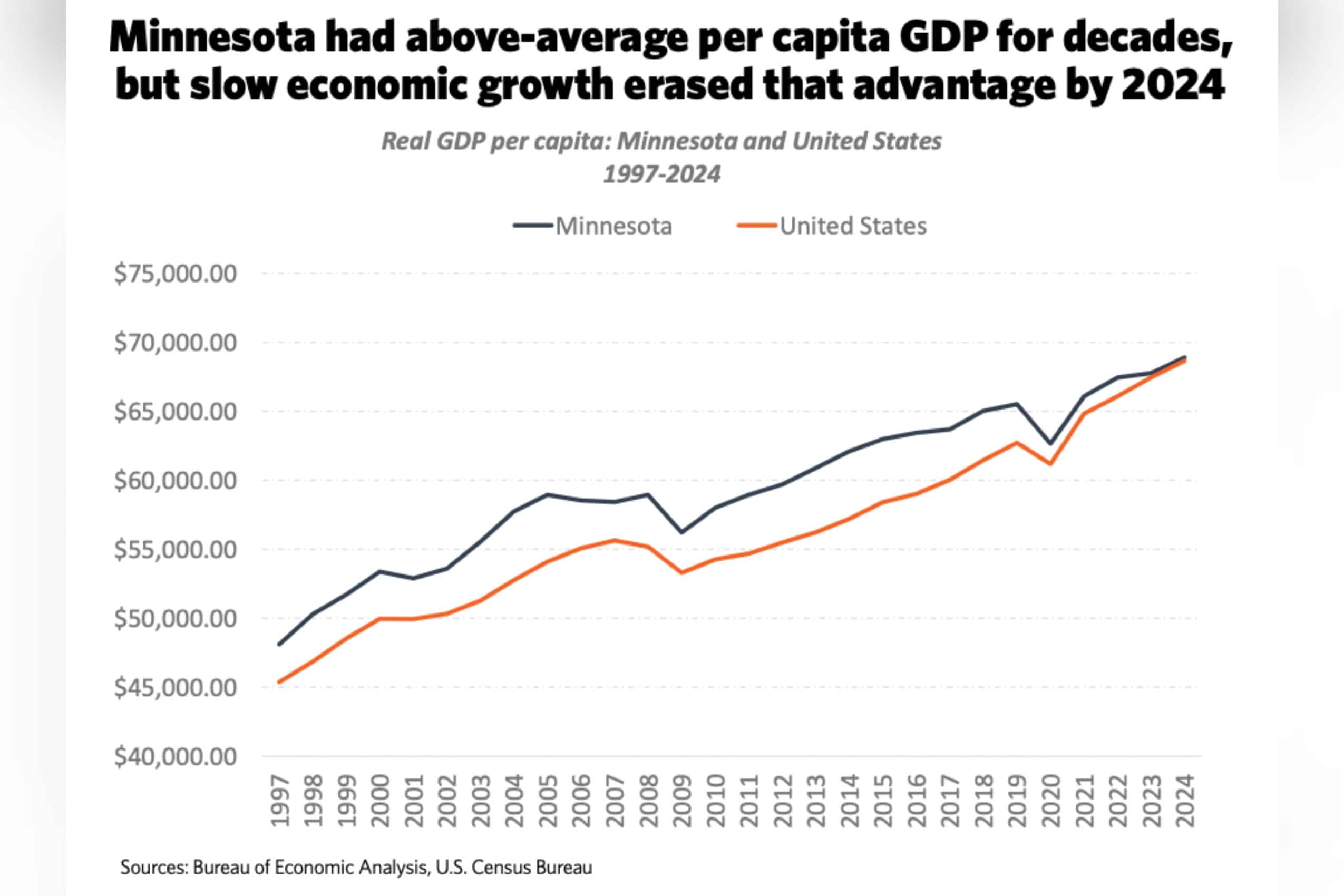
“Minnesota had above-average per capita GDP for decades, but slow economic growth erased that advantage by 2024,” the report said.
The Chamber’s report noted that Minnesota “ranks 44th for overall tax competitiveness, with the 2nd highest corporate rate and the 6th highest personal income tax rate.”
Share of foreign-born workers in Minnesota has increased
The Chamber of Commerce also sounded the alarm on Minnesota’s slowing labor force growth. The report says Minnesota’s workforce grew “by about 1.7% per year from 1976 to 2000,” but that metric slowed to just 0.2% per year from 2019 to 2024.
Interestingly, the report said “positive international migration has helped sustain population and labor force growth in the first quarter of the century. This impact has only increased in recent years, with 94% of Minnesota’s net population growth coming from immigration from 2020-2024.”
“The state’s foreign-born labor force grew by 41% since 2010, compared to just 4% for U.S.-born Minnesotans,” added the report.
This, combined with the GDP figures, means Minnesota’s GDP growth has failed to keep pace even in spite of the fact that the state has been flooded with foreigners in recent years.
Minnesota has net negative domestic migration
The report also showed that Minnesota was among a list of states experiencing a net loss of people to domestic migration. In short, more people have left Minnesota for another state than come to Minnesota from another state.
“Perhaps the most pressing long-term challenge is Minnesota’s migration trend,” said Loon. “For 20 of the past 24 years, more people have left our state than moved here. From 2020 to 2024, Minnesota ranked 41st in net domestic migration, losing nearly 48,000 residents to other states.”
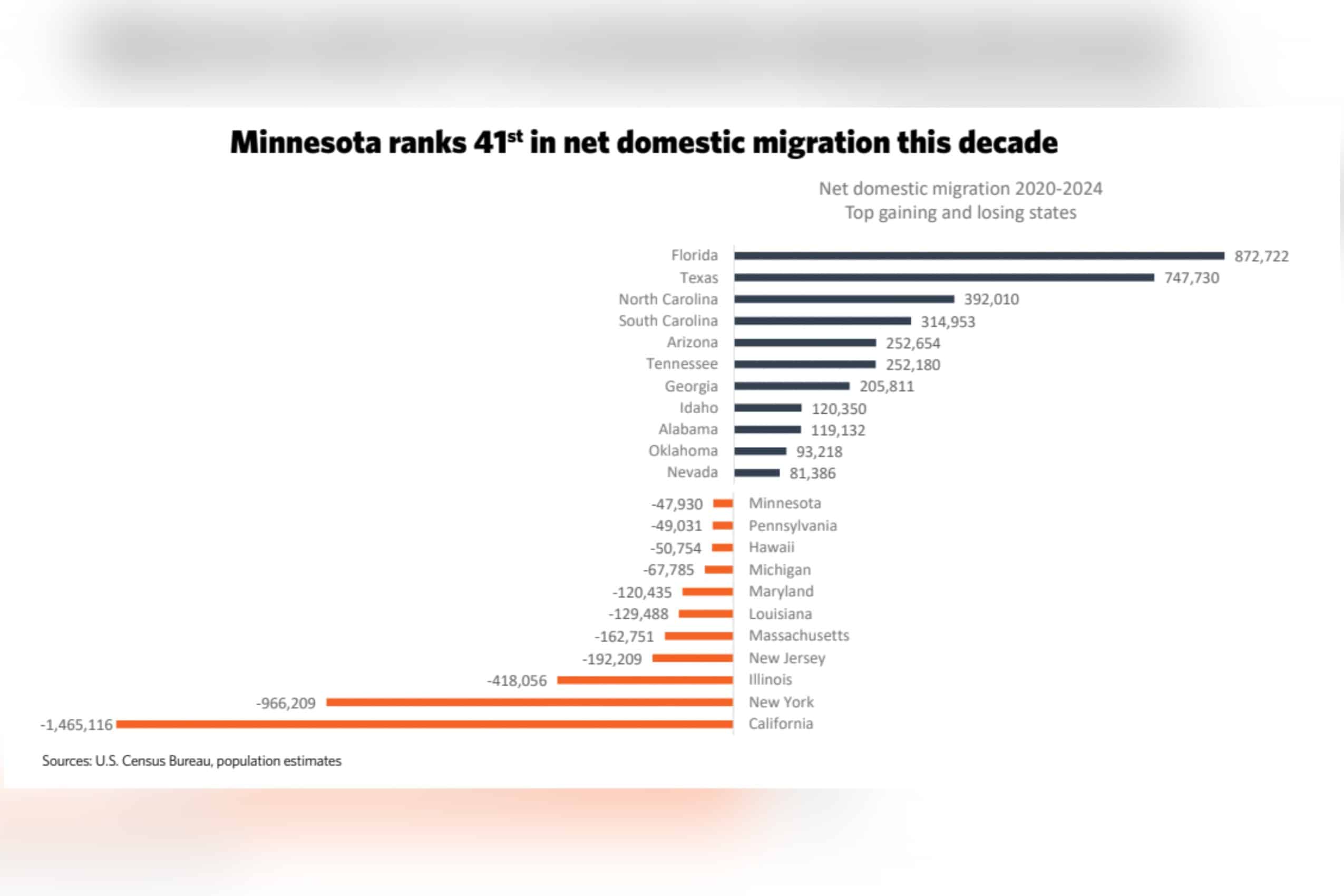
California, New York, Illinois, New Jersey, and Massachusetts were also listed among the states losing people to domestic migration. Meanwhile, states such as Florida, Texas, South Carolina, Tennessee, and Georgia are gaining residents from domestic migration.
From 2020 to 2024, Minnesota’s net domestic migration was -47,930. The report said Minnesota’s taxes, limited housing, child care costs, and high cost of living were among the list of things that are “holding us back.”

Luke Sprinkel
Luke Sprinkel previously worked as a Legislative Assistant at the Minnesota House of Representatives. He grew up as a Missionary Kid (MK) living in England, Thailand, Tanzania, and the Middle East. Luke graduated from Regent University in 2018.