



A new report released Dec. 10 regarding Somali immigrants in Minnesota provides insight into the population’s issues of poverty and welfare.
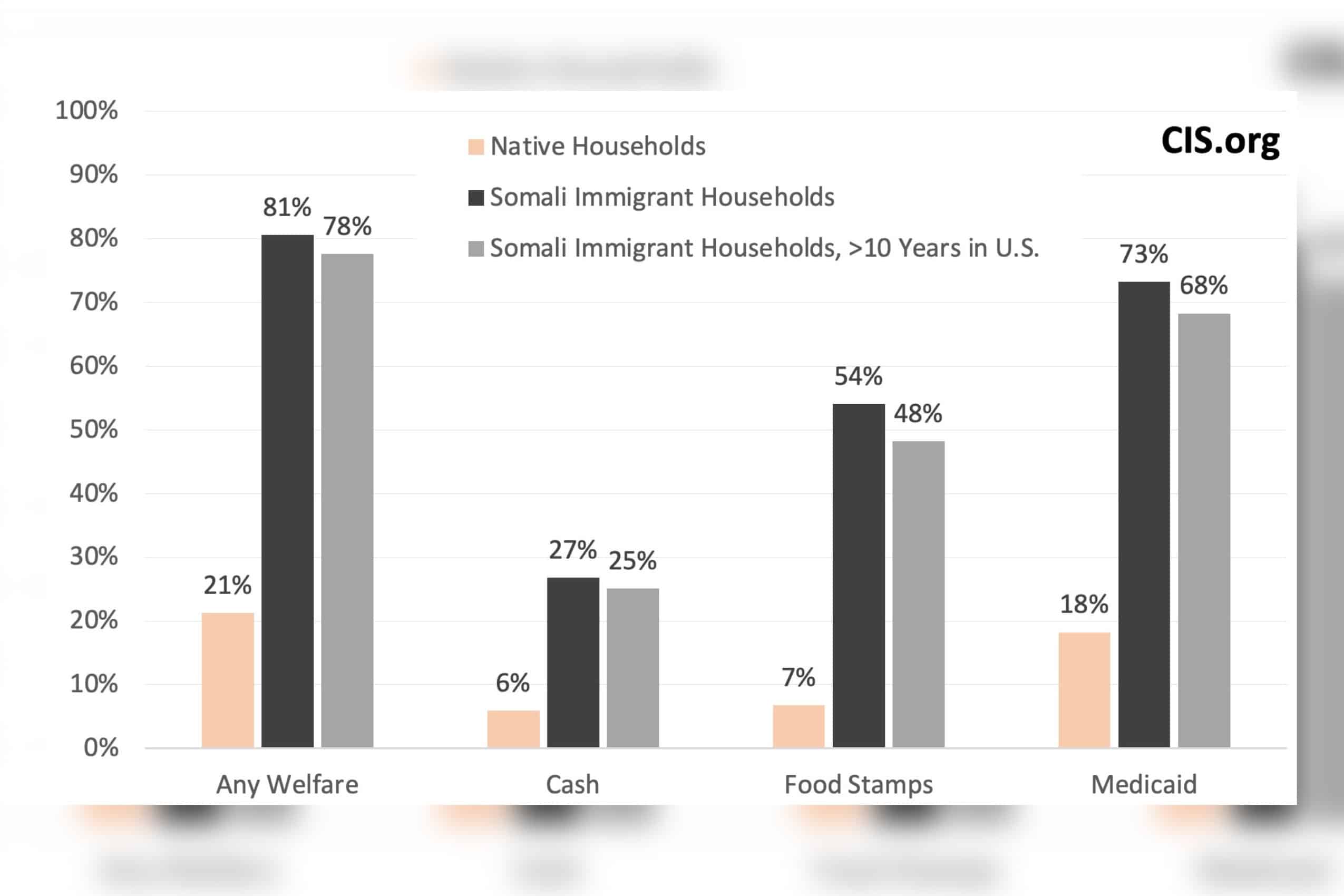
The Center for Immigration Studies (CIS) report found that “nearly every Somali household with children (89 percent) receives some form of welfare.”
“Altogether, 81 percent of Somali households consume some form of welfare, compared to 21 percent of native households. Somalis with 10 years of residency have welfare consumption rates that are only marginally lower than the Somali population as a whole,” says the CIS report, authored by Jason Richwine.
Other findings of the report include:
- “More than half (52 percent) of children in Somali immigrant homes in Minnesota live in poverty, while only 8 percent of children in native-headed homes are in poverty.
- About 39 percent of working-age Somalis have no high school diploma, compared to just 5 percent of natives.
- Among working-age adult Somalis who have lived in the U.S. for more than 10 years, half still cannot speak English ‘very well.’
- About 54 percent of Somali-headed households in Minnesota receive food stamps, and 73 percent of Somali households have at least one member on Medicaid. The comparable figures for native households are 7 percent and 18 percent.”
So what’s the impact to taxpayers? As the CIS report notes, the Somali community makes up a small percentage of the state’s total population, yet “some of the state’s poverty-related problems still have a pronounced Somali component.”
For instance, the report says, “Somali households account for 2.5 percent of children in Minnesota but 12.8 percent of the state’s child poverty. In fractional terms, one out of every eight children in poverty in the state comes from a Somali household.”
“These disproportionate burdens imposed by immigration have upended a state once lauded for its low rate of social problems,” the report says.
Then there is the problem of fraud, with federal prosecutors saying billions of dollars have been stolen from state programs in cases where most of the defendants are Somali.
Bill Glahn, a policy fellow at the Center of the American Experiment who has been closely tracking Minnesota’ fraud problem, linked the state’s projected budget deficit to fraud in a recent post on PowerLine.
“If you look at the most recent state budget documents (p. 8), most of that ‘unexpected’ increase in spending occurs in a single budget line-item: ‘forecasted services’ within the state’s health and human services budget area, a/k/a fraud central. The fraud problem and the budget deficit problem are one and the same,” Glahn wrote.
How many Somalis live in Minnesota?
Minnesota now has the largest Somali population in the U.S., with many Somalis first arriving in the state in the early 1990s upon the outbreak of civil war in their home country.
“Many Somalis have chosen Minnesota because of their social networks, for educational and employment opportunities, and to access an array of services. Somalis also cite Minnesota’s high standard of living and a reputation for martisoor (hospitality),” says the Minnesota Historical Society.
However, the current Somali population in Minnesota can be difficult to quantify.
Based on the 2020 Census, Minnesota was home to roughly 91,000 people of Somali descent, but a 2024 survey estimated the population size at 108,000.
The Minnesota State Demographic Center highlights some issues that impact data collection, which can result in underestimating “the size of our immigrant populations because trust and language issues reduce response rates to Census surveys.”
Another issue “with using ancestry data is that some respondents do not answer the question. Also, because that question is open-ended, some people answer with a broad group or continent,” the demographic center says. “For example, it’s likely that some people of Somali or Liberian ancestry answer with ‘African’ which would exclude them from estimates of Somalian or Liberian ancestry. Additionally, some people report their ancestry as simply ‘American.’”
Immigration and Customs Enforcement (ICE) has been carrying out operations across the Twin Cities over the last several days amid national scrutiny of Minnesota’s fraud crisis.