


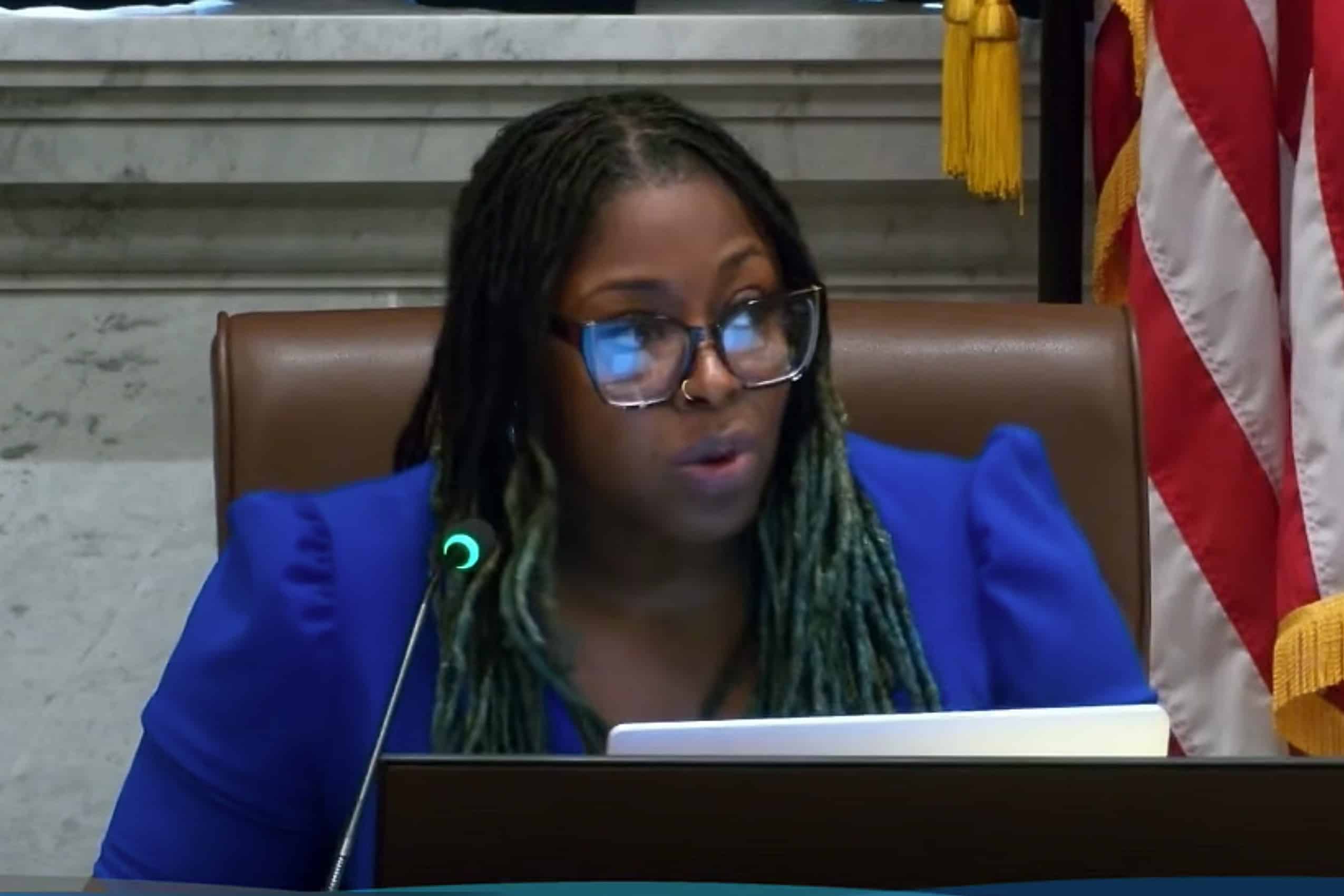
Far-left Minneapolis City Council Member Robin Wonsley slammed the Minneapolis Police Department (MPD) in a newsletter to constituents last week. In her letter, she described MPD as “one of the largest drains” on the city’s budget.
Currently, Minneapolis is facing a budget shortfall that is likely to exceed $30 million. Mayor Jacob Frey is expected to unveil a city budget later this week that could include cuts to city spending, increased property taxes, and more.
In advance of that budget proposal, Minneapolis City Council members are making known their priorities for city spending — and Wonsley is taking aim at MPD.
“The City is facing extreme financial pressures,” Wonsley wrote in a weekly newsletter to her constituents. “One of the largest drains is MPD, which is responsible for about a third of the entire general fund.”
Wonsley, who is endorsed by the Democratic Socialists of America (DSA), said the city’s police department “routinely goes over budget by tens of millions of dollars for overtime, which has no measurable outcomes and does not improve public safety.”
Wonsley continued to slam MPD, saying the city faces “multi-million dollar liabilities each year created by MPD’s pattern and practice of racial bias and excessive force, as well as PTSD claims that are widely understood to be vulnerable to fraud.”
The far-left city council member also criticized Frey and the city council, saying they have given pay increases to MPD without securing “meaningful” police reforms.
“Taxpayers will continue to see increased property taxes every year until the City stops rubber stamping blank checks for MPD regardless of public safety outcomes or reform implementation,” Wonsley said.
Police spending in Minneapolis has gone up significantly in recent years. In 2019, the city spent approximately $181 million on police. The city’s 2026 budget, which spent just over $2 billion in total, allocated $229 million for policing.
While that may seem like a big increase, the difference lines up with inflation: $181 million in 2019 is equal to approximately $230 million in 2026.
However, Minneapolis has far fewer officers this year than it did seven years ago and is on pace to overspend its police overtime budget again this year. Frey has said the overtime spending is necessary to meet the city’s policing needs.
In 2019, the city had nearly 900 police officers. As of June this year, Minneapolis had 638 officers with another 30 in training. Minneapolis is required by law to have a minimum of 731 police officers on staff, but recruitment has proved difficult for the agency.
Alpha News asked MPD about its spending, but the agency did not immediately respond to a media inquiry.
In her recent newsletter, Wonsley argued that public safety should be measured by metrics of success rather than staff numbers. To that end, she said homicide clearance rates and police response times are better now than in years when MPD had more officers.
A July presentation from the city shows the homicide clearance rate increased from 65% in 2019 to 83% in 2025. Alpha News asked Wonsley about her claim that police response time has improved, but she did not immediately respond to the inquiry.
Additionally, Wonsley was asked why she described MPD as “one of the biggest drains” on the city budget and whether she believes MPD should have the 731 minimum officers as required by law.
After Frey unveils his budget proposal this week, the Minneapolis City Council will spend the next several months reviewing the budget, amending it, and eventually producing a final budget that will either be signed or vetoed by the mayor.
In a June newsletter, Wonsley said her budget priorities include creating a city agency to mitigate they city’s legal and financial liabilities, exploring the possibility of publicly owned housing, and stopping cuts to “programs that serve marginalized communities.”
“Minneapolis has amongst the highest racial inequities in the country,” she wrote. “Our police force has a confirmed pattern of racially discriminatory policing. Our residents were just targeted by the federal government in a violent occupation.”
“Cutting programs that serve residents of color and low-income residents will worsen these inequities and are a nonstarter,” she added.
Luke Sprinkel
Luke Sprinkel previously worked as a Legislative Assistant at the Minnesota House of Representatives. He grew up as a Missionary Kid (MK) living in England, Thailand, Tanzania, and the Middle East. Luke graduated from Regent University in 2018.