




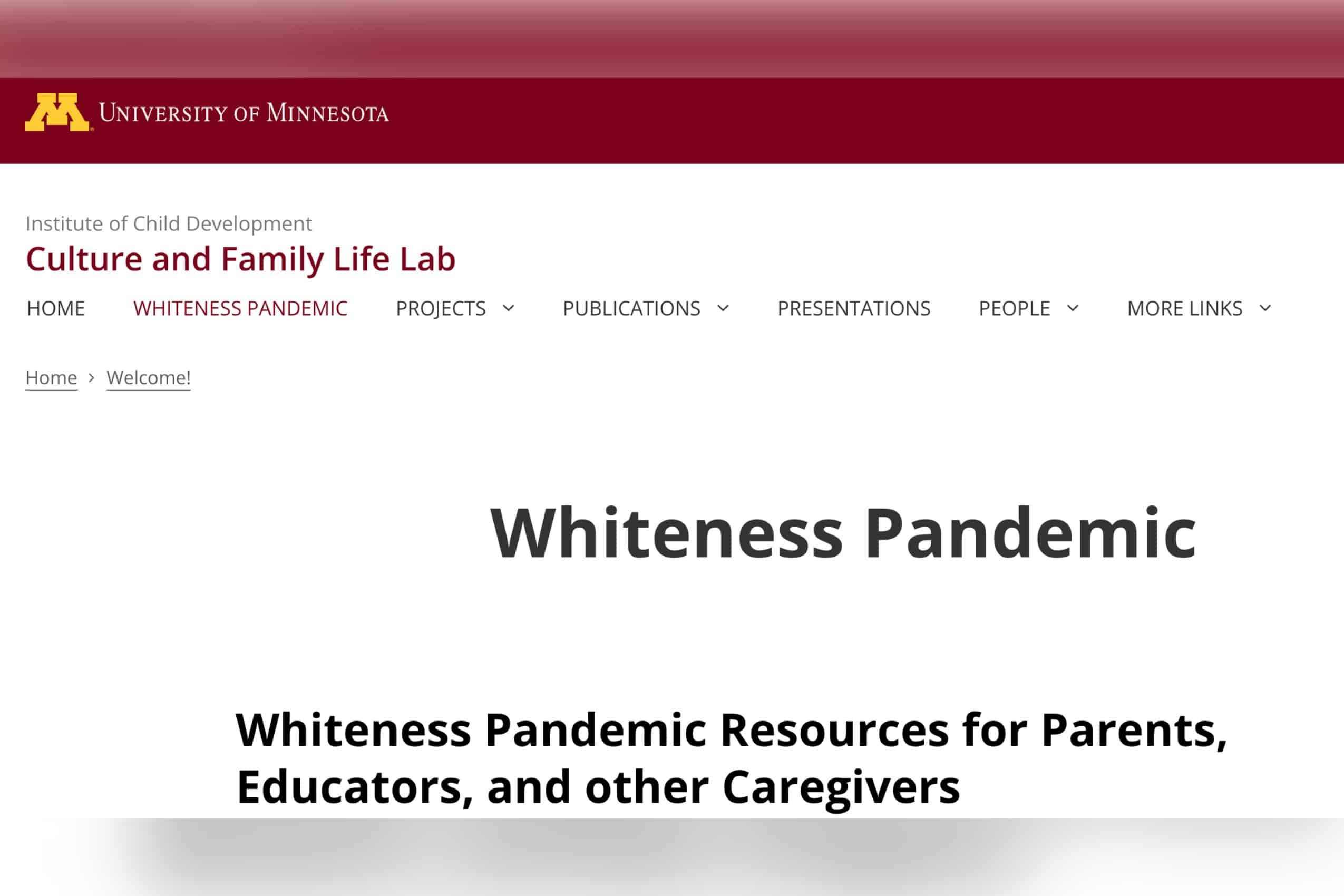
The University of Minnesota is facing criticism for hosting a page on its website that brands “whiteness” as a “pandemic.”
The “Whiteness Pandemic” page — featured on the website of the Culture and Family Life Lab at the U of M’s Institute of Child Development — leans heavily on a 2021 academic paper analyzing how white Minneapolis mothers talked to their children after George Floyd’s death, a report from Defending Education first revealed.
According to the study, published in American Psychologist, most mothers were “apathetic,” “fearful,” or simply overwhelmed and avoided discussing racism with their kids. Only 17% reportedly demonstrated what researchers called “more advanced White racial identity development,” engaging in “color- and power-conscious parenting.”
We @DefendingEd discovered that U of MN is warning against a "whiteness pandemic" & providing "resources" on how to "halt and reverse" the issue
Among its other insanities?
“The family system one of the most powerful systems involved in systemic racism”
Tuition is paying for… https://t.co/FWQFxU8SqJ
— Sarah Parshall Perry (@SarahPPerry) November 25, 2025
The webpage characterizes whiteness as a “centuries-old culture” defined by “colorblindness, passivity, and White fragility,” which it labels “covert expressions of racism.”
“Naming the Whiteness Pandemic shifts our gaze from the victims and effects of racism onto the systems that perpetrate and perpetuate racism, starting with the family system. At birth, young children growing up in White families begin to be socialized into the culture of Whiteness, making the family system one of the most powerful systems involved in systemic racism,” the website says.
The site ties racism itself to public health language — calling it both an epidemic and a pandemic — and claims that “whiteness” is the underlying cultural force keeping it alive.
“If you were born or raised in the United States, you have grown up in the Whiteness Pandemic,” the website states, adding that white adults, because of their “power and privilege,” have a special obligation to “halt and reverse this pandemic.”
Project dedicates itself to George Floyd and others
The initiative dedicates its work to the “living memory” of George Floyd, Daunte Wright, and dozens of other “Black and Brown” individuals killed by police since 1968.
Creators of the project include lab director Gail M. Ferguson and various graduate fellows.
Meet Gail Ferguson, a professor at the @UMNews, pushing the idea that Whiteness is a “pandemic” that is driving a “racism pandemic” in the US.
She also believes children born in White families are raised in a culture of racism, and they should join BLM in order to “reverse the… https://t.co/Vpb7OkRStC pic.twitter.com/7dwJbbgaOG
— Libs of TikTok (@libsoftiktok) November 25, 2025
Project urges ‘self-reflection,’ ‘re-education’ and anti-racist parenting
The project, funded in part by the National Institute of Mental Health and several internal U of M fellowships, includes a list of “practical resources for courageous parenting.”
Among them are Layla Saad’s “Me and White Supremacy” workbook; Ibram X. Kendi’s “How to Raise an Antiracist” and his children’s book “Antiracist Baby”; and PBS Kids’ racial justice video segments.
The website lists the Black Lives Matter movement (BLM) as one of its “practical resources for self-reflection to develop a healthy white racial identity.”
The project also encourages white adults to “self-reflect, re-educate yourself, and act,” describing silence around race as a form of complicity.
“If you are a White adult, antiracist action involves an ongoing process of self-reflection in order to develop a healthy positive White identity while engaging in courageous antiracist parenting/caregiving,” the website states.
A university spokesperson told Fox News that the school is “steadfast in its commitment to the principles of academic freedom.”

Jenna Gloeb
Jenna Gloeb is an Edward R. Murrow Award-winning journalist, media producer, public speaker, and screenwriter. Most recently, she worked as a reporter and on-air host for CCX Media. Jenna is a Minnesota native and resides in the Twin Cities with her husband, son, daughter, and two dogs.