



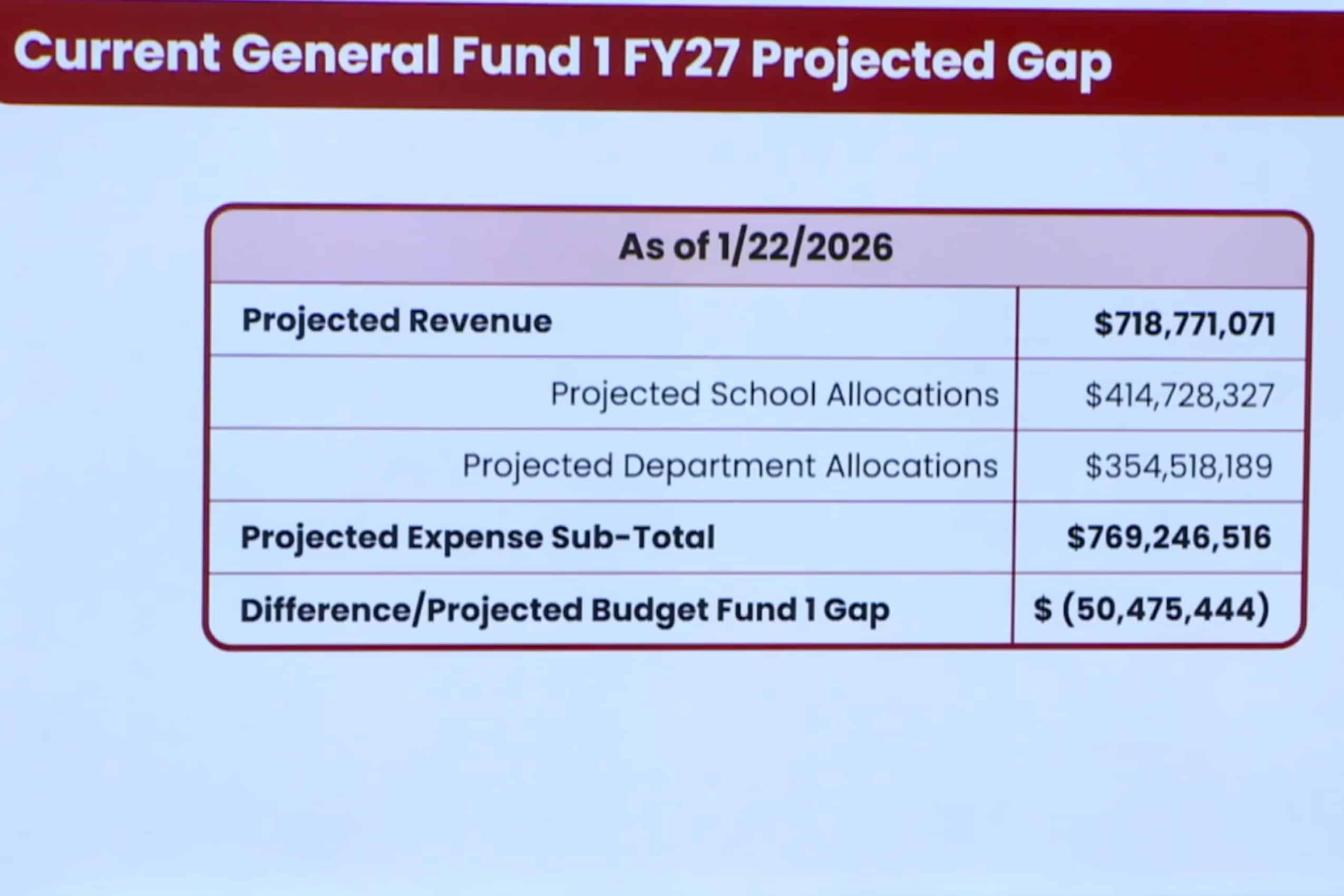
Minneapolis Public Schools’ projected deficit for the 2026–27 school year has grown to more than $50 million — up from earlier estimates.
District leaders say the number could still change before the budget is finalized in June, but the widening gap only highlights ongoing financial and leadership turmoil inside one of Minnesota’s largest school districts.
A budget process under pressure
The updated figures were presented at the Feb. 10 school board meeting by Ryan Strack, the district’s senior executive officer. Strack opened his presentation by emphasizing transparency and explaining why the district is sharing detailed assumptions earlier in the process.
“Our goal really is to provide an increased level of transparency with access to information,” Strack told board members, adding that district leaders want the public to understand “what assumptions we’re using and what methodologies go into this budget process so that we are showing our work.”
He stressed that budgeting for a large urban district is inherently fluid.
“The budget process here in Minneapolis and in all school districts is dynamic,” Strack said. “It will change. Change is expected.”
Leadership exits
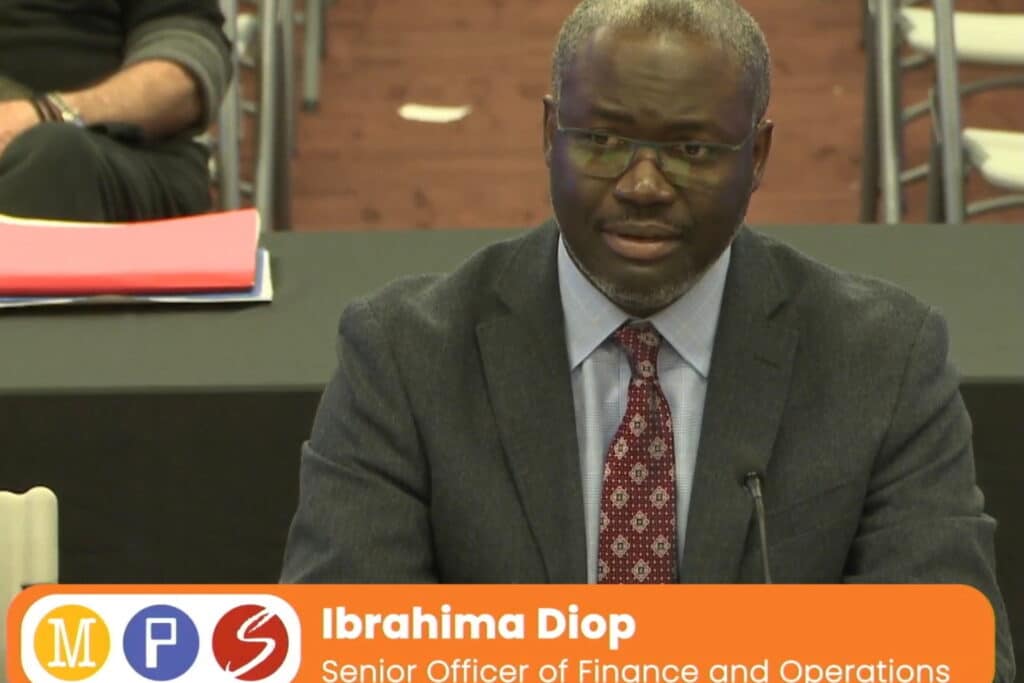
The latest budget update comes weeks after former senior finance chief Ibrahima Diop left Minneapolis Public Schools after being placed on administrative leave.
Alpha News has reported extensively on Diop and questionable multi-million dollar contracts he signed with transportation companies.
Last month, local media in Milwaukee reported that Milwaukee Public Schools hired Diop as its new deputy superintendent at a salary of $240,000 a year. TMJ4 reported that Diop was hired on Dec. 18, before he was placed on administrative leave in Minneapolis for allegedly failing “to submit necessary financial paperwork to the state.”
When Diop was first placed on leave, Alpha News asked the district to confirm his employment status and whether the leave was related in any way to transportation vendors or contracting decisions. In response, Minneapolis Public Schools said only: “Due to data privacy laws, Minneapolis Public Schools cannot comment at this time.”
Structural challenges and funding gaps
In his presentation, Strack said that long-standing issues with Minnesota’s education funding formulas are a major driver of the district’s financial strain.
“Had the general education formula, which is kind of our base per-pupil funding in the state of Minnesota, kept up with inflation every year since 2003, MPS would be receiving an additional $50 million this year,” he said.
He added that if special education services were “fully funded,” the district would receive another $43 million annually.
“So just from those two funding streams alone, we would be having an additional $93 million as a part of our budget process,” Strack said. “That is not money we have.”
Strack also noted that Minneapolis Public Schools must sometimes pay unreimbursed special education costs for resident students attending schools outside the district — without receiving corresponding funding.
“We are paying for services to support students that are not enrolled with MPS, and that’s a state issue,” he said.
From projections to reality
Earlier preliminary projections had estimated the district’s shortfall at roughly $30 million, but Strack said updated assumptions — including higher benefit costs — pushed the projected gap higher.
“MPS is projecting for fiscal year 27 a gap of about $50.5 million,” he said.
He explained that employee benefits play a major role in rising expenses, with the districtwide fringe rate increasing to 38.55% for fiscal year 2027.
“These are obligations that we are required to make,” Strack said. “We need to have the budget available to make those.”
The law requires school districts to approve balanced budgets, Strack reminded board members, adding that Minneapolis Public Schools faces an earlier deadline than most districts.
“Our budget must be approved by June 15 of the year, whereas other school districts have until June 30 to approve theirs,” he said.
Strack said the district has taken steps in recent years to close structural gaps, including through voter-approved levies, enrollment efforts and expense reductions following the expiration of federal COVID relief funding.
“We have not completely addressed our structural deficit,” he said, warning against reliance on one-time funds. “They function much like a savings account, where once you use the money, unless you’re taking action to replenish it, they’re gone.”
As the budget process moves forward, Strack said district leaders will continue refining projections while working within legal and contractual limits.
“We are taking the best information we have available at this time,” he said. “And we’re basically starting a process before we have all the details.”

Jenna Gloeb
Jenna Gloeb is an Edward R. Murrow Award-winning journalist, media producer, public speaker, and screenwriter. Most recently, she worked as a reporter and on-air host for CCX Media. Jenna is a Minnesota native and resides in the Twin Cities with her husband, son, daughter, and two dogs.