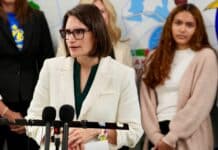


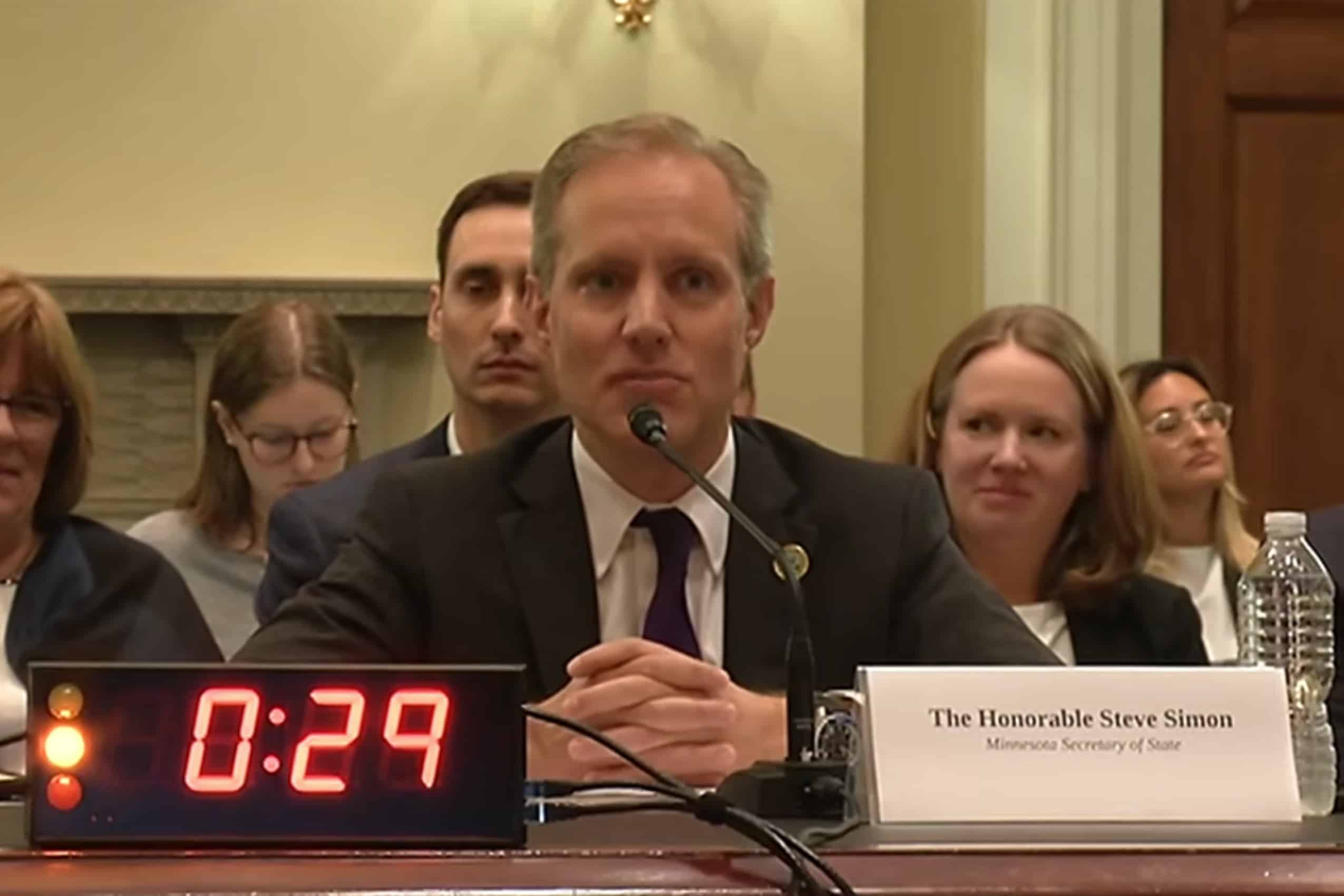
Minnesota’s controversial voter “vouching” law was back in the spotlight Thursday when Secretary of State Steve Simon defended the decades-old same-day registration policy before Congress.
Testifying before the Committee on House Administration, Simon acknowledged under questioning from Rep. Bryan Steil, R-Wis., that one registered voter may vouch for the residency of up to eight individuals seeking same-day voter registration.
The exchange quickly zeroed in on one of Minnesota’s most-debated election laws.
Congressional exchange puts vouching law in focus
“In Minnesota, you have a vouching opportunity as well,” Steil said.
“That’s right,” Simon replied.
🚨WATCH: @MNSteveSimon, Minnesota Secretary of State, speaks on voter registration and the vouching process in Minnesota: Individuals are “only vouching for where they live, not their citizenship or age.” pic.twitter.com/V9NmfyNv5D
— Off The Press (@OffThePress1) April 16, 2026
“So an individual who is registered to vote in Minnesota could show up with up to eight individuals and vouch for them. Is that accurate?” Steil asked.
“Yes, but they are only vouching for where they live, not their citizenship or age — only their residence,” Simon said.
Steil pressed further.
“Because it’s not asked, right? I mean, they would simply check a box that would say that they are a U.S. citizen. Is that accurate?” he asked.
“As in almost every other state, yes,” Simon said.
“So it’s an attestation aspect. So where they live is what you could vouch for?” Steil continued.
“Correct,” Simon said.
Steil then raised a hypothetical.
“So an individual who’s registered to vote in Minnesota could walk in with eight people from the Quality Learing Center, vouch that they live in Minneapolis, and those individuals would then be registered to vote and capable of casting a ballot. Is that accurate?” he asked.
Simon pushed back slightly, but confirmed the core of the process.
“Not quite. Almost,” Simon said. “I would say they have to live in the same precinct and they have to swear an oath.”
Steil followed up.
“Well, they have to swear to that, right? I mean, the one person could vouch for up to eight individuals?”
“Correct,” Simon said.
“That is the case?” Steil asked.
“Just as to residence, that is true,” Simon said.
Later in the hearing, Rep. Barry Loudermilk, R-Ga., pointed out that voters who are vouched for aren’t required to use provisional ballots.
“So if you find out that they weren’t registered voters, their votes still count?” he asked.
“Theoretically, that would be the case,” Simon replied.
🚨 WATCH: U.S. Rep. Barry Loudermilk presses Secretary of State Steve Simon on Minnesota's vouching system
This system allows a registered voter to vouch for the residency of up to eight other voters.
Loudermilk: "The ballot that the voters that were vouched for, are they… pic.twitter.com/vYd1Bv4cuV
— Alpha News (@AlphaNews) April 16, 2026
Minnesota law allows same-day voter registration at the polls. Voters who do not have standard proof of residence may still register if a voter already registered in the same precinct signs an oath affirming where they live. The law caps each voucher at eight individuals per Election Day.
Alpha News previously reported that the Justice Department earlier this year formally questioned whether Minnesota’s voter vouching system complies with federal law.
Concerns about noncitizens voting
Critics have also pointed to Minnesota’s 2023 “Driver’s Licenses for All” law, which permits residents to obtain a standard state driver’s license regardless of citizenship status.
They also cite the use of identical driver’s licenses for citizens and noncitizens, along with cases involving noncitizens who have registered or voted, including one individual who was charged just this week.
Rep. Mary Miller, R-Ill., highlighted these facts while stressing the importance of using the Systematic Alien Verification for Entitlements (SAVE) database, which “checks against multiple federal databases for citizenship verification of registered voters.”
Simon said his office has come to conclusion that the SAVE database is “not yet ready for use in Minnesota and would require our legislature to change our law.”
“That’s really too bad because it would be helpful,” Miller said. “I think it would be extremely helpful and give people confidence to know that you are accessing everything available, including this database that President Trump has made available to ensure that noncitizens are not voting.”

Jenna Gloeb
Jenna Gloeb is an Edward R. Murrow Award-winning journalist, media producer, public speaker, and screenwriter. Most recently, she worked as a reporter and on-air host for CCX Media. Jenna is a Minnesota native and resides in the Twin Cities with her husband, son, daughter, and two dogs.