



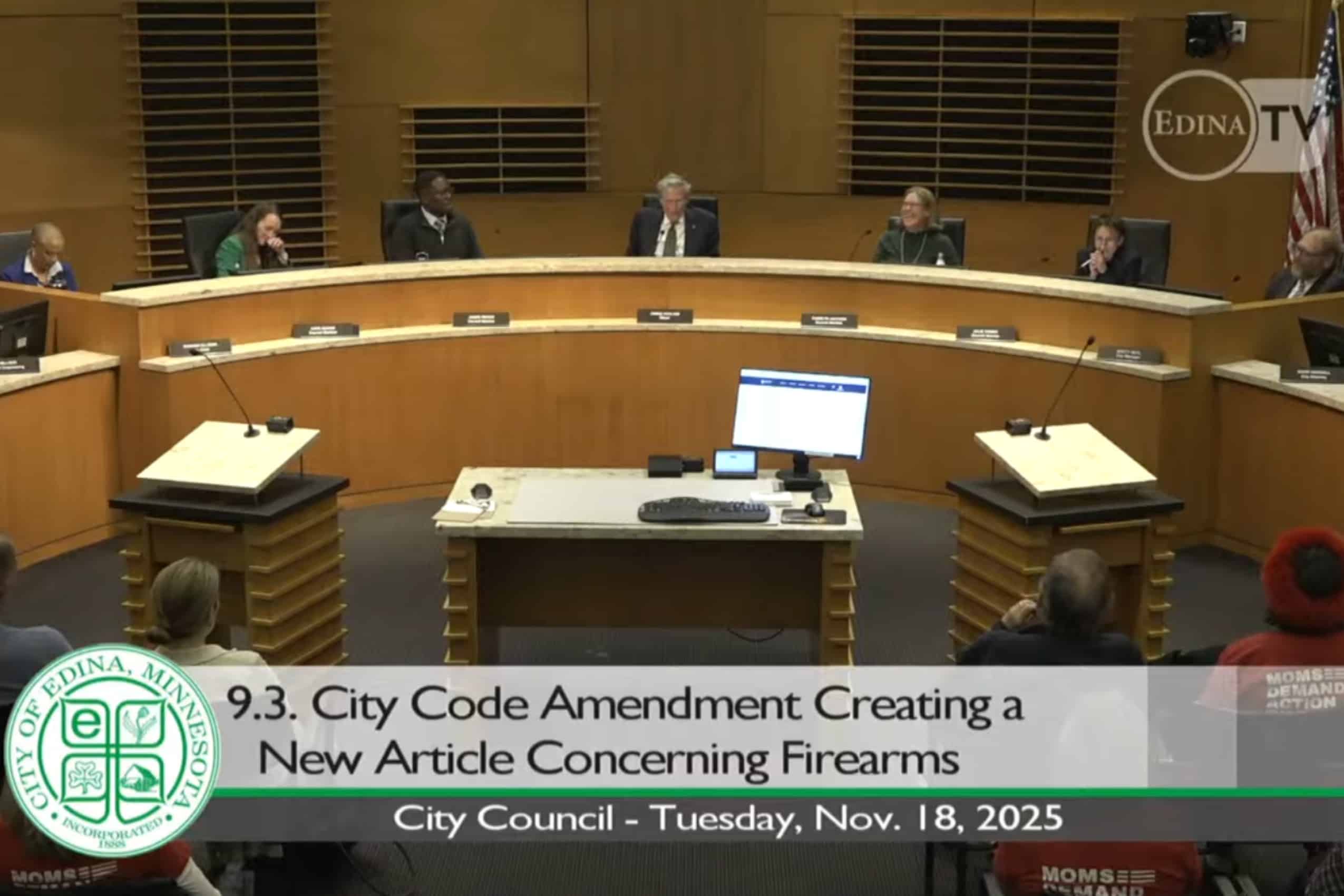
The Edina City Council unveiled a new city ordinance that attempts to ban the possession of binary triggers, ghost guns, certain gun magazines, and many firearms within city limits.
However, no action was taken on the ordinance during the council’s Tuesday night meeting. Instead, the council will explore alternative ordinances and a town hall on firearm issues.
Edina’s decision to unveil their proposed ordinance is the latest development in the ongoing saga unfolding around municipal firearm regulations.
Local governments banned from regulating firearms under state law
For months, elected officials in Minnesota cities have expressed a desire to enact firearm regulations at the local level in the wake of the August shooting at Annunciation Catholic School in Minneapolis.
Earlier this month, the St. Paul City Council unanimously approved an ordinance that would ban “assault weapons, large-capacity magazines, and binary triggers within city limits;” require all firearms to have serial numbers; and establish penalties for violations of the ordinance.
However, St. Paul’s ordinance will only become effective if the Minnesota Legislature enacts a similar law or the state preemption law is repealed.
Under state law, local jurisdictions are preempted from passing their own gun regulations. In fact, all ordinances from local governments that attempt to regulate firearms are void. This law exists to ensure Minnesota has uniform gun laws throughout the state.
Given the closely-divided nature of the Minnesota Legislature, additional gun control laws or a repeal of the firearm preemption law are almost certainly going nowhere.
Despite all of this, Edina has pursued its own firearms ordinance.
Edina’s ordinance would ban many firearms and gun magazines
Last month, the Edina city attorney was asked to draft an ordinance that regulates firearms despite his own memo which said such an ordinance would be invalidated by state law and cost taxpayer dollars to defend in court.
The city attorney instead recommended that the Edina City Council pass a resolution that calls on the legislature to change state law. While the city council supported the resolution idea, the city attorney was still directed to draft an ordinance.
On Tuesday, that firearms ordinance was unveiled during a city council meeting.
Specifically, the draft ordinance would ban the possession, manufacturing, and sale or transfer of an “assault weapon, large capacity magazine, binary trigger, or ghost gun within the City.” Additionally, the ordinance contains a firearms storage mandate.
Like the St. Paul ordinance, Edina’s proposed ordinance uses a state law definition of “assault weapon” which includes a wide variety of firearms. Among them is the AR-15 rifle, one of the most popular firearms in the country.
Edina’s ordinance defines “large capacity magazine” as “any ammunition feeding device, whether accessory to a firearm or a firearm component, that has a capacity of more than twenty (20) rounds or is designed, marketed, created, or assembled to have a capacity of more than twenty (20) rounds.”
Unlike the St. Paul ordinance, the Edina ordinance says it would only be effective when the city council passes a resolution affirming the ordinance is not preempted by state statute.
The Minnesota Gun Owners Caucus, already suing St. Paul over its ordinance, previously warned Edina that enactment of a firearms ordinance would result in a lawsuit.
When Edina’s draft ordinance was discussed on Tuesday night, the Edina city manager said he could not support the ordinance because of the state preemption law and because of the “unenforceable nature” of the ordinance.
Meanwhile, the city attorney explained that the ordinance would only be effective upon a city declaration that state preemption was lifted. The reason for doing this, he explained, was to keep from putting police in a position where they are enforcing an ordinance that conflicts with state law.
The council proceeded to have a lengthy discussion that included expressions of support for the ordinance, concerns the ordinance effectively does nothing, talk of drafting multiple ordinances based on their legal standing, and conversation about facing a potential lawsuit.
In the end, the city council directed staff to set up a town hall or public hearing on the matter and provide different ordinance options to the city council. No date has been set for the public hearing.
Tuesday’s city council meeting represented the first reading of the ordinance. The language of the ordinance designates Dec. 2 as the date for its second reading.

Luke Sprinkel
Luke Sprinkel previously worked as a Legislative Assistant at the Minnesota House of Representatives. He grew up as a Missionary Kid (MK) living in England, Thailand, Tanzania, and the Middle East. Luke graduated from Regent University in 2018.