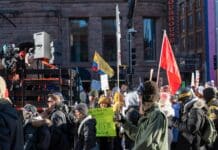




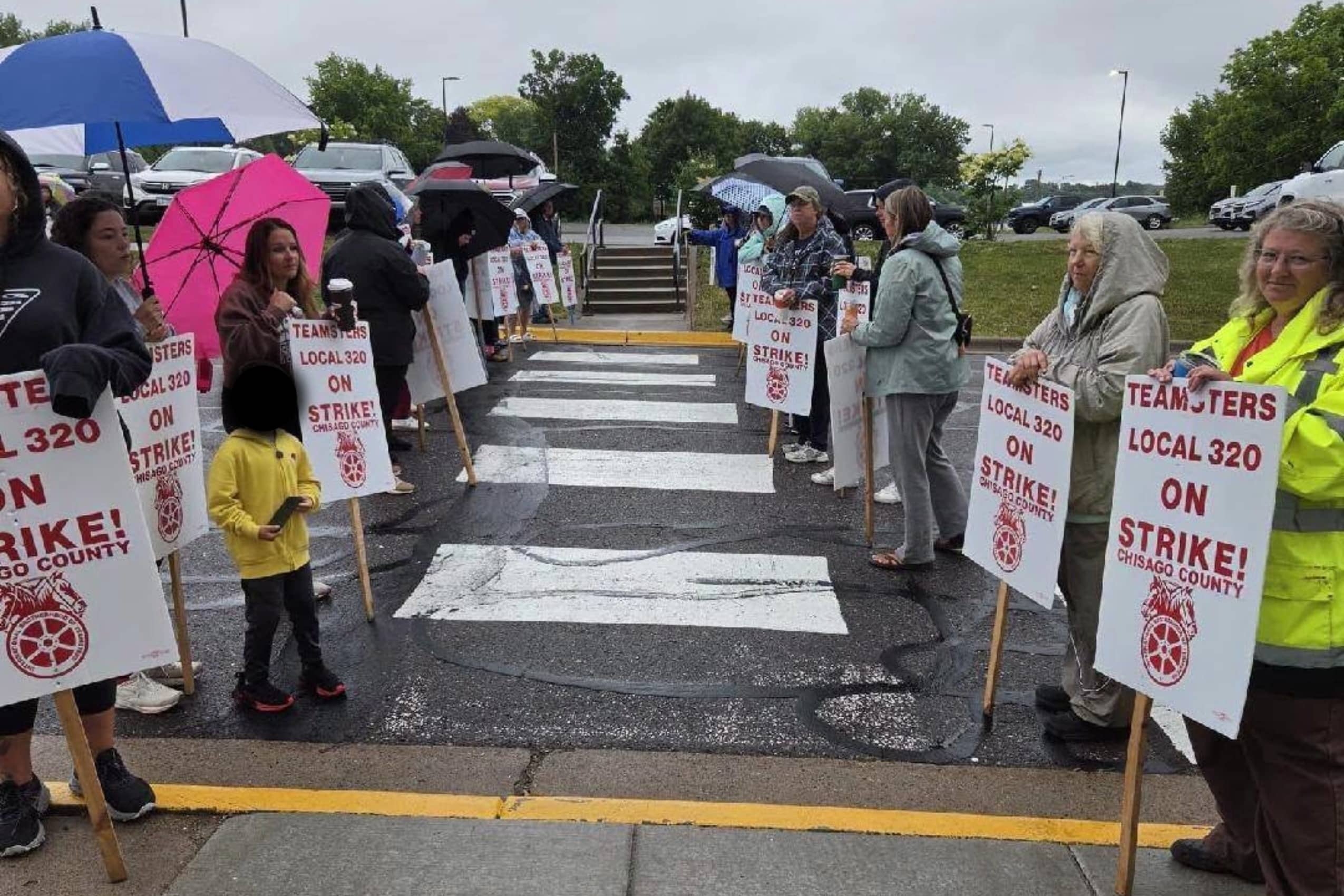
More than two and a half months into one of Minnesota’s longest county strikes, Chisago County officials say essential services for vulnerable residents have continued uninterrupted, even as the labor dispute has grown beyond a fight over wages and health insurance.
Teamsters Local 320 workers walked off the job May 1 after contract negotiations and state-mandated mediation failed to produce a new contract.
County leaders say Chisago County taxpayers are footing the bill for temporary workers and overtime to keep essential services running, and allege that many striking workers are now earning more on the picket line than they would on the job.
The strike involves about 110 of the 170 Chisago County Health and Human Services (HHS) employees represented by Teamsters Local 320. Those employees administer SNAP benefits, investigate child protection cases and provide disability-related services to thousands of county residents.
The issues keeping workers on the picket line
Chisago County Administrator Chase Burnham told Alpha News that the strike remains centered on two issues: wages and health insurance.
Burnham said the county’s latest proposal would increase total compensation by roughly 6.5% in the first year through a 3% across-the-board raise and standard step increases. He contends the county has made a competitive offer but says the union has repeatedly shifted its priorities during negotiations.
“At one point it was wages, then it became working conditions, then it became wages, then it became health insurance. Then it became all of the above,” Burnham said.
On health insurance, Burnham disputes one of the union’s central criticisms of the county’s plan — its $10,000 family deductible.
He said the deductible doesn’t tell the whole story because the county contributes $3,000 annually to employees’ Health Savings Accounts (HSA) and another $3,200 through a Health Reimbursement Account, significantly reducing employees’ actual out-of-pocket costs.
Burnham said the county has repeatedly asked the union to provide comparable wage data to justify its demands but “the county has not been provided any of those things.”
In its most recent public statement, the county said negotiations require compromise from both sides and defended its approach to bargaining.
“Collective bargaining requires compromise. Neither party should expect to receive every proposal it puts forward, and successful negotiations require both sides to make concessions,” the statement said. “Our obligation is to reach an agreement that is fair to employees while also protecting the interests of taxpayers and ensuring County services remain financially sustainable for years to come.”
Burnham defends administrator raises
The union has also criticized salary increases awarded to county administrators while contract negotiations with union employees have stalled.
Burnham said he was not the only county official to receive a market adjustment. Similar adjustments, he said, were also approved for the Chisago County sheriff, county attorney, chief deputy county attorney and the Sheriff’s Office deputy bargaining unit.
According to Burnham, those increases were based on market analyses, recruitment and retention needs, and comparisons with similar positions in other counties — not collective bargaining.
“My 20% is still actually 12% below the market average,” Burnham said.
He said Chisago County’s administrative office also has fewer staff than many comparable counties, requiring him to perform responsibilities that are divided among multiple administrators elsewhere.
Burnham added that, unlike union employees who are negotiating a new labor agreement, his own compensation is governed by an employment contract approved by the county board.
Republican accuses DFL leader of inserting politics into local dispute
The strike has also drawn the attention of Democratic elected officials.
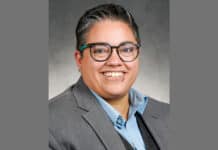
On July 9, House DFL Leader Zack Stephenson sent a letter to the Chisago County Board of Commissioners urging officials to resolve the labor dispute, writing that the county’s continued failure to reach an agreement was “actively harming the community.”
He said workers deserve “fair wages, affordable health care, safety in the workplace, and to be treated with dignity and respect.”
Burnham, however, dismissed the letter as “basically … nothing but Teamsters 320 talking points.”
“There’s no specifics,” Burnham said. “They just say, ‘Give us everything we’re demanding or we’re going to continue to strike.'”
Stephenson’s letter also drew criticism from State Rep. Max Rymer, R–North Branch, whose district includes much of Chisago County.
In a video posted to X, Rymer said he had intentionally stayed out of the labor dispute because he did not believe it was appropriate for state lawmakers to influence local contract negotiations.
Tim Walz makes a new ridiculous headline every week. Keith Ellison jars us with his soft-on-crime and soft-on-fraud attitude. Amy Klobuchar is more of the same.
But for Minnesota to return to sanity, you’re going to have to reject someone else whose name may not be on your… pic.twitter.com/IwOhNfzG0R
— Max Rymer (@maxrrymer) July 12, 2026
“I have made the conscious decision, as your state representative, to not get involved in those conversations, because I don’t want it to look like a state official is putting a thumb on the scale one way or the other,” Rymer said.
Rymer said county employees “should get a fair deal,” while county commissioners “should be watchdogs for the taxpayer to ensure that any deal that we get is not overburdening property taxpayers.”
He argued the negotiations “should remain local” between county officials and employees.
However, Rymer said Stephenson’s letter transformed the dispute into a partisan political issue.
“All of a sudden, this fight becomes a partisan political fight,” Rymer said.
He criticized Stephenson for using “his official letterhead, and his position as House DFL leader” to weigh in on a dispute outside his district, saying local officials — not lawmakers in St. Paul — should resolve the negotiations.
“If you are in Chisago County, I advise you to contact your county commissioner and tell them to stand strong against this type of bullying,” Rymer said. “We can still get a fair deal done … one that doesn’t overburden the property taxpayers in Chisago County, and one that gives our workers a fair deal.”
Stephenson is not the only Democratic official to weigh in. U.S. Rep. Angie Craig, who is running for the U.S. Senate, visited the Chisago County picket line and later wrote on X: “Labor built Minnesota’s middle class and union workers are still the backbone of this state. Proud to join Teamsters Local 320 on the picket line in Chisago County!”
Labor built Minnesota’s middle class and union workers are still the backbone of this state. Proud to join Teamsters Local 320 on the picket line in Chisago County! pic.twitter.com/jLG5t2odpP
— Angie Craig (@AngieCraigMN) May 11, 2026
Union strike pay
According to Burnham, the union has made striking financially rewarding for many workers, with nearly half now earning more on the picket line than they would by returning to work.
“About 45% of the staff are actually receiving more money picketing and fighting for what they think they’re entitled to versus coming to work and serving the public,” Burnham told Alpha News.
The union is providing strike benefits of $1,200 per week, according to a letter posted to Facebook.
“As the strike continues, Teamsters Local 320 has increased strike benefits to $1,200 per week and established a Strike and Defense Fund to assist workers facing upcoming health care costs and other financial hardships caused by the labor dispute,” the May 21 letter stated.
Burnham also pointed to what it describes as increasingly aggressive tactics aimed at employees who continue reporting to work.
In a July 8 Facebook post, Teamsters Local 320 Secretary-Treasurer Erik Skoog warned members who cross the picket line that “SCABS WILL NOT BE TOLERATED IN THIS UNION. For those of you who cross our picket line, you are scheduled to stand trial before Local 320’s Executive Board Tuesday July 14 at 10:00 am,” the post states.
Alpha News reached out to Teamsters Local 320 and House DFL Leader Zack Stephenson for comment but did not receive a response before publication. This story will be updated if either responds.

Jenna Gloeb
Jenna Gloeb is an Edward R. Murrow Award-winning journalist, media producer, public speaker, and screenwriter. Most recently, she worked as a reporter and on-air host for CCX Media. Jenna is a Minnesota native and resides in the Twin Cities with her husband, son, daughter, and two dogs.