

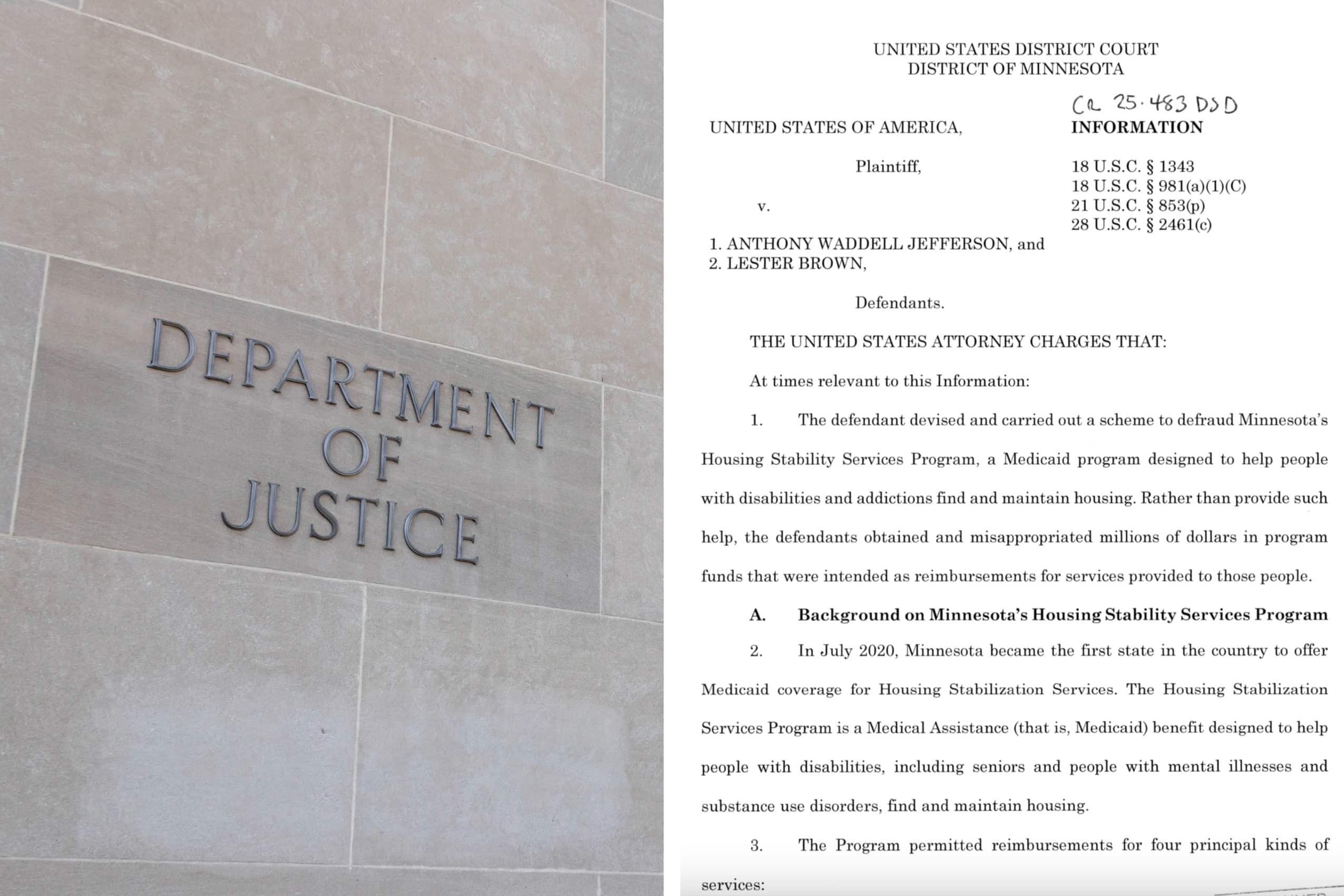
Two men from Pennsylvania charged with defrauding Minnesota’s Housing Stabilization Services (HSS) program have each pleaded guilty to one count of wire fraud. The guilty pleas mark the latest development in Minnesota’s ongoing fraud saga.
For years, Minnesota has seen widespread fraud occur in government programs. Late last year, the U.S. Attorney’s Office in Minnesota estimated that more than $9 billion could have been stolen from 14 state-run, Medicaid-funded programs since 2018.
Perhaps the most infamous among those programs was the Housing Stabilization Services (HSS) program which reimbursed businesses for helping “people with disabilities, including mental illness and substance use disorder, and seniors find and keep housing.”
In 2021, the housing assistance program cost $20 million. By 2024, program costs had ballooned to over $100 million. The program was shuttered last August after the Minnesota Department of Human Services (DHS) determined HSS had been pillaged by fraudsters.
In December, federal prosecutors charged Anthony Jefferson and Lester Brown each with one count of wire fraud in connection with a scheme to defraud the HSS program.
According to the criminal charges, Jefferson and Brown were living in Pennsylvania in 2021 and were told by another person that the HSS program was a good way to make money. In turn, both Jefferson and Brown allegedly registered their own companies in Minnesota.
Jefferson’s company was called Chozen Runner LLC, and Brown’s company was called Retsel Real Estate LLC.
Charges say those companies were then enrolled in the HSS program, and Jefferson and Brown repeatedly traveled from Pennsylvania to Minnesota in order to recruit people to receive HSS benefits via their companies.
The pair reportedly marketed themselves to prospective HSS beneficiaries as “The Housing Guys” and used lists of those names to bill the HSS program for services. Charges say both men “fraudulently submitted bills exceeding the services their companies provided.”
Additionally, Jefferson reportedly directed some of his employees to create “fake client notes purporting to document HSS services provided” by his company. Brown also allegedly made up fake notes to satisfy requests from insurance companies.
Charges say the pair became HSS providers despite “living on the other side of the country and having no network in or connections to Minnesota or its communities. Ultimately, their sole connection to Minnesota was their fraudulent participation in the [HSS] program.”
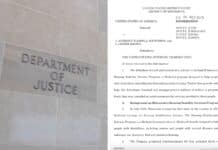
On Tuesday, the U.S. Department of Justice (DOJ) announced that Jefferson and Brown each pleaded guilty to one count of wire fraud.
In a press release, the DOJ referred to Jefferson and Brown as “fraud tourists,” and said the case “represents the first charges involving the use of artificial intelligence to further a fraud scheme targeting health care programs in Minnesota.”
According to federal authorities, Jefferson and Brown defrauded the HSS program of roughly $3.5 million. Both men are facing up to 20 years in prison. Sentencing will occur at a later date.
“Criminal fraud not only robs taxpayers — it shatters trust in our institutions,” U.S. Attorney General Pam Bondi said. “Under President Trump’s leadership, yesterday’s convictions are just the beginning. Our prosecutors will work tirelessly to unravel criminal fraud schemes and charge their perpetrators in Minnesota and across the country.”
Notably, the pleas were announced by the Justice Department in Washington, D.C. rather than the U.S. Attorney’s Office in Minnesota, the office that brought the original charges.
In the time since the original charges were filed, the U.S. Attorney’s Office in Minnesota has seen many federal prosecutors leave the office, and questions remain about its ability to handle outstanding fraud cases.
Luke Sprinkel
Luke Sprinkel previously worked as a Legislative Assistant at the Minnesota House of Representatives. He grew up as a Missionary Kid (MK) living in England, Thailand, Tanzania, and the Middle East. Luke graduated from Regent University in 2018.