




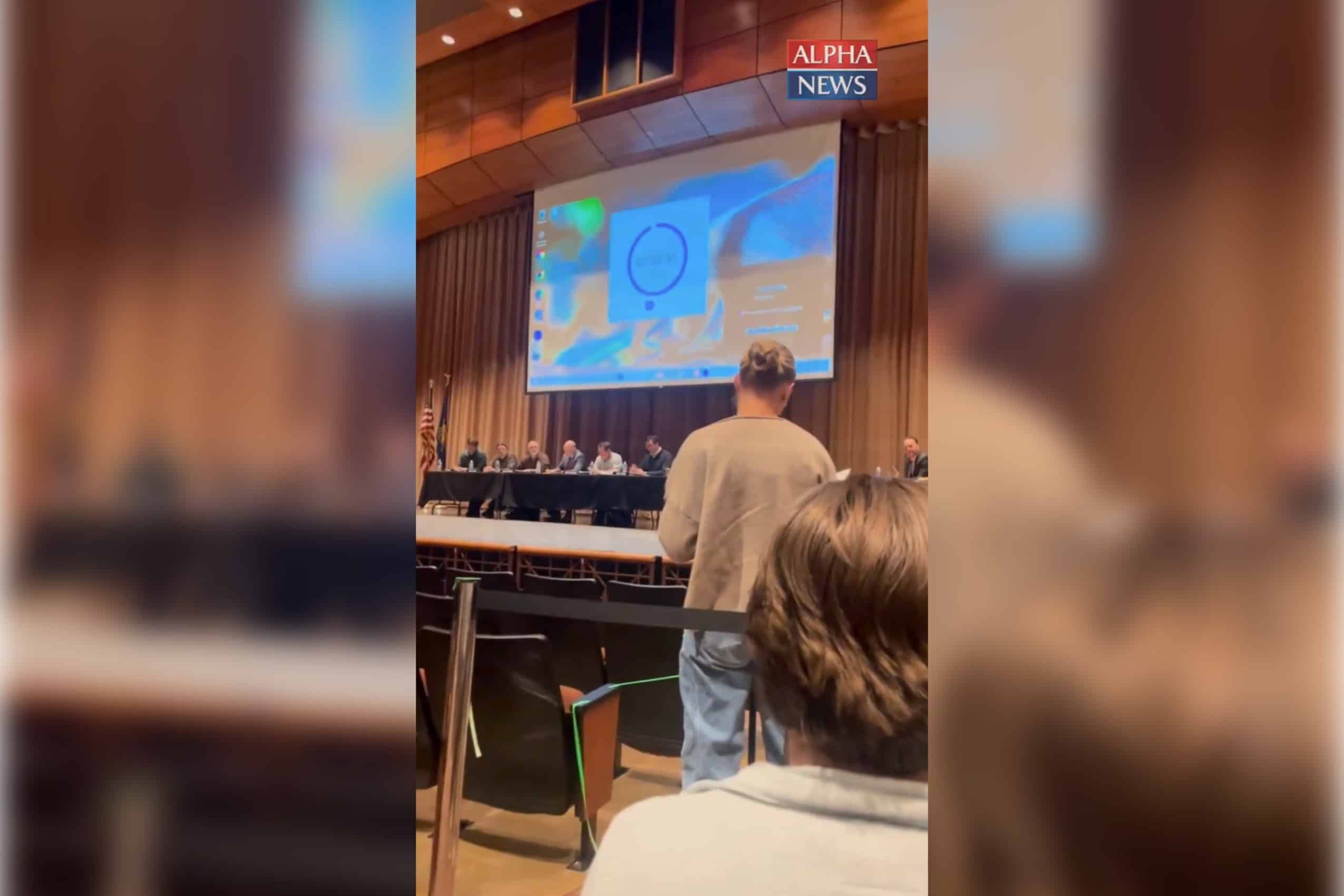
For four hours Tuesday night, parents and students in a fast-growing western Wisconsin community lined up at the microphone — many with shaking hands and cracking voices — to confront the New Richmond School Board over a practice of allowing biological boys to use the girls’ bathroom.
The meeting, which was not livestreamed and was described by attendees as standing-room only, followed the circulation of an email from the New Richmond High School principal outlining the district’s legal stance on accommodations for transgender students.
Nikki Benson is the principal of New Richmond High School in Wisconsin. She apparently allows males to use the girl’s bathroom, making girls feel unsafe. She says if a girl is uncomfortable with a boy in her bathroom, she’s the one who has to use a different bathroom and the boy… pic.twitter.com/zmbGcqGb65
— Libs of TikTok (@libsoftiktok) February 10, 2026
Girls describe anxiety, fear and avoiding bathrooms
A high school student addressed the board directly and said having to share a bathroom with biological boys makes her feel “embarrassed,” “anxious” and afraid.
“I mostly just feel fear. That fear is so strong that most days I don’t use the bathroom at school anymore — I hold it in all day until I get home. I know that’s not healthy, I know it can cause problems like infections and that scares me, too,” she said.
She said the school told her she could request a “single stall bathroom pass,” but she worries that doing so would single her out as someone “causing problems.”
She concluded by asking the district to consider her and other female students’ feelings about privacy and safety.
“Girls should not have to stand in front of the adults and beg to feel safe at school. That should already be guaranteed. Adults are supposed to protect kids, not put us in situations where we feel scared, embarrassed, or ignored. I am asking you, please, listen to the girls in this district. Please protect our privacy, our safety, and our dignity. Because right now, a lot of us feel like we are being forgotten.”
Another New Richmond High School student testifies: "How do we monitor which men get to use the girl’s bathroom and do you have a way to say no the ones that have the wrong motives for wanting to enter my private space?” pic.twitter.com/Jk0B4duWgj
— Jenna Gloeb (@JennaReports) February 11, 2026
Another female high school student spoke about bathrooms being inherently private spaces — especially for teenage girls navigating puberty.
“It’s a very vulnerable space and girls of this age especially have a hard enough time changing in front of their peers or teammates.”
She questioned how the district would prevent abuse of the situation.
“It’s easy to talk about shared vulnerable spaces until an incident occurs. How do we monitor which men get to use the girls’ bathroom and do you have a way to say no the ones that have the wrong motives for wanting to enter my private space?” she said to thunderous applause.
“Once biological men can go into the woman’s areas designated for privacy, that space is no longer a risk-free environment,” said the student.
To that, a woman in the audience shouted, “Lie!”
The student continued, arguing that the burden should not fall on girls who are uncomfortable to use alternative facilities.
“Outside the privacy and potential safety violations, the burden should not be shouldered by the majority,” she said, arguing that it is not “feasible” for all of the girls who are uncomfortable sharing a bathroom with a boy to use a single-stall bathroom in the nurse’s office.
“There’s already barely enough time to use the bathroom in between classes, and it would be even more difficult for the large number of students that are uneasy with these allowances to use the restroom without being tardy or disrupting classes.”
One attendee at the meeting read a letter from Republican Congressman Tom Tiffany, who urged the school district “to reverse this policy.”
“Our daughters should feel safe and treated with dignity here in Wisconsin. We must uphold the original intent of Title IX, which was created to protect equal opportunity for women and girls,” said the letter.
Questions about transparency and legal basis
Alpha News spoke with Matthew Bocklund, former chair of the St. Croix County Republican Party, who attended the meeting.
Bocklund said parents are demanding to know who first authorized the practice of allowing biological males in the girls’ bathroom — and why it was never communicated to parents or formally presented to the board. He added that the district already has gender-neutral stalls and questioned why those could not serve as an accommodation instead.
“There is not a current policy in New Richmond School District. They’re trying to use the Whitaker case in the Seventh District Court,” he alleged, referring to the Whitaker v. Kenosha Unified School District case — a 2017 ruling by the U.S. Court of Appeals for the Seventh Circuit involving a transgender high school student in Wisconsin who challenged her district’s refusal to let her use the boys’ restroom.
The court held that the policy likely violated Title IX and the Equal Protection Clause, and ordered the district to allow the student to use facilities consistent with her gender identity.
Bocklund said he believes New Richmond is being used as a testing ground and warned that if the policy is not challenged, it could spread to neighboring districts.
“If this gets out of New Richmond, this will go to Hudson. It will go to Somerset, and it will cross all of our school districts if we don’t stop it,” he said.
He added that policies in one district often influence others.
“When they come for one, they come for all,” Bocklund said. “If it happens in one community, eventually, it’ll come to all communities. It spreads.”
As the meeting ended, Bocklund said no final policy had been adopted. Instead, he said the issue moves into what is expected to be weeks of legal review, public scrutiny and additional debate.
Alpha News reached out to Superintendent Troy Miller seeking clarification on the district’s current restroom policy, the legal basis for its position, and whether parents were formally notified of any changes. The district did not respond prior to publication.

Jenna Gloeb
Jenna Gloeb is an Edward R. Murrow Award-winning journalist, media producer, public speaker, and screenwriter. Most recently, she worked as a reporter and on-air host for CCX Media. Jenna is a Minnesota native and resides in the Twin Cities with her husband, son, daughter, and two dogs.