




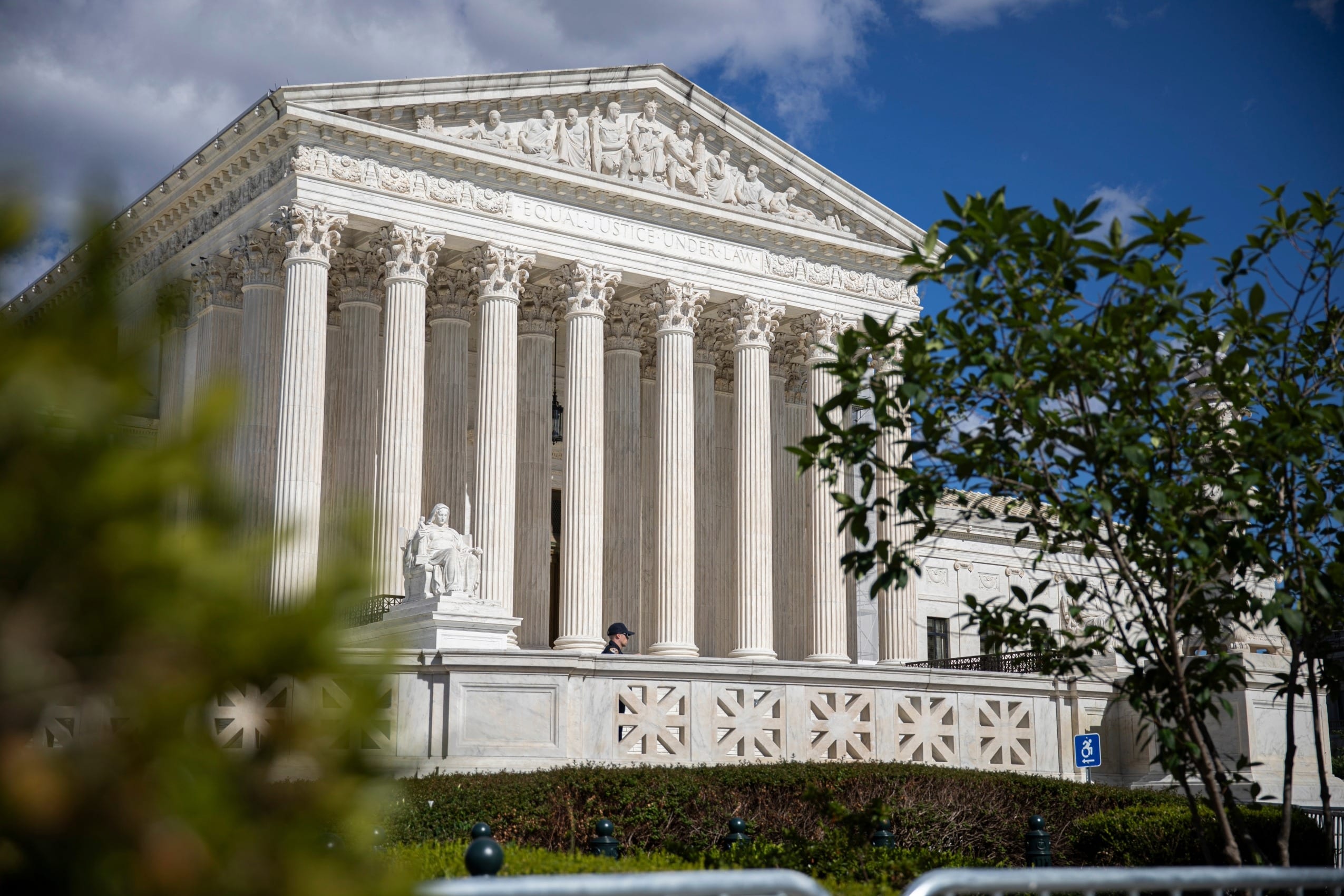
(The Center Square) – The U.S. Supreme Court is set to hear arguments Dec. 2 in two cases over whether semiautomatic weapons bans violate the Second Amendment.
The cases, Khaya v. Cook County and Grant v. Higgins, challenge semiautomatic weapons bans out of Cook County, Ill., and Connecticut. The justices consolidated them into a single argument session. The argument is expected to focus on whether AR-15s and similar weapons are in common use or “unusually dangerous,” as the governments maintain.
The Illinois case was previously named for petitioner and gun owner Cutberto Viramontes, but he asked to be removed from the case and it is now led by a different petitioner.
Gun rights advocates want the court to recognize AR-15s and other semiautomatic weapons as being in common use while Cook County and Connecticut argue the bans should be ruled constitutional because the weapons are dangerous.
John Commerford, executive director of the National Rifle Association’s Institute for Legislative Action, urged the justices to strike down the bans.
“In a perfect scenario it would restore the rights that have been taken away by these bans on the most common firearm in America, America’s rifle, the AR-15,” Commerford told The Center Square in an interview.
Janet Carter, Second Amendment Litigation Manager for Everytown, said arguments based on the common use of semiautomatic weapons would likely not prevail.
“History has allowed governments to regulate especially dangerous weapons even if they are common,” Carter told The States by The Center Square in September. “So I don’t think that that principle that they’re relying on, which is very simplistic and quite strange, is going to carry the day.”
The court’s 2022 decision in New York State Rifle & Pistol Association v. Bruen will be central to the cases. In Bruen, the justices ruled that governments must show a gun restriction is consistent with the nation’s historical tradition of firearms regulation.
Legal analysts such as Commerford point to the Militia Act of 1792, which required white men ages 18 to 45 to enroll in a local militia and supply their own military weapons and gear. Analysts said the law could establish the history and tradition needed to strike down bans on semiautomatic weapons today.
“I would think that one of the best conditions of what the framers thought of military weapons was not even that they abandoned them, they required them,” said Robert Cottrol, a law professor at George Washington University.
Commerford praised the Bruen decision. He said its history and tradition test set the stage for expanding Second Amendment protections.
“Bruen really laid the groundwork for what is this modern-day fight to restore the Second Amendment,” Commerford said.
Commerford drew a distinction between how civilians and the military use semiautomatic weapons. He pointed to civilians’ use of them in home defense, self-defense, hunting and for recreation compared with the military’s use to achieve key objectives.
“There’s a reason that they’re the most popular firearm in America,” Commerford said.
Ahead of the arguments on Dec. 2, legal analysts said they will be watching how narrowly tailored the justices’ questions are. Commerford said the court could keep to a narrow definition, as in similar Second Amendment cases, or issue a more far-reaching decision.
“We hope that they create a ruling that restores Second Amendment rights in many of these states that have trampled on gun rights for too long,” Commerford said.
He said the court’s review is critical after Democrats made gains in state legislatures across the country in the 2026 midterm elections. Commerford said the NRA is closely watching gun legislation in Arizona, Nevada, Pennsylvania, Michigan, Minnesota and Wisconsin, where Democrats will hold the governorship and both legislative chambers.
Commerford said the Supreme Court’s decision is “going to play a critical role in fighting back against unconstitutional legislation in multiple states related to our most recent election results.”
“It will create the road map for protecting magazines as well and again treating the Second Amendment as a core civil right, not a second-class right,” Commerford said.