




(The College Fix) — The University of Minnesota’s taxpayer-funded pregnancy training for state workers was recently updated to include claims that patients get better care from doctors who share their race.
The course, “Dignity in Pregnancy and Childbirth,” teaches employees at Minnesota hospitals that they may have “implicit” or “unconscious bias,” according to a news release from medical advocacy group Do No Harm.
The group’s director of programs, Laura Morgan, told The College Fix the ideologies promoted in this course could negatively impact patients and their providers.
“The course uses inflammatory and racially discriminatory language, and pushes the concept of racial concordance,” she said.
“This theory claims that non-white patients have better outcomes when cared for by non-white healthcare providers; but these claims are provably false,” she said.
Morgan cited a report from earlier this year that claimed there is no evidence to support the idea of racial concordance.
“This results in racially divisive ways of thinking, which the healthcare industry certainly does not need,” she said.
The training targets doctors and nurses, but patients get the same message from the media, which damages the trust that makes medical care effective, Morgan told The Fix.
“Maintaining a perpetual focus on immutable characteristics, instead of seeing patients as unique individuals with unique needs, only serves to erode relationships and jeopardizes the outcomes that DEI ideologies claim to improve,” Morgan said.
Further, these concepts are becoming “embedded in the healthcare industry” as they “are often cultivated in academia.”
As a result, new healthcare providers are entering the professional medical world “armed with the politicized ideologies they were indoctrinated with while in school,” she said.
Morgan also said that, while this trend can be seen “across many healthcare disciplines,” it “is particularly prominent in the specialty of obstetrics.”
The course begins with a slide claiming “unconscious bias” is a major culprit behind racial gaps in health outcomes. Do No Harm, however, claims in its news release that “there is simply no evidence to support this claim.”
The course also states that white doctors and nurses treat white patients better than those of other ethnicities.
“Furthermore, studies show that white doctors, nurses, and other healthcare professionals often display warmer and friendlier verbal and non-verbal behavior toward white patients than toward patients of other races and ethnicities,” the course states.
“This means that your black and other minority or marginalized patients and their families may have had deeply disappointing experiences with healthcare. They may be afraid that provider bias will get in the way of their care,” it states.
The course also offers a scenario in which a white nurse tells a black man pleading for help with a patient to “calm down.” Trainees must check boxes on why she did it.
One “correct” answer states, “White people are prone to seeing even neutral Black faces as angry or hostile.”
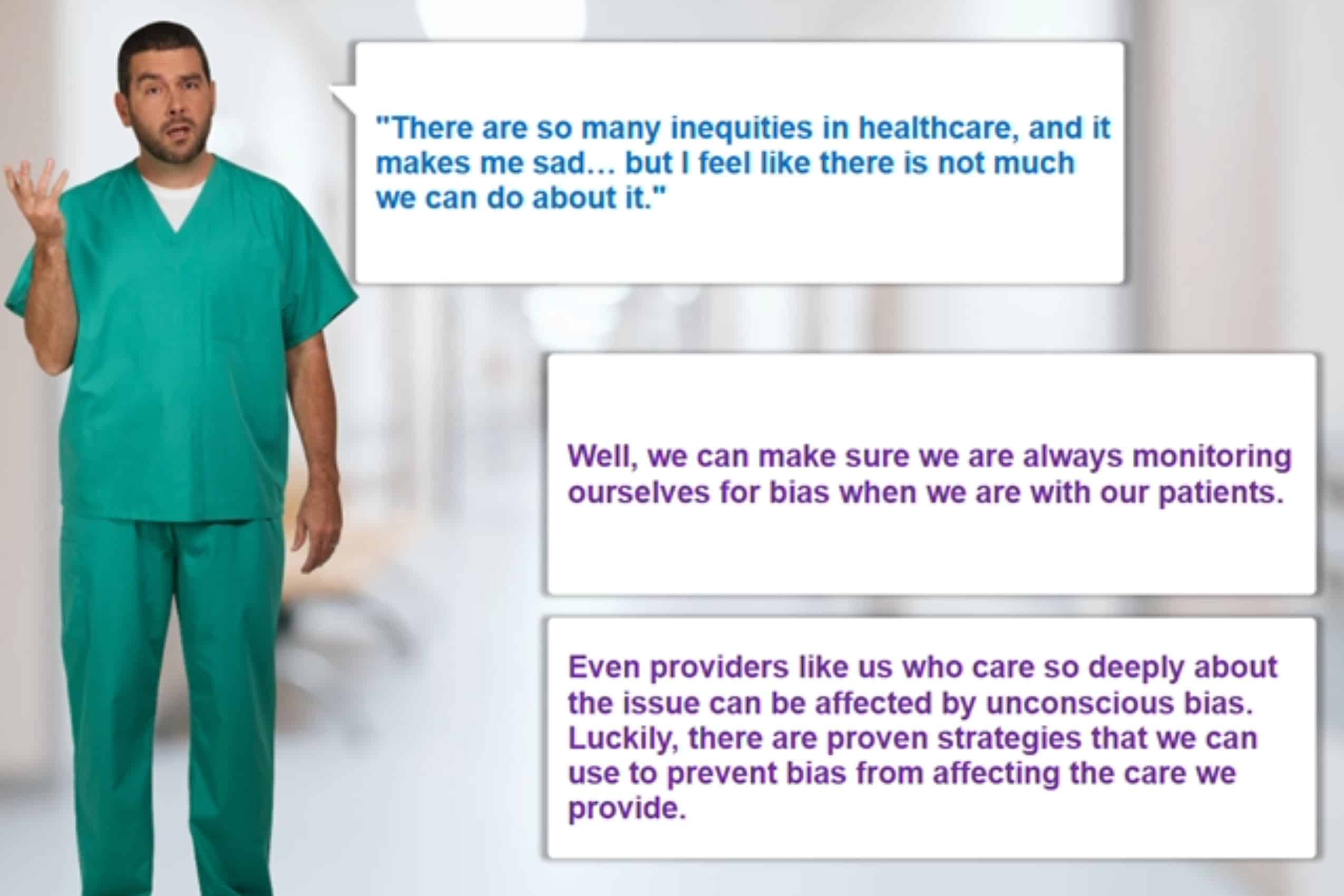
Further, a screenshot of the course included in the news release states there is “unconscious bias” even among those who “care so deeply about the issue.”
However, studies have shown that the Implicit Association Test, which is used to test this bias, has no value.
For example, University of Toronto Mississauga psychology professor Ulrich Schimmack said, “Twenty years of research produced very little evidence that the IAT test predicts any real-world behaviour.” In addition, “some of the articles that claim it does, on close inspection, fail to show that.”
The course was created in response to a Minnesota statute that states, “hospitals with obstetric care and birth centers must develop or access a continuing education curriculum and … a continuing education course on anti-racism training and implicit bias.”
To create the course, the Minnesota Department of Health partnered with the University of Minnesota and the Humanitas Institute.
The College Fix attempted to reach UMinn several times through email and phone over the last two weeks, but has received no reply.
The Humanitas Institute declined to comment when contacted via email by The Fix.
This article was originally published by The College Fix and reprinted here with permission.

Anna Poff | The College Fix
College Fix contributor Anna Poff is a student at Benedictine College. She is studying journalism and mass communication with minors in English and education.