

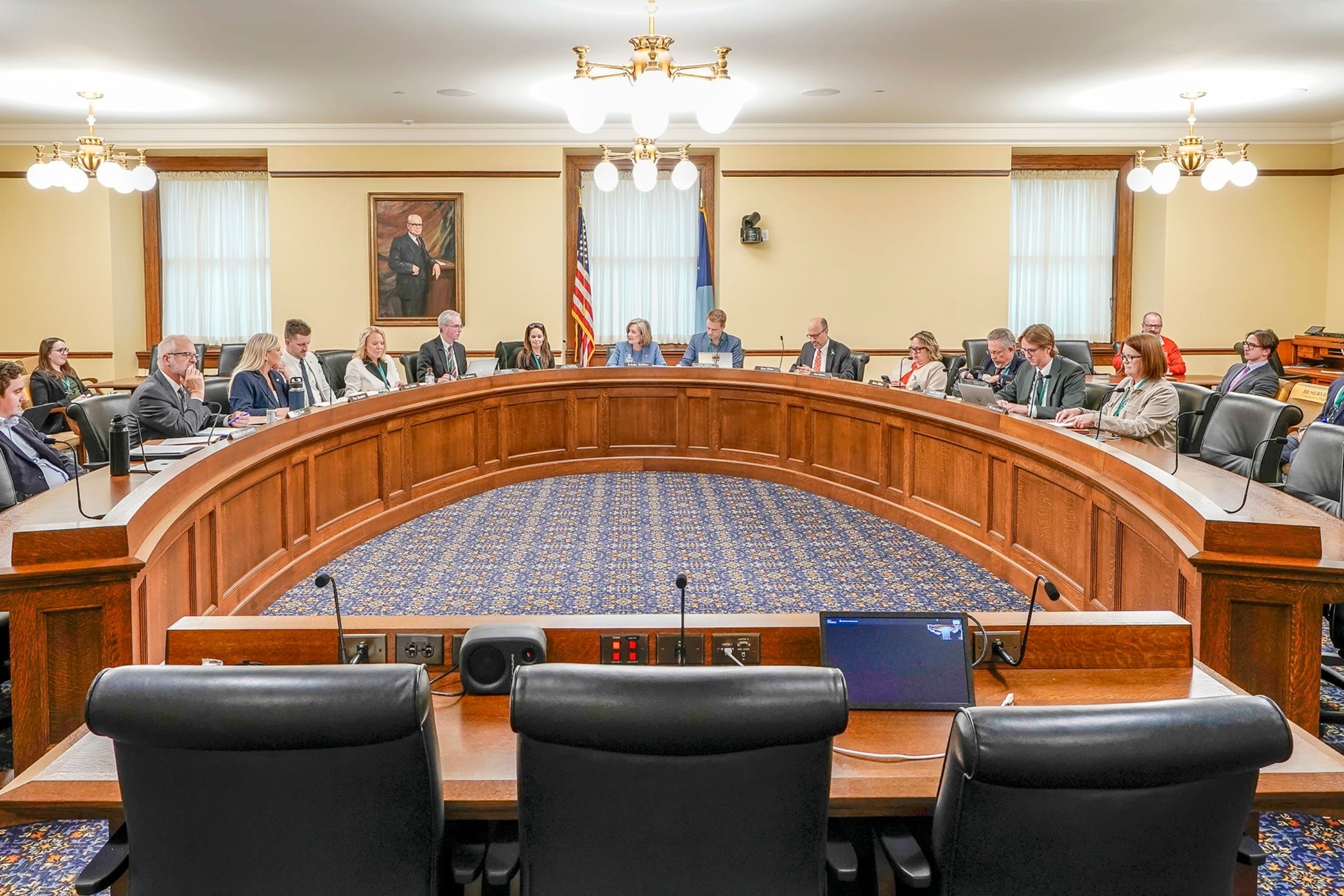
The Fraud Prevention and State Agency Oversight Committee in the Minnesota House of Representatives released its final report after two years of hearings on fraud.
That report, which was authored by the Republican majority on the committee, says the committee concluded that the Walz Administration allowed fraud in state government to “explode to unprecedented levels.”
Beginning in 2025, the committee heard from fraud whistleblowers, state agency leaders, elected officials, and other subject-matter experts about fraud in Minnesota. Many of those hearings shined a light on fraud in state-run, Medicaid-funded programs.
Now, the five Republican members of the committee have authored a final report about what they learned from those hearings.
According to the report, the committee found that the Walz administration “ignored and consciously downplayed shocking levels of fraud across more than a dozen Medicaid waiver programs,” and that the governor “created a culture that enabled fraud.”
Additionally, the report says the Walz administration retaliated against whistleblowers, did not take action to prevent fraud despite sufficient authority, and “allowed the fraud to explode to unprecedented levels.”
“All of these failures have created opportunities for serial fraudsters to steal billions from Minnesota taxpayers across multiple programs for years,” the report says.
The 84-page report also outlines what it calls “The Anatomy of Fraud,” a summary of the typical methods used by fraudsters who have bilked state government.
Further, the report contains detailed findings about the committee’s review of programs targeted by fraudsters such as the Child Care Assistance Program, Housing Stabilization Services, a state autism program, and nonemergency medical transportation.
The GOP report concludes with more than two dozen recommendations which include extending the statute of limitations on fraud, creating an independent office to investigate fraud, mandatory video surveillance of service providers, electronic attendance records for service providers, and others.
Alpha News contacted the Walz administration for this story but did not hear back.
On Wednesday, GOP Rep. Kristin Robbins, the chair of the oversight committee, held what she said could be the committee’s last meeting. In the Minnesota Legislature, committees are dissolved at the end of the biennium and reformed by the newly-elected legislature.
As such, the next legislature may choose not to bring back the oversight committee.
In her remarks, Robbins said the legislature never had an oversight committee prior to the creation of her committee. She said “the work we’ve done has hopefully carved a path for the next legislature to continue this important work.”
Robbins recommended that the next legislature form an oversight committee because it played “a very important role” in examining state agencies and fraud.
DFL Reps. Dave Pinto and Emma Greenman disagreed with Robbins’ comments, with Pinto saying the committee “achieved nothing” and was a forum for “partisan presentation after partisan presentation” while other committees worked on anti-fraud legislation.
GOP Rep. Isaac Schultz rejected Pinto’s comments about partisan presentations, noting that the committee heard from Walz officials in 23 of its 25 meetings.
Additionally, Robbins said the purpose of the committee was to provide oversight, hear from the public, uncover fraud, get testimony from state agencies, and produce a report. She said other committee are responsible for passing anti-fraud bills.
At Wednesday’s hearing, the committee voted to adopt the Republican majority’s report. However, DFLers abstained from the vote. Pinto said the report was filled with “partisan nonsense and speculation, some good information as well, but a lot of errors.”
DFLers also said they were only allowed to see the report 24 hours before Wednesday’s hearing and were not given the opportunity to weigh in on its contents.
Robbins, who worked with the Oversight Committee in the U.S. House of Representatives, said that body always produces a majority report and a minority report on issues reviewed. She said neither side lets the other review report contents prior to publication.
Robbins also said she informed the DFL that the report was forthcoming and invited them to write their own minority report.
Greenman expressed her disdain for the oversight hearings in Congress, calling them “show trials,” and said “modeling anything after Congress is not what Minnesota wants. It doesn’t seem like a good model.”
Responding to Greeman’s comments, Robbins agreed that some of what happens in the federal Oversight Committee “is show trial,” but she said her committee has not conducted itself in the same way.
Robbins concluded by saying she would be happy to hear a minority report on Friday. In the end, the GOP report was approved in a 5-0 vote.
Luke Sprinkel
Luke Sprinkel previously worked as a Legislative Assistant at the Minnesota House of Representatives. He grew up as a Missionary Kid (MK) living in England, Thailand, Tanzania, and the Middle East. Luke graduated from Regent University in 2018.