


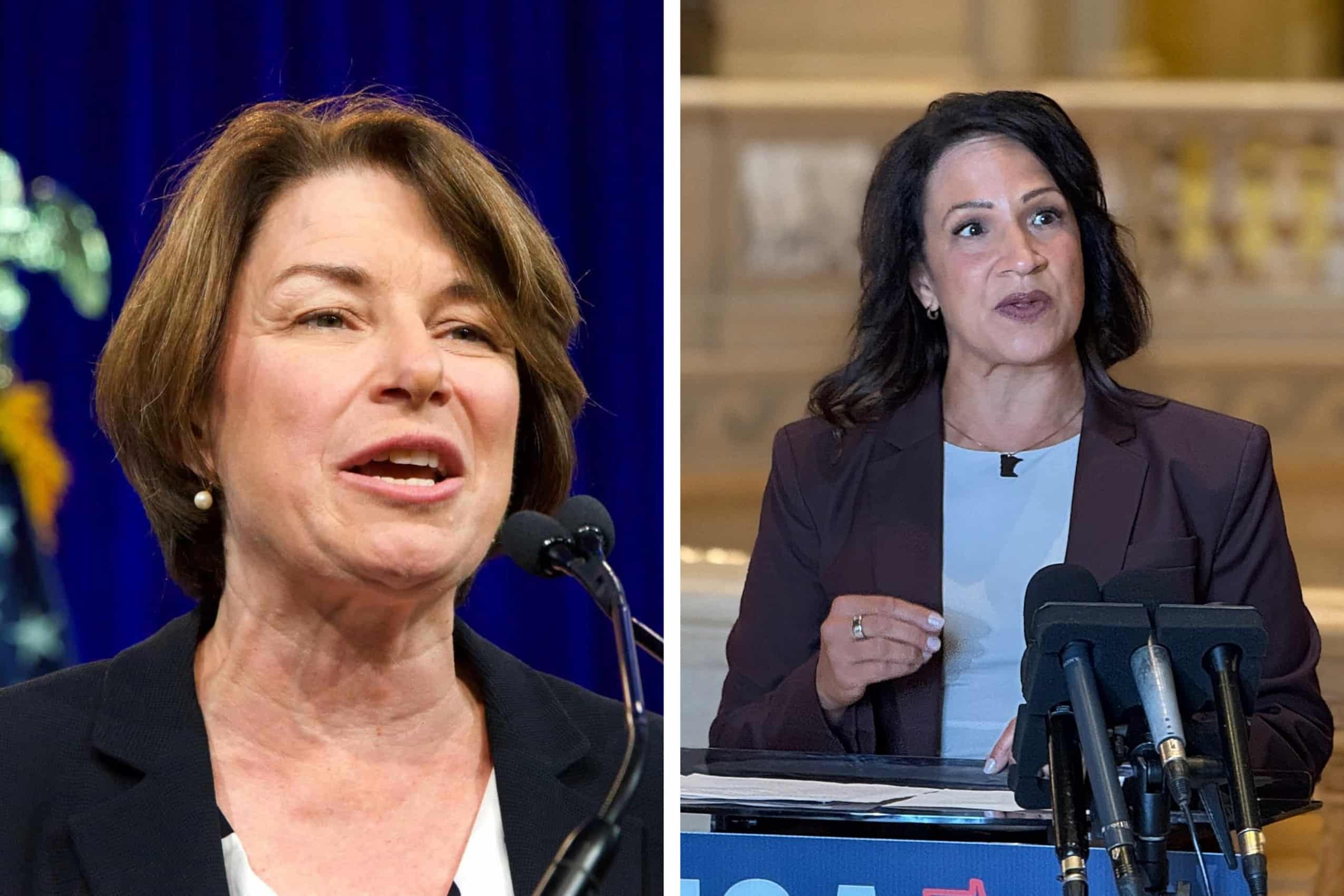
DFL Sen. Amy Klobuchar and Republican House Speaker Lisa Demuth participated in their first gubernatorial debate Monday morning in Brainerd. The event was the first of two gubernatorial debates scheduled for this week.
Hosted by the Minnesota Chamber of Commerce, the debate saw both candidates lay out their respective visions for Minnesota’s economy — and it was not without some fireworks.
A four-term U.S. senator, Klobuchar said she would focus on “growth” as governor.
“My vision for Minnesota is growth,” she said. “I think that is the smartest thing we can do if we’re going to reduce costs, if we’re going to have a government that matches the drive and ambition of the people of this state, your drive and ambition, we must have growth.”
Most notable from Klobuchar’s debate remarks was her repeated embrace of many ideas that are right-leaning and out of step with much of her party. For example, Klobuchar said she would not raise taxes as governor and would instead like to lower taxes.
She also opened the door to adjusting the Paid Leave program, saying it should be “fiscally responsible,” expressed a desire to end the moratorium on new nuclear power plants, and called for an audit of state government, an issue she has campaigned on for months.
Klobuchar also said her first directive as governor would be that “no unfunded mandates” are placed on local governments by state government. The GOP has repeatedly criticized unfunded mandates that were passed by the DFL trifecta in 2023.
Further, Klobuchar was pointedly critical of DFL Gov. Tim Walz and his administration.
During the debate, Klobuchar criticized Walz’s failure to catch the pervasive fraud that has occurred in state welfare programs, saying, “I would have caught that fraud. I would have done something about it. [Gov. Walz and I] have very different backgrounds.”
The DFL senator also said she would bring in new people to staff state agencies, told debate attendees she did not like how the DFL trifecta used the state’s record $17.5 billion state budget surplus in 2023, and called out the governor’s pardon of a child rapist.
“When they had that surplus I would [have] used it to pay for things that aren’t as sexy, like infrastructure, [an update to government IT systems], and do things like that,” she said. “I would have clearly not pardoned a sex offender.”
Klobuchar was also critical of high fuel prices and the Trump administration’s tariffs.
Meanwhile, Demuth laid out her own economic vision for the state and took several jabs at her DFL opponent throughout the debate.
A member of the Minnesota House of Representatives since 2019, Demuth was critical of the way Democrats managed the economy during the last few years and said she wants to lower taxes, reduce state mandates, and address regulatory reform as governor.
“What Minnesota needs now is a fresh start,” Demuth told the crowd of debate attendees. “We need a change of direction because we fully know the path that we are on for business in the State of Minnesota is unsustainable.”
During the debate, Demuth called out the DFL for increasing the state gas tax by indexing it to inflation in 2023. Demuth said she would repeal that policy and said Klobuchar “voted against the Keystone pipeline which would have brought in 800,000 barrels a day.”
That was not the only time Demuth went on offense against Klobuchar.
On fraud, Demuth questioned why Klobuchar did not do more to address fraud when the Feeding Our Future scandal was unfolding. Klobuchar responded, saying she contacted the Justice Department to make sure federal prosecutors had enough resources to tackle the Feeding Our Future scandal.
On healthcare, Demuth criticized Klobuchar for voting for Obamacare, saying healthcare is “harder to find, it is more expensive, and we are on a trajectory that will not work.”
Klobuchar did not respond to that directly but did say healthcare “costs too much and Trump has made it worse.” Klobuchar has pledged to create state healthcare tax credits to lower healthcare premiums if the federal government fails to enact similar credits.
Demuth even made a not-so-veiled reference to allegations Klobuchar threw office supplies in the direction of staffers while frustrated. Referencing this, Demuth said, “You will never see me disrespect my employees” and “I will not be throwing office supplies.”
Klobuchar ignored those comments.
The pair also sparred over insulin. Klobuchar said Demuth voted against capping insulin costs while Demuth said she supported legislation in 2020 which capped insulin costs.
On data centers, Klobuchar and Demuth both supported a new state law requiring data centers to pay their own energy costs. Klobuchar said localities should not be forced to have a data center while Demuth said localities should have “input” on data centers.
The race between Klobuchar and Demuth is coming to an end with Election Day right around the corner. Klobuchar is considered the favorite to win the governor’s office given her high name-ID and the state’s preference for the DFL Party.
According to a KSTP/SurveyUSA poll from earlier this month, Klobuchar is in the lead with 48%, Demuth is at 41%, Green Party candidate Steve Young is at 3%, and 8% are undecided. Minnesota has not elected a Republican governor since 2006.
Klobuchar and Demuth are set to appear at another gubernatorial debate this week. That event will be televised live by FOX 9 at 7 p.m. on Wednesday, Oct. 21.
Election Day is Nov. 3, but early voting is already underway.

Luke Sprinkel
Luke Sprinkel previously worked as a Legislative Assistant at the Minnesota House of Representatives. He grew up as a Missionary Kid (MK) living in England, Thailand, Tanzania, and the Middle East. Luke graduated from Regent University in 2018.