




Minnesota’s crackdown on fraud in human services has frozen new licenses and triggered raids. Now it may be doing something else: sparking demand for licenses the state says can’t be sold.
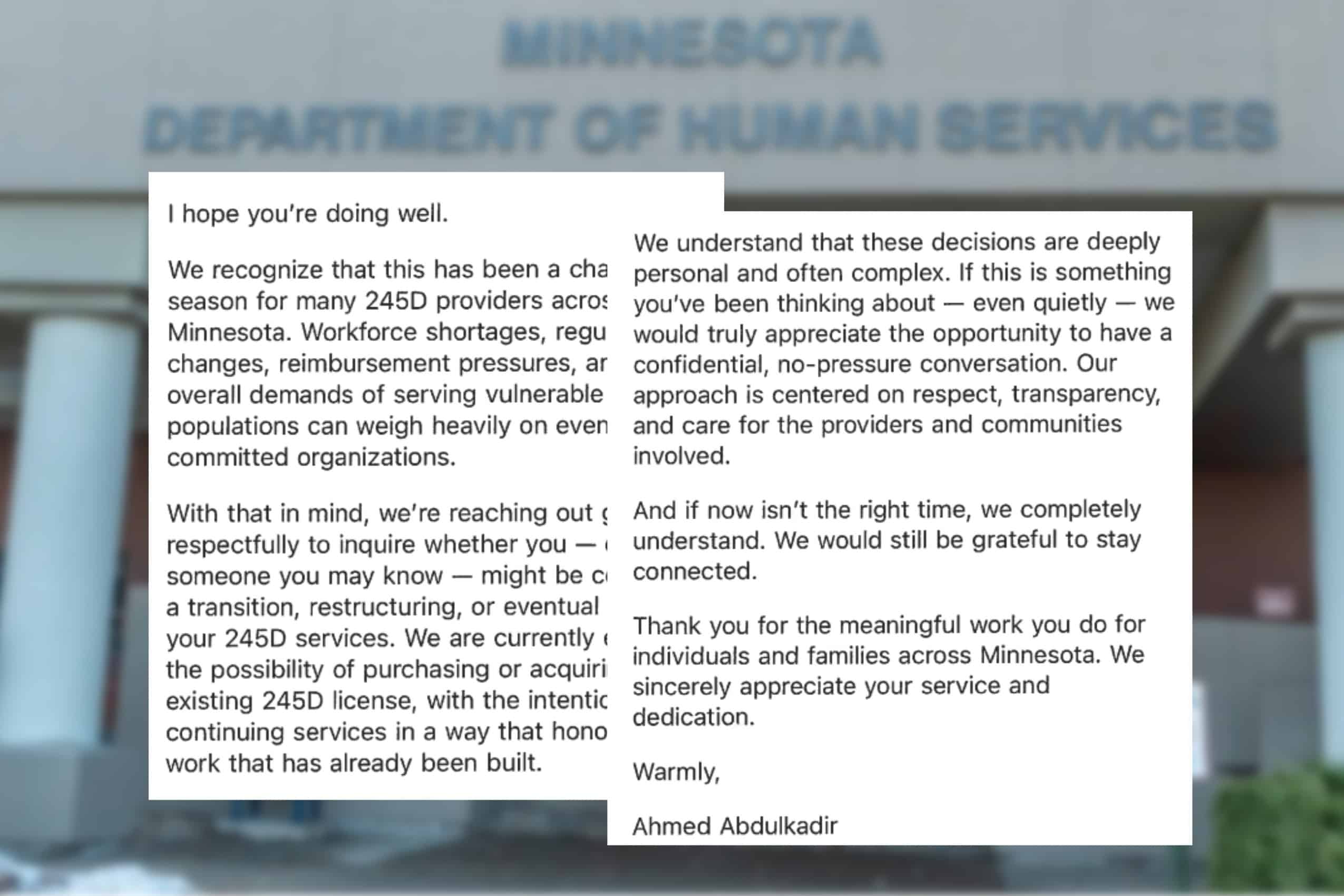
With “245D” services — which provide home and community-based services to vulnerable adults and children — now under a statewide licensing moratorium due to a high risk for fraud in the program, current providers are receiving unsolicited offers to buy their licenses.
One such email was obtained by Alpha News through a source, who said multiple established providers reported receiving similar messages from people seeking to purchase their 245D licenses.
Letter proposes acquiring existing licenses
The email was sent under the subject line “Connecting with MN 245D Providers.”
“We are currently exploring the possibility of purchasing or acquiring an existing 245D license,” the message states.
The outreach asks whether providers — or “someone you may know” — might be “considering a transition, restructuring, or eventual exit,” and invites them to a “confidential, no-pressure conversation.”
It is signed by Ahmed Abdulkadir and includes a phone number.
Alpha News called the number, and a man who identified himself as Ahmed answered.
“No, I don’t recall,” he said when asked if he sent the solicitation email. “I don’t have any businesses at all.”
That denial comes despite the email appearing to being sent from a “Lakeside Home Health” email address. State records show an organization under that name listing Ahmed Abdulkadir as a registered agent.
When pressed about the email, he added: “I don’t want to touch anything 245 or DHS with a 75-foot pole.”
When asked whether he was aware that 245D licenses cannot be transferred under Minnesota law, he hung up.
DHS: licenses not transferable
Alpha News reached out to the Minnesota Department of Human Services (DHS), which confirmed it is aware of such solicitations but does not track them.
“DHS does not maintain specific data points around reports of these solicitations,” a spokesperson said.
The agency emphasized that licenses cannot be transferred under any circumstances.
“DHS-issued licenses are not transferable or assignable,” DHS said, citing state statutes.
At the same time, DHS said “there is not a specific statute or rule that prohibits solicitation of a license.”
Officials added that while business owners may negotiate the sale of a company, they cannot include the transfer of a DHS license as part of that transaction.
“Only DHS has the authority to issue a license, which is assigned to a specific business and its specific controlling individuals,” DHS said.
“Because transfers of this sort are not allowed under statute, DHS cannot and will not approve them, and requests by a license holder to transfer their license in this manner will be denied,” the agency continued. “If we have information that a license holder has sold a license or allowed another individual to assume operations when that individual is not authorized to operate the licensed program, DHS will investigate.”
In those cases, officials said the department can take action against the license holder.
“When situations like this have been brought to our attention, usually by existing license holders that have been solicited, we inform/remind them that such transactions are prohibited under Chapter 245A. When appropriate, we refer these cases to the Program Integrity and Oversight Division,” DHS added.
The agency also said the current moratorium does not change how ownership transitions must be handled under state law.
“The statutory prohibition applies regardless of whether a moratorium is in effect or not,” DHS said.

Jenna Gloeb
Jenna Gloeb is an Edward R. Murrow Award-winning journalist, media producer, public speaker, and screenwriter. Most recently, she worked as a reporter and on-air host for CCX Media. Jenna is a Minnesota native and resides in the Twin Cities with her husband, son, daughter, and two dogs.