




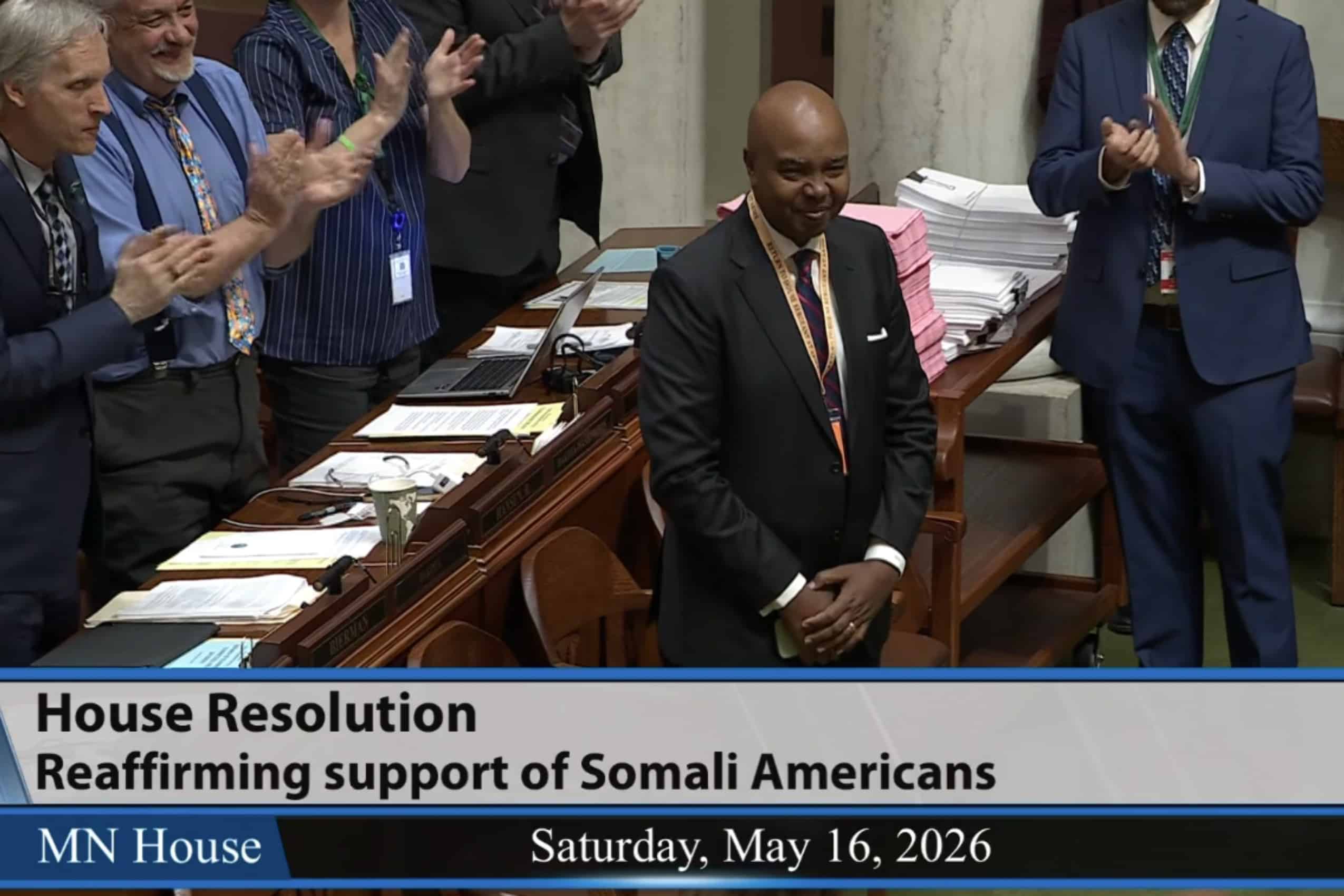
Republican and Democrat lawmakers in the Minnesota House of Representatives took turns reading a resolution on Saturday that affirmed the House’s “strong support for Minnesota’s Somali-American community.”
That reading, which occurred two days before the Minnesota Legislature adjourned for the year, was done in honor of a former Somali official who was visiting the House.
During announcements on the House floor that day, Republican House Speaker Lisa Demuth recognized a DFL state lawmaker who began to read a resolution from the House that reaffirmed “support of Somali-Americans.”
DFL and GOP lawmakers then took turns reading portions of that resolution.
Just two days before the end of session, Republican and Democrat members of the Minnesota House read a resolution that affirmed the House's "strong support for Minnesota's Somali American community."
Among other things, the resolution recognized "their many contributions to the… pic.twitter.com/fr1qXxb532
— Luke Sprinkel (@LukeSprinkel) May 19, 2026
Among other things, the House resolution acknowledged that “Minnesota is home to the largest Somali-American community in the United States with more than 100,000 of [sic] residents” and many Somalis arrived in Minnesota after fleeing civil war.
The resolution continued, saying, “Somali-American Minnesotans are long-term community members” and “Somali-Americans have built dynamic neighborhoods and community organizations that enrich local and state culture.”
Additionally, the resolution affirmed the House’s “strong support for Minnesota’s Somali community” and recognized “their many contributions to the cultural, social, civic, and economic health of [Minnesota].”
Following the reading, DFL House Floor Leader Jamie Long said the resolution “is in honor” of Mohamed Abdirizak, a former foreign minister for the Somali government.
Abdirizak was in the chamber when the resolution was read and Demuth asked the chamber to “please stand and honor our guest” after the reading. Members of the House stood and applauded Abdirizak for a short period.
In a later social media post, Abdirizak expressed appreciation for the resolution and said he “arrived in the United States seeking refuge after the collapse of Somalia.”
“Minnesota has shown that diversity is not a weakness but a strength,” Abdirizak said in his post. “I am deeply grateful to the House members from both parties who stood together in affirming the dignity, inclusion, and belonging of Somali Americans.”
Notably, a majority of the Republican seats on the House floor were empty when the resolution was read.
Alpha News contacted the House Republican Caucus and the House DFL Caucus to ask who organized the resolution. However, neither caucus responded to questions.
In recent months, the Somali community in Minnesota has come under heavy scrutiny as fraud in Minnesota government programs has made international news and become the most widely-discussed political issue in the state.
To date, the U.S. Attorney’s Office in Minnesota has charged and convicted dozens of fraudsters in the infamous $250 million Feeding Our Future scheme.
Further, the U.S. Attorney’s Office previously estimated that 14 state-run, Medicaid-funded welfare programs have been defrauded of $9 billion or more. One of those programs was so thoroughly riddled with fraud that state government shut it down outright.
Last month, the federal government raided nearly two dozen child care centers and businesses as part of another fraud investigation. Sources told Fox News that those locations were “largely Somali linked businesses.”
The overwhelming majority of those charged and convicted by federal authorities in Minnesota’s ongoing fraud saga are from the Somali community. Many of the fraudsters used their ill-gotten gains to purchase overseas property, luxury cars, and other items.
Saturday’s House resolution contained no mention of fraud.
A 2025 report from the Center for Immigration Studies found that 81% of Somali households in Minnesota “consume some form of welfare, compared to 21 percent of native households. Somalis with 10 years of residency have welfare consumption rates that are only marginally lower than the Somali population as a whole.”

Luke Sprinkel
Luke Sprinkel previously worked as a Legislative Assistant at the Minnesota House of Representatives. He grew up as a Missionary Kid (MK) living in England, Thailand, Tanzania, and the Middle East. Luke graduated from Regent University in 2018.