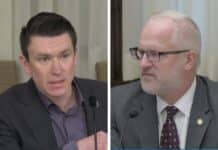


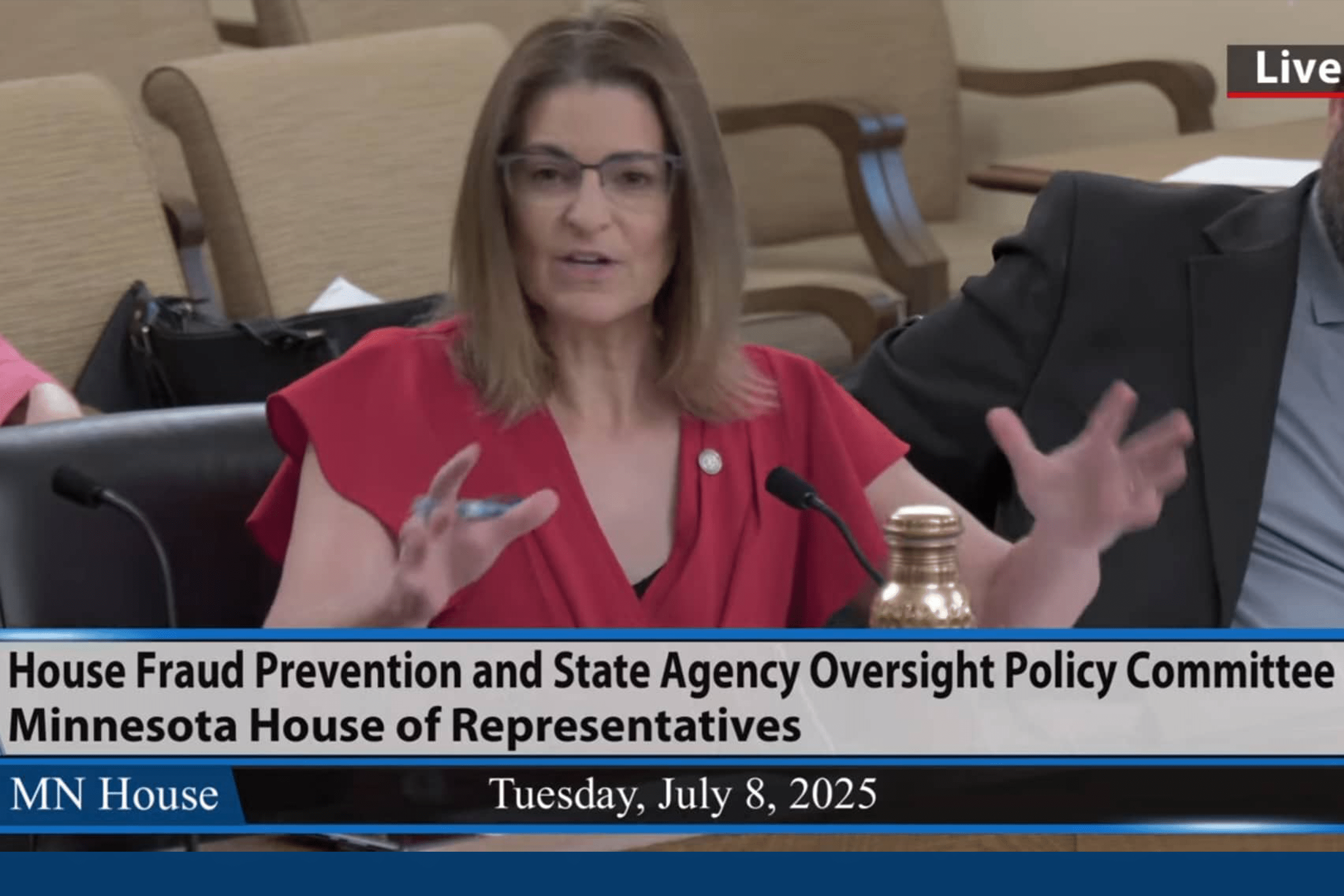
In its first meeting since the end of the Minnesota legislative session, a fraud prevention oversight committee—created by the Minnesota House of Representatives—turned its attention on Tuesday to reforms to catch and prevent Medicaid fraud.
The committee agenda included a presentation for legislators from the Minnesota Department of Human Services about the reform measures the department has taken in recent months to combat fraud within the state agency’s $20 billion Medicaid disbursement program.
Much of the discussion among the bipartisan House Fraud Prevention and State Agency Oversight Committee revolved around questions and comments that Republican members about the volume of whistleblowers who work inside DHS—who have told legislators they fear their concerns about reporting suspected instances of Medicaid fraud will either result in retaliation or lack of action.
“Whistle blowers from DHS have approached us and have alleged that efforts to try to bring impropriety to the attention of the inspector general or the commissioner or the higher ups within DHS has resulted in, to one degree or another, discouragement, even retaliation, is a word that’s been thrown around,” said Rep. Walter Hudson, R-Albertville, in a question he directed to DHS Commissioner Shireen Gandhi.
“And that obviously counters to what you said today in terms of a priority to that you guys place on ensuring these allegations were taken seriously,” Hudson added.
Gandhi, who was appointed by Gov. Tim Walz earlier this year following the February resignation of Jodi Harpstead, assured committee members that no such retaliation is occurring inside DHS.
“Our frontline employees… are our best window into things going wrong,” Gandhi said. “And it is of paramount importance to me that they feel safe in reporting any concerns that they have.”
Gandhi added she understands there “are always concerns of retaliation. That’s just part and parcel of reporting concerns.” She pointed out several avenues for employees to report suspected fraud within DHS and other state agencies, the Office of Legislative Auditor and even legislators themselves.
Legislators: Whistleblowers concerned they are being surveilled
But that wasn’t enough to quell the frustration.
Rep. Marion Rarick, R-Maple Lake, says that she’s heard from whistleblowers inside the agency who allege they are being surveilled when it becomes apparent that they suspect fraud among Medicaid recipients or providers.
“That’s what the whistleblowers are telling me, that they are being surveilled,” Rarick said, directing her comments at Gandhi. “And when they reach out… and say ‘I see something wrong here,’ they are retaliated against.”
Gandhi replied that “DHS does not surveil its employees.”
“Retaliation is not acceptable in any form,” she said. “I will stand by that every single day, and I will be happy to share with you the types of things we are looking for in investigations, when we do look at emails, phone calls, text messages. That’s government data. It is not the personal property of the staff.”
The meeting took place just a few weeks after the Minnesota Department of Human Services announced that a local Medicaid services provider will pay $18.5 million in a settlement after it was found to have submitted fraudulent claims.
Investigating Medicaid fraud
DHS and the U.S. Attorney’s Office in Minnesota worked alongside each other in the investigation that determined NUWAY Alliance submitted false claims to Medicaid for IOP services they had not provided as they involved double-billing the same period of time as distinct billable units, over a period of five years.
The Minnesota Office of Attorney General also worked on the investigation.
“When someone steals from Medicaid, they are both stealing from taxpayers and stealing money meant to pay for poor people’s health care,” Minnesota Attorney General Keith Ellison said, following news of the settlement last month “That’s disgraceful and I will not stand for it,” he added.
Also on Tuesday, members of the committee heard from James Clark, the Department of Human Services’ newly hired inspector general, who manages a staff of more than 300 employees tasked with a number of compliance related work to spot fraud and improper payments. About 30 of those employees actually work on the initial stage of suspected fraud cases. Clark told legislators that as recently as 2022, a report indicated that less than 2 percent of Medicaid spending was found to be improper payments. That’s compared to a national average of slightly more than 5 percent. Clark emphasized that improper payment doesn’t automatically equate to criminal fraud.
“It could mean administrative error, documentation issues,” Clark said. He added that his staff refers about 100 cases per year for criminal fraud investigation to the Office of the Attorney General.

Hank Long
Hank Long is a journalism and communications professional whose writing career includes coverage of the Minnesota legislature, city and county governments and the commercial real estate industry. Hank received his undergraduate degree at the University of Minnesota, where he studied journalism, and his law degree at the University of St. Thomas. The Minnesota native lives in the Twin Cities with his wife and four children. His dream is to be around when the Vikings win the Super Bowl.