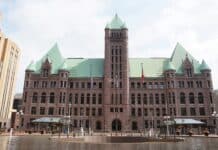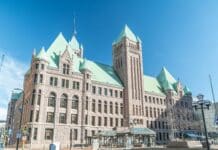




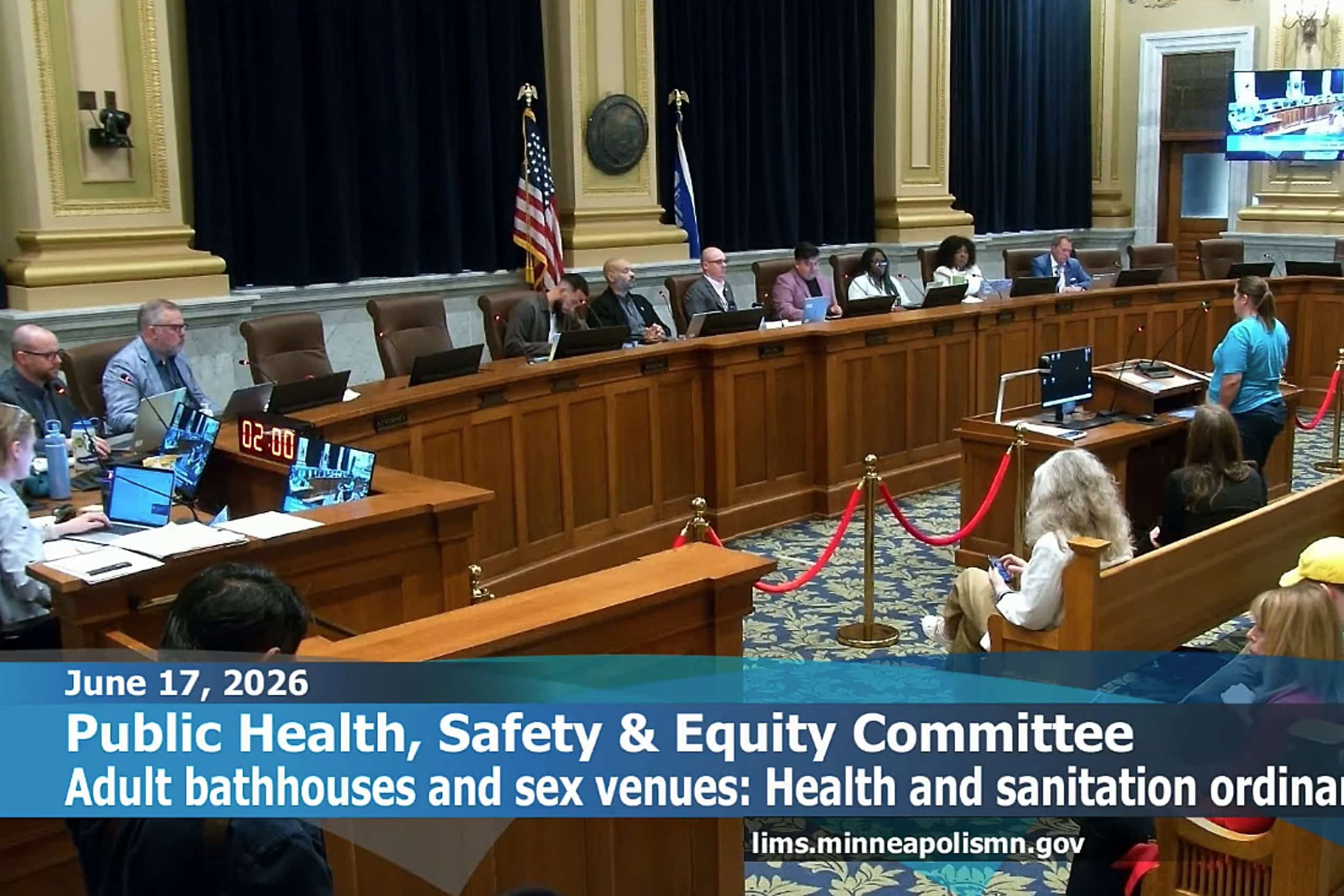
The Minneapolis City Council advanced two ordinances last week that could lead to the legalization of adult bathhouses and sex venues in the city. The full city council will vote on the two ordinances this Thursday.
One of those ordinances amends the city’s health code and the other changes business regulations. The ordinances themselves do not legalize bathhouses outright. Instead, the ordinances rearrange existing city code language to allow for future legalization.
The health ordinance, which would repeal an existing ban on bathhouses, was approved by the council’s public health committee last week in a 6-1 vote. Meanwhile, the business regulations ordinance was advanced without recommendation in a 4-3 vote last week.
Bathhouses are routinely used by LGBT people as locations to meet up for anonymous sex. Bathhouses and sex venues were banned by the Minneapolis City Council in 1988 in an effort to stop the spread of AIDS.
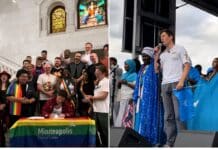
During last week’s discussion of the health code amendments, LGBT activists filled the room and talked about why they believe bathhouses should be legalized. Almost three dozens members of the public spoke.
“This policy change will strengthen our public health system,” one speaker claimed during the meeting. “Public health has evolved dramatically since the original bathhouse bans which were issued in raids, fear, and shame around HIV.”
Many bathhouse proponents claim that the venues are a benefit to public health because it allows underground activity to be regulated. Additionally, proponents claim bathhouses can provide education on safe sex practices.
“In my perspectives as a gay, trans person, bathhouses and commercial sex spaces are so special,” one speaker said. “They’re places that are centered on connection. That’s the point of them. They’re places of deep care between strangers.”
During the committee meeting, Council Member Soren Stevenson said the two pending ordinances “creates a pathway for regulation and legalization of adult bathhouses/sex venues upon development of a business license code.”
However, Stevenson noted that the amendments are “very technical in nature” and will not “open up bathhouses right away.” Instead, he said the ordinances set the city council up for “future work” with various city departments on this topic.
At the committee meeting that discussed the business-related bathhouse ordinance, Council Member Pearll Warren said, “I support my 2SLGBTQIA+ community members, but I … also want to keep them safe. So I cannot support this at this time.”
Warren, along with Council Members Elizabeth Shaffer and Michael Rainville, voted against that ordinance. Rainville also opposed the health-related bathhouse ordinance. At that meeting, Rainville said he “still has a lot of questions” and had not made up his mind.
Both ordinances are authored by Council Members Elliott Payne, Robin Wonsley, Soren Stevenson, Jason Chavez, Aisha Chughtai, and Aurin Chowdhury. The push to legalize adult bathhouses and sex venues in Minneapolis has been in progress for months.
Should the 13-member city council decide to approve both ordinances on Thursday, the legalization of adult bathhouses and sex venues could follow in the coming months.

Rachael Van Rossum
Rachael Van Rossum is a journalist and author who studies political science in the Twin Cities. She previously interned with the Illinois House of Representatives and recently published her debut fantasy novel "The Hellburner of Sovi." Rachael is passionate about telling compelling stories and bringing to life the voices of political figures, athletes, and members of her community through engaging writing. She is the Alpha News journalism fellow for the summer of 2026.

Luke Sprinkel
Luke Sprinkel previously worked as a Legislative Assistant at the Minnesota House of Representatives. He grew up as a Missionary Kid (MK) living in England, Thailand, Tanzania, and the Middle East. Luke graduated from Regent University in 2018.