



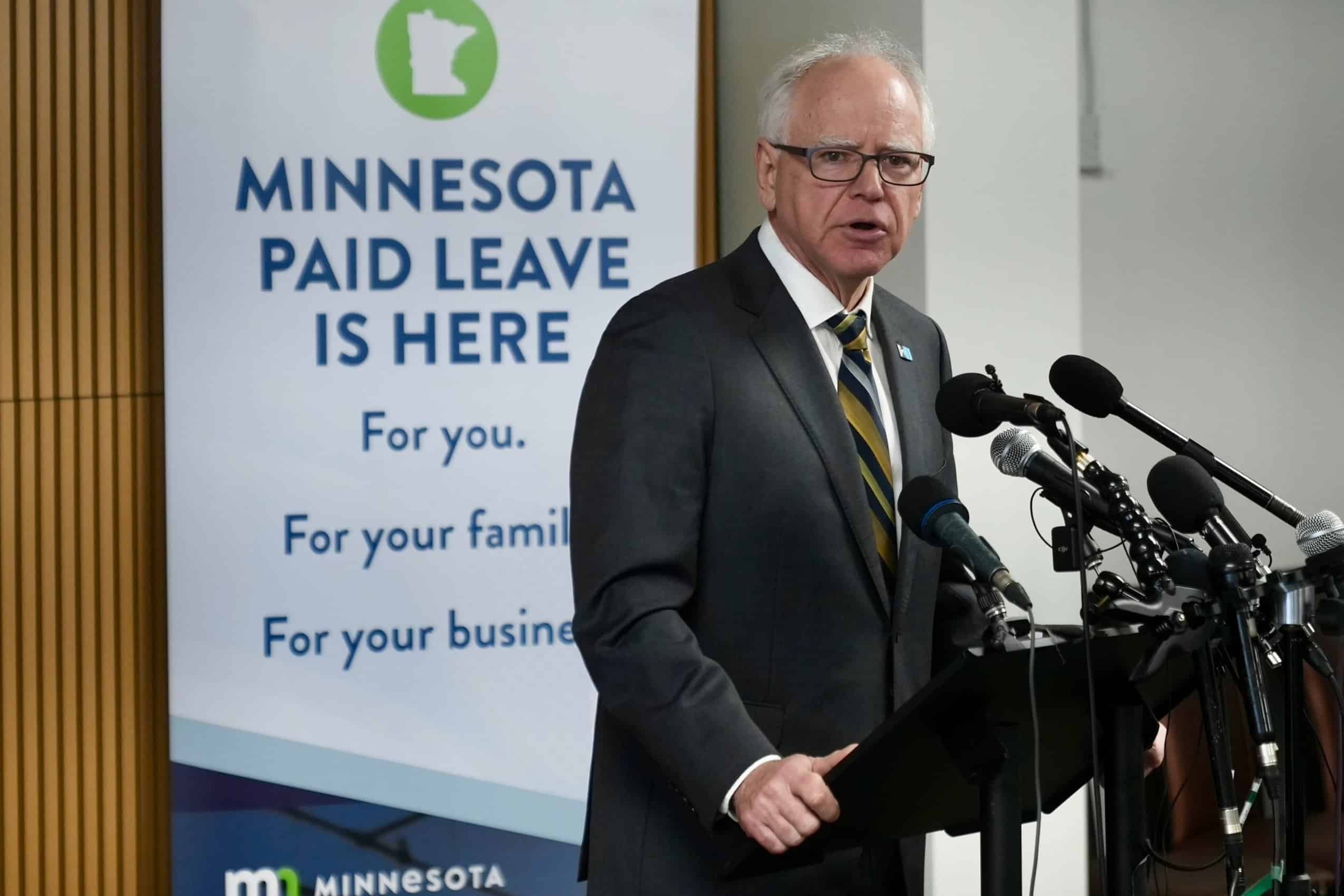
The controversial Minnesota Paid Leave program has already paid out nearly $600 million of benefits in its first six months of operation. Now, the highly-touted welfare program could end up consuming an even greater share of taxpayer dollars.
Minnesota Paid Leave was created in 2023 by DFL Gov. Tim Walz and Democrats in the state legislature. The program allows Minnesota residents to take up to 12 weeks of paid medical leave or 12 weeks of paid family leave in a single year.
If a person wants to take a combination of medical leave and family leave, they can receive paid leave benefits for up to 20 weeks. Paid leave recipients typically receive between 55% and 90% of their regular wages with a maximum weekly amount of $1,423.
The program is funded via a 0.88% payroll tax that is evenly split between employers and employees. If an employer wants to pay the entire 0.88% tax, they can elect do so. Small employers, with 30 or fewer employees, pay a 0.66% payroll tax that is also divided.
Minnesota Paid Leave was passed despite strong objections from the state’s business community which warned that the program would crush small businesses. The program officially became operational in January of this year.
Since Minnesota Paid Leave began operating, the program has been criticized for service delays, and some have expressed concerns that the program could become a new vector for fraud. Further, the state has refused to say whether illegal aliens can receive paid leave.
Earlier this month, the Minnesota Department of Employment and Economic Development (DEED) announced that nearly $600 million of paid leave benefits were issued to 75,000 recipients in the program’s first six months. The average benefit was $1,083 per week.
According to DEED, the Minnesota Legislature established a $688 million trust fund in 2023 to help cover the launch of the program. Additionally, DEED announced it collected $344 million in “premiums” in Q1 of this year and expected to collect a similar amount in Q2.
“Premiums” is how the state refers to the payroll taxes that fund Minnesota Paid Leave.
“This all easily covers the $598 million in benefits that were paid for the first two quarters of 2026,” DEED told Alpha News.
However, the 0.88% payroll tax that funds Minnesota Paid Leave could increase or decrease next year based on the results of a study that will be released by the end of this month.
According to state law, DEED must contract with an independent actuarial consultant every year to conduct an actuarial study of the Minnesota Paid Leave program. In turn, the DEED commissioner must adjust the premium rates for 2027 based on that study.
“We will learn whether changes will be made to Paid Leave premiums for 2027 by the end of this month,” a DEED spokesperson told Alpha News.
In short, this means Minnesotans could see a paid leave tax increase if the program requires more money. According to Minnesota state law, the annual premium rate cannot exceed 1.1%.

Luke Sprinkel
Luke Sprinkel previously worked as a Legislative Assistant at the Minnesota House of Representatives. He grew up as a Missionary Kid (MK) living in England, Thailand, Tanzania, and the Middle East. Luke graduated from Regent University in 2018.