



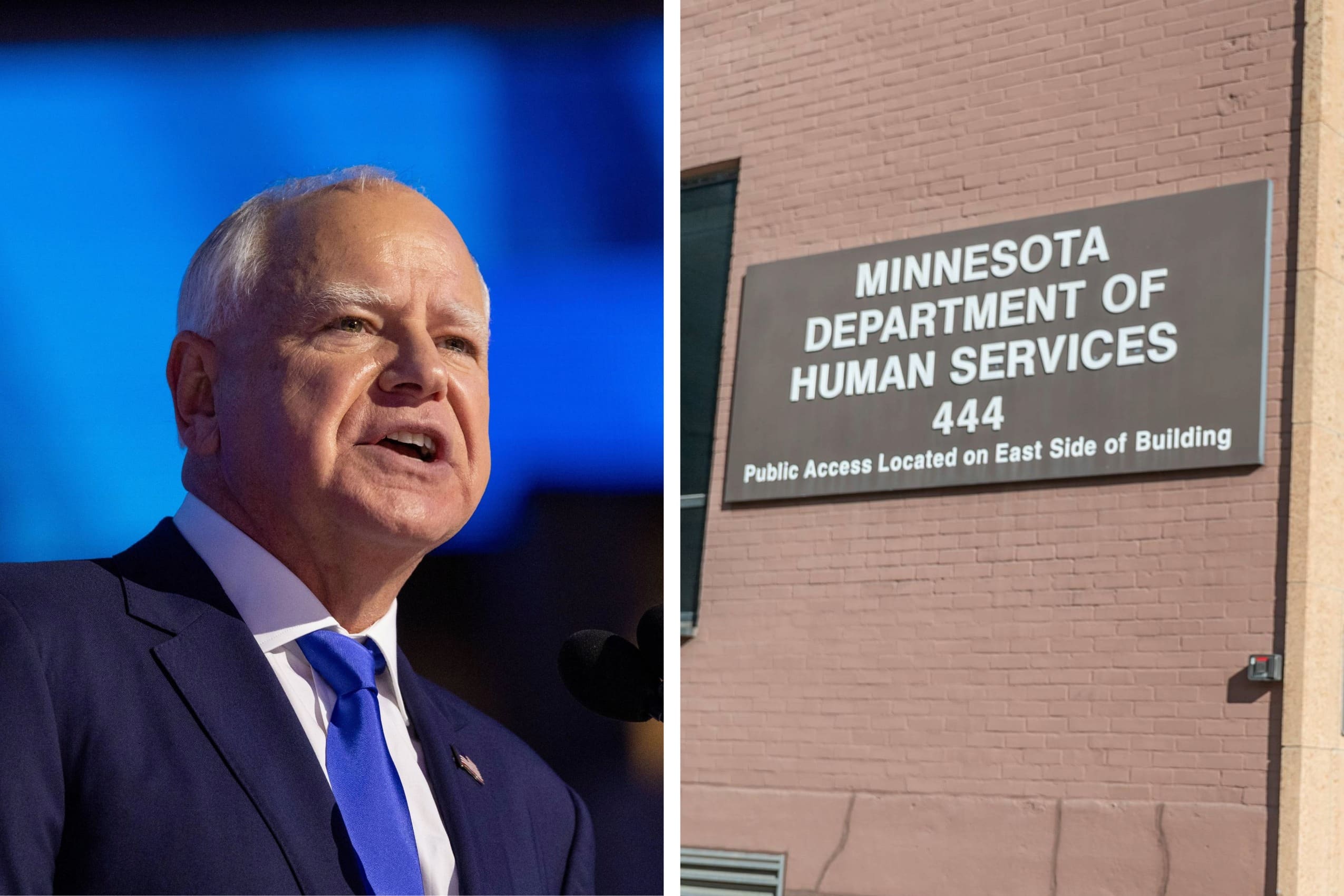
The Minnesota Department of Human Services (DHS) published a so-called “fact check” this week which attempted to “correct misleading information and outright false claims about Medicaid fraud in Minnesota.”
In its fact check, DHS pushed back against claims surrounding Minnesota’s ongoing fraud problems. One of the claims the agency “fact checked” was an unattributed statement which said: “Minnesota’s fraud problem is uniquely bad.”
Shockingly, DHS rejected that claim, placing a red “X” mark next to that statement.
“Fraud is a nationwide challenge and is not unique to Minnesota,” DHS said. “Higher visibility does not equal higher fraud. Targeted misinformation thrust Minnesota in the spotlight, but we are committed to leading the nation in Medicaid program integrity and fighting fraud.”
Attempting to support its argument, DHS referenced fraud scandals that have occurred in other states. Among them was a $490 million healthcare fraud scheme in California, a $2.5 billion Medicaid scheme in Arizona, and an alleged $14.6 billion Medicaid and Medicare fraud scheme that occurred in New York, Illinois, California, and North Carolina.
While those schemes are substantial, all of those states are larger than Minnesota, and some of those states are significantly larger than Minnesota. Yet, Minnesota still rivals, or outpaces, the fraud schemes being perpetrated in those states.
Since 2022, federal authorities in Minnesota have prosecuted fraud in the $250 million Feeding Our Future scheme. Additionally, the Minnesota U.S. Attorney’s Office estimated that fraud in 14 state-run, Medicaid-funded programs could exceed $9 billion since 2018.
Dozens of people, the overwhelming majority of whom are from the Somali community, have been charged and convicted in Minnesota’s ongoing fraud saga. Fraud has turned into the top political issue in Minnesota, and Gov. Tim Walz was all but ushered into an early retirement because of it.
On top of this, federal prosecutors in Minnesota have repeatedly highlighted how Minnesota is an outlier when it comes to this fraud.
In December of 2024, then-U.S. Attorney Andy Luger said Minnesota had a serious fraud problem, and “no other state had a Feeding Our Future, we did. No other state has had some of the kinds of problems we’ve had with government fraud.”
Luger served as Minnesota’s U.S. attorney during the presidencies of Joe Biden and Barack Obama. After President Donald Trump was elected, Luger resigned as U.S. attorney and Joe Thompson was selected to serve as the acting U.S. attorney in Minnesota.
Prior to serving as acting U.S. Attorney, Thompson was the office’s top fraud prosecutor and led the federal government’s many fraud prosecutions in Minnesota. Both in that role and later when he served as first assistant U.S. attorney, Thompson kept the focus on fraud.
In April of 2025, Thompson told Alpha News Minnesota was not previously known for fraud, but “suddenly now, in recent years, we’re known for fraud.”
On other occasions, Thompson has said “fraud is a huge problem in Minnesota,” described the problem as “a far-reaching fraud crisis that’s swamping Minnesota,” and said the level of fraud in state-run, Medicaid-funded programs is “staggering.”
At a December press conference, Thompson said, “Minnesotans and taxpayers deserve to know the truth of the fraud. The fraud is not small. It isn’t isolated. The magnitude cannot be overstated. What we see in Minnesota is not a handful of bad actors committing crimes.
“It’s a staggering, industrial-scale fraud. It’s swamping Minnesota and calling into question everything we know about our state,” he added.
At that event, Thompson was asked how the ballooning costs of those programs compares to other states. He said, “I think we are an outlier in a bad way, yes. Have I gone through [all 50 states]? No, but you don’t see fraud on this scale in other states.”
Additionally, Thompson said the U.S. Attorney’s Office in Minnesota is “a relatively small U.S. Attorney’s Office, and every day we look under a rock and find a new $50 million fraud scheme. That shouldn’t be the case in a state of our size.”
Elaborating, Thompson said, “Certainly other states have problems with fraud, but I think our problem is unique insofar as we’ve just opened the door.”
DHS is the state agency that oversees state-run, Medicaid-funded programs
In its “fact check,” DHS highlighted federal documents showing Minnesota has a lower projected Medicaid improper payment rate (2.2%) than the national average (6.12%). DHS also appeared to suggest that it was limited in what it could do to stop the fraud.
“Fraud is criminal deception,” it wrote. “MN DHS did not authorize fraud; criminals external to the state agency falsified records and exploited vulnerabilities. Allowing a program to operate under federal rules is not approval of fraudulent activity. Oversight limitations are not the same as permission.”
However, DHS is the agency that oversees the 14 state-run, Medicaid-funded programs under scrutiny. Only after fraud became an unavoidable issue that dominated Minnesota’s political landscape did the agency begin to take dramatic steps to stem the fraud.
Among its actions, DHS classified those 14 programs as being at “high-risk” for fraud. The agency also shut down one of those programs, the Housing Stabilization Services (HSS) program, after it determined it had been pillaged by fraudsters.
Additionally, DHS is implementing an automated prepayment review system to screen Medicaid claims submitted to the state’s welfare programs, and re-checking every Medicaid provider in the state to ensure compliance with legal requirements.
While the agency has begun taking those steps in recent months, one former state official has repeatedly said action could have been taken sooner.
For 38 years, Jim Nobles served as Minnesota’s legislative auditor. In that role, he led audits of the state’s government programs. Nobles has repeatedly said Minnesota’s fraud problem could have been avoided if the state had implemented basic financial controls.
Nobles has also said Walz does not have standing to question the $9 billion fraud estimate from the U.S. Attorney’s Office since “it is that office — not any state office — that has brought accountability to those who stole money.”
Walz previously disputed the $9 billion fraud estimate, referring to it as “speculating.” DHS essentially reiterated the governor’s assertion in their “fact check.”
According to DHS, its Wednesday “fact check” was the first in a series of fact checks that will be posted on its website. Shortly after DHS posted its first entry, a social media account that says it represents 480 staff within DHS slammed the webpage.
“This is a shameful website by DHS full of incoherent and inaccurate excuses on why DHS fraud is ‘not so bad,'” wrote the group. “Tim Walz’s website has no accurate data. Just opinions and falsehoods to excuse their incompetence.”
Alpha News reached out to the governor’s office for this story but did not hear back prior to publication.

Luke Sprinkel
Luke Sprinkel previously worked as a Legislative Assistant at the Minnesota House of Representatives. He grew up as a Missionary Kid (MK) living in England, Thailand, Tanzania, and the Middle East. Luke graduated from Regent University in 2018.