




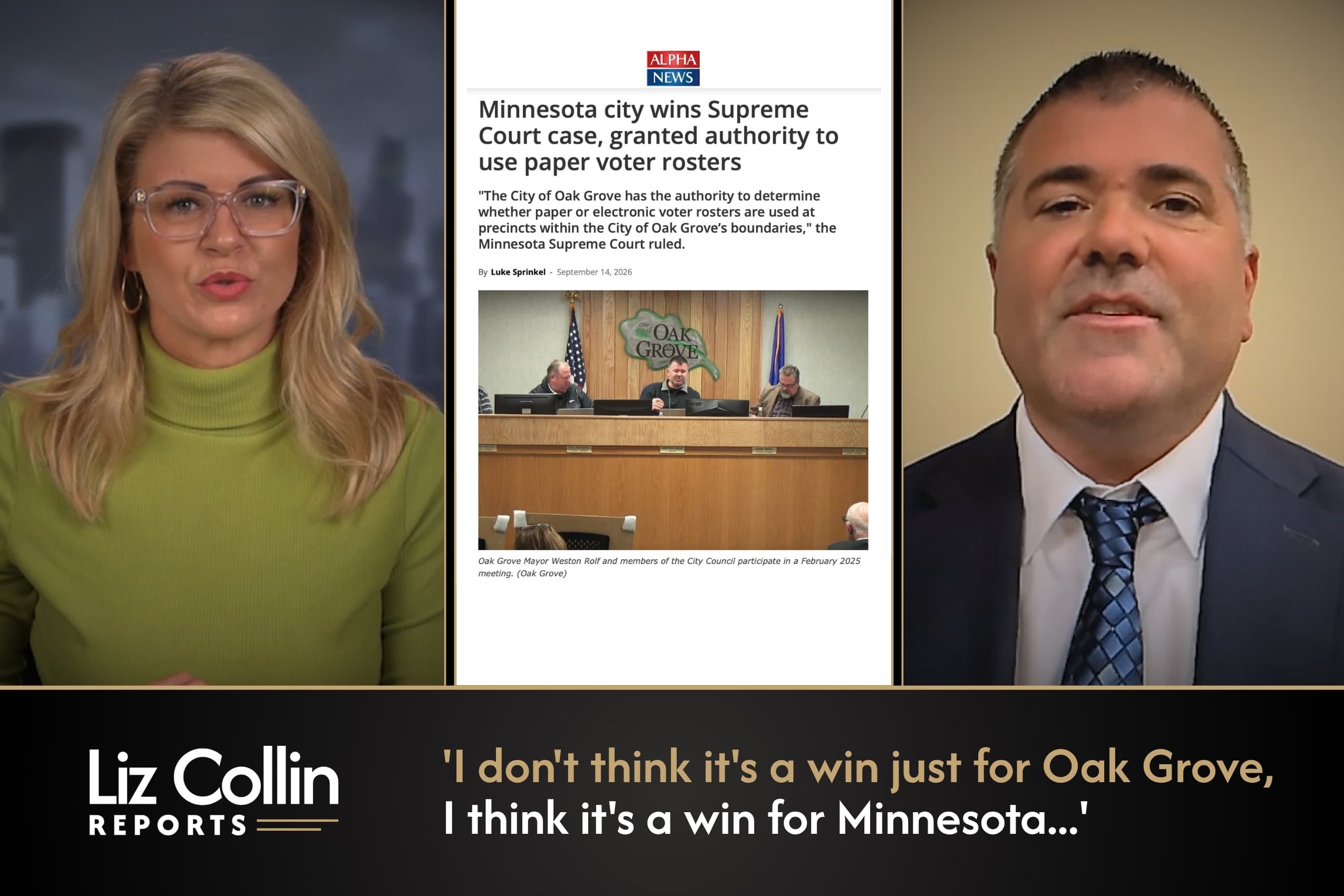
The city of Oak Grove recently scored a rare win for election integrity in Minnesota — one that has other municipalities taking note, if not following the city’s lead for the upcoming election in November.
Weston Rolf, the mayor of Oak Grove, joined Liz Collin on her podcast to discuss the Minnesota Supreme Court’s ruling that the city can use paper voter rosters instead of electronic ones for the upcoming election.
WATCH:
“I’m sure everyone has heard and read over the years of concerns about elections. You know, we’ve heard elections have been stolen, there’s cheating, there’s fraud, there’s all kinds of different things going on. So what we decided in Oak Grove is that we wanted to move towards building trust in the election process,” Mayor Rolf said.
While Oak Grove may be relatively small, the city of around 9,000 people about 30 miles north of Minneapolis has played a big role in the battle for election integrity — and local authority — in Minnesota.
But winning the battle didn’t happen overnight; it stemmed from years of growing concerns about election security. Mayor Rolf explained that, “When it comes to security, we believe that paper rosters are more secure than electronic rosters.”
“We also know that the poll pads, which are the electronic rosters, are third-party vendors. And I have no idea, and nor does most people know, who has access to those records. When do they, when do they not. And so we feel that paper is more transparent,” he said.
As featured in the Alpha News documentary “Minnesota Mao,” the city of Oak Grove informed the Secretary of State’s Office that it wanted to use paper instead of electronic devices back in 2024.
The state said “no,” claiming the city did not have the authority to do so and sparking a “David and Goliath fight.”
“I don’t really know why they were pushing back. I think autonomy might be part of it. You know, we believed that we had the right to make that decision, whether we wanted to use paper poll rosters or electronics,” Mayor Rolf said.
Anoka County even threatened felony charges, but with the help of the Upper Midwest Law Center, Oak Grove took the case to the Minnesota State Supreme Court and won.
The ruling from the Supreme Court was very clear that state law allows paper rosters. Since then, Rolf told Collin how other municipalities have reached out about switching from electronic to paper voter rosters.
“I have been contacted by several elected officials throughout the Metro and even the state. There are a lot that have interest in going back to paper rosters,” Rolf said.
“The vast majority of people that have contacted me, not only from Oak Grove, but all over Minnesota, have congratulated us and, you know, have supported us and continue to hope that we move forward and keep trying to bring transparency and integrity back to the election process. And at the end of the day, I don’t think this is a win just for Oak Grove. I think this is a win for Minnesota,” he explained.
Along with Oak Grove, Isanti County has also made the move.
For those seeking to do the same, Rolf said that voters themselves need to get involved: “They need to contact their mayor, their council member, their board members, county commissioners, and express their concern and their desire to go back to paper.”
He also pointed out how voters and elected officials may face pushback from city and county workers.
“The one thing that I continue to hear from elected officials is that they’re interested in moving forward with this, but they seem to always have a problem with staff. And staff, they like the electronic poll rosters because they find them convenient,” Rolf said.
“I can respect that. But I’m not looking for convenience as mayor of Oak Grove. I’m looking to build trust and integrity in our election process. And if that means we have to do more work in order to do that, I’m fine doing that,” he added.
Alpha News reached out to the office of Minnesota Secretary of State Steve Simon to find out if there were specific deadline requirements to switch to paper voter rosters ahead of the upcoming elections in November.
“No, our office has not indicated a deadline. Neither Minn. Stat. 201.225, nor the court order, specify a deadline for when a municipality may choose to switch from electronic rosters to paper rosters,” a spokesperson said. “Given the short timeline between now and November 3, and the high impact of a change in roster type, our office encouraged counties to connect with municipalities as soon as possible to lessen impact on voters, and outline additional tasks/requirements.”

Liz Collin
Liz Collin is a multi-Emmy-Award-winning investigative reporter, news anchor, and producer who cares about Minnesota. She is the producer of The Fall of Minneapolis and Minnesota v We the People documentary films, and author of the Amazon best-selling book, They’re Lying: The Media, the Left, and The Death of George Floyd. Her work has prompted important state laws. Yet perhaps most of all, Liz has been giving a voice to the truth—and helping others tell their stories—for more than 20 years.

Dr. JC Chaix
Dr. JC Chaix is an editor, educator, and an expert in media studies. He wrote and directed the Alpha News documentary "The Fall of Minneapolis" and "Minnesota v We the People."