



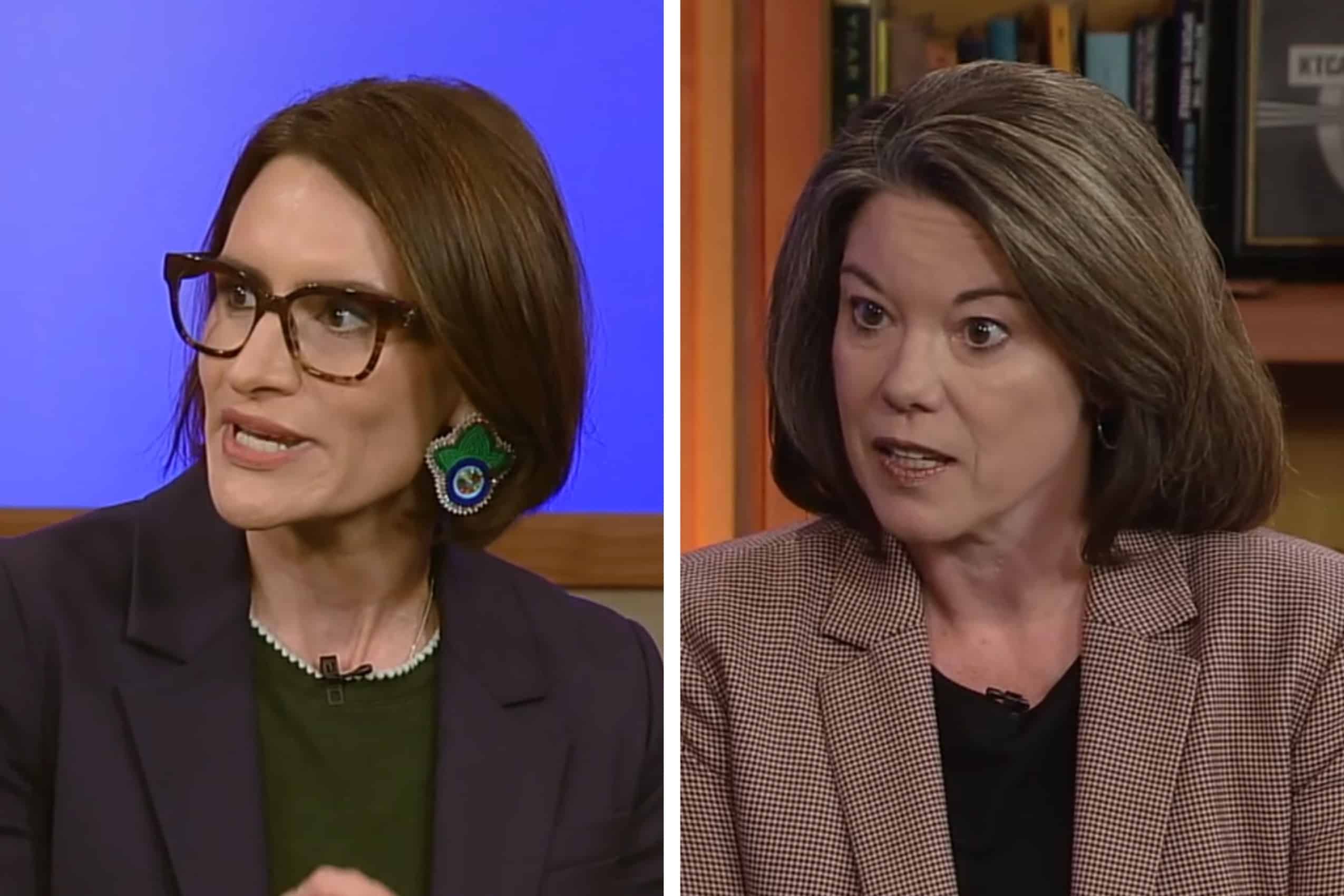
Minnesota Rep. Angie Craig and Lt. Gov. Peggy Flanagan met Friday for their first debate as the two compete for the DFL nomination for U.S. Senate. The debate, which was hosted by TPT Almanac, saw the candidates spar over immigration, AIPAC, and other topics.
Leading up to the debate, immigration and the Laken Riley Act have been at the center of the DFL primary between Flanagan and Craig.
For months, Flanagan has attacked Craig for voting to pass the Laken Riley Act, a law which requires ICE to take custody of illegal aliens charged with certain crimes. The 2025 law was named after Laken Riley, a Georgia college student who was murdered by an illegal alien.
At Friday’s debate, the Laken Riley Act was featured prominently. However, moderator Cathy Wurzer bizarrely refused to refer to the law as the Laken Riley Act. Instead, Wurzer said “I’m going to call it the Trump immigration bill just for purposes here.”
Flanagan would later use the law’s actual title but said Wurzer’s decision to refer to the law as “Trump’s immigration bill” was “appropriate.”
Craig, who has said she regrets her vote for the Laken Riley Act, said she came to regret her vote after watching the events of Operation Metro Surge, the federal government’s recent immigration enforcement efforts in Minnesota.
“As I stood and watched what happened in Minnesota with Operation Metro surge — the killing of Renee Good, the killing of Alex Pretti, as I stood at the Whipple center, I couldn’t help but regret giving this administration any additional authority under immigration,” Craig told the moderators.
Craig said other Democrats such as Sens. Raphael Warnock, Jon Ossoff, and Mark Kelly voted for the Laken Riley Act. However, Flanagan attacked Craig for her decision to vote for the Laken Riley Act, noting that Craig was the only Minnesota Democrat to support the law.
“Amy Klobuchar, Sen. Tina Smith, Kelly Morrison, Betty McCollum, Ilhan Omar — they all knew what was coming and they had the judgement to vote no,” Flanagan said.
Trying to counter Flanagan’s attack, Craig said she voted against ICE funding, supported efforts to impeach former Homeland Security Secretary Kristi Noem, and accused Flanagan of soliciting campaign funds from a contractor that builds ICE detention centers.
Craig said Flanagan solicited those donations while Flanagan was the chair of the Democratic Lieutenant Governor’s Association (DLGA).
Flanagan said that accusation was “absolutely not true” and told the moderators that she told the DLGA to “return [that money].” Craig said Flanagan did not tell the DLGA to return the money until after Flanagan launched her campaign for U.S. Senate.
Eventually, the debate turned to fraud in state welfare programs. Flanagan said she is angry about the fraud but did not provide an answer when pressed on whether she ever had cabinet-level discussions about suspicions of fraud in state government programs.
Instead, Flanagan touted recent anti-fraud action taken by Minnesota state leaders such as the creation of the Office of the Inspector General (OIG).
Meanwhile, Craig touted anti-fraud bills she introduced in Congress and said “any amount of fraud in Minnesota is too much.” Craig said it is “stunning to me that [Flanagan] continues to shift every bit of the blame to the governor for the fraud that has occurred in Minnesota.”
Craig continued, saying Republicans want to run against Flanagan in the November general election rather than herself because they believe Flanagan is weak on the fraud issue.
Responding, Flanagan appeared to imply that Craig’s argument was hypocritical, saying Craig recently referred to fraud-related attacks as “Republican political theater.”
“What’s so interesting about that is the fact that, again, Congresswoman Craig is using Republican talking points which I think is probably where she is most comfortable as the Minnesota Democrat who votes more with Donald Trump than anyone else,” Flanagan said.
Later on, Craig said Democrats can’t “stop Donald Trump and Republicans unless we win elections. The lieutenant governor has never faced a competitive race on the ballot by herself — not in her entire political career.”
Craig then predicted that Republican U.S. Senate candidate Michele Tafoya will be the GOP nominee in the general election. Tafoya, a former sportscaster, has significant name ID and a substantial campaign war chest.
The congresswoman said “[Tafoya is] one of the best candidates [Republicans] have fielded in 20 years” and “fraud is the number one issue.”
Craig went on to question whether Democrats want someone “who has served as the No. 2 in the state government, who takes no responsibility or accountability for anything that was happening under her watch” as their nominee in November.
Additionally, the two U.S. Senate candidates discussed Israel and the American Israel Public Affairs Committee (AIPAC), a powerful, pro-Israel lobbying group.
Both candidates were critical of Israeli Prime Minister Benjamin Netanyahu, with Craig saying “the best thing that can happen for Middle East peace is Benjamin Netanyahu loses his election in October.”
Flanagan expressed support for a two-state solution and said, “I believe that what’s happened to the people of Gaza is horrific, the people of Israel, the children of Israel deserve to live in peace, Palestinians deserve the right to self-determination.”
Craig expressed a similar sentiment, saying “at the end of the day, we want Israelis and we want the Palestinians, whether it’s in Gaza, whether it’s in the West Bank, to be able to live in peace with security and not terrorism around them.”
However, the agreement appeared to end when AIPAC was brought up.
Flanagan said she does not take AIPAC money because her values do not align with the group. She said AIPAC has “moved even further towards being primarily responsible for moving Benjamin Netanyahu’s agenda.”
The lieutenant governor also referenced a MinnPost article which said Craig has taken $1 million from AIPAC. Craig said the numbers used by Flanagan “are absolutely ridiculous” and “AIPAC has not contributed at all to my Senate campaign. Not one penny.”
Flanagan pushed back, saying AIPAC has held “over a dozen fundraisers for [Craig] including one at the home of the head of AIPAC in this election specifically for the Senate because they understand who their candidate is in this race.”
Craig said “that is completely untrue,” but noted that “of course, individuals who support AIPAC, pro-Israel Democrats, have also supported me. I’m sure pro-Israel Democrats have also supported the lieutenant governor over the years.”
Flanagan and Craig are the two leading candidates for the DFL nomination for U.S. Senate in Minnesota.
Last month, Flanagan won the DFL endorsement for the office at the party’s convention in Rochester. Craig did not compete for the endorsement. Instead, Craig opted to run in the August primary election with her substantial campaign war chest.
The DFL primary election for U.S. Senate will take place on August 11th.

Luke Sprinkel
Luke Sprinkel previously worked as a Legislative Assistant at the Minnesota House of Representatives. He grew up as a Missionary Kid (MK) living in England, Thailand, Tanzania, and the Middle East. Luke graduated from Regent University in 2018.