



Far-left Minneapolis City Council members voted against submitting a grant application to the federal government for updated ballistic imaging technology. Their reason? They were uncomfortable with the federal government’s invitation to apply for the grant.
Since 2002, the Minneapolis Police Department (MPD) has been a part of the National Integrated Ballistic Information Network (NIBIN), a federal database of ballistics evidence and images that is used to solve crimes across the country.
MPD was among a list of law enforcement agencies that were recently invited by the federal government to apply for grants that would fund updated NIBIN technology. MPD stands to gain $300,000 from the grant, and MPD has said the grants are non-competitive.
In a presentation about the grant, MPD said Minneapolis’ current NIBIN technology was installed in 2014 and “many existing NIBIN systems are reaching the end of their service life” and “without modernization, agencies risk downtime or degraded performance.”
According to the federal government’s invitation to apply for the $300,000 grant, the NIBIN grants are funded by the One Big Beautiful Bill Act with a purpose of enhancing immigration enforcement and investigating “crimes committed by illegal aliens.”
On Thursday, the 13-member city council considered whether to give MPD authorization to submit the grant application to the federal government. However, far-left council members were opposed to the language used in the grant invitation and the purpose behind it.
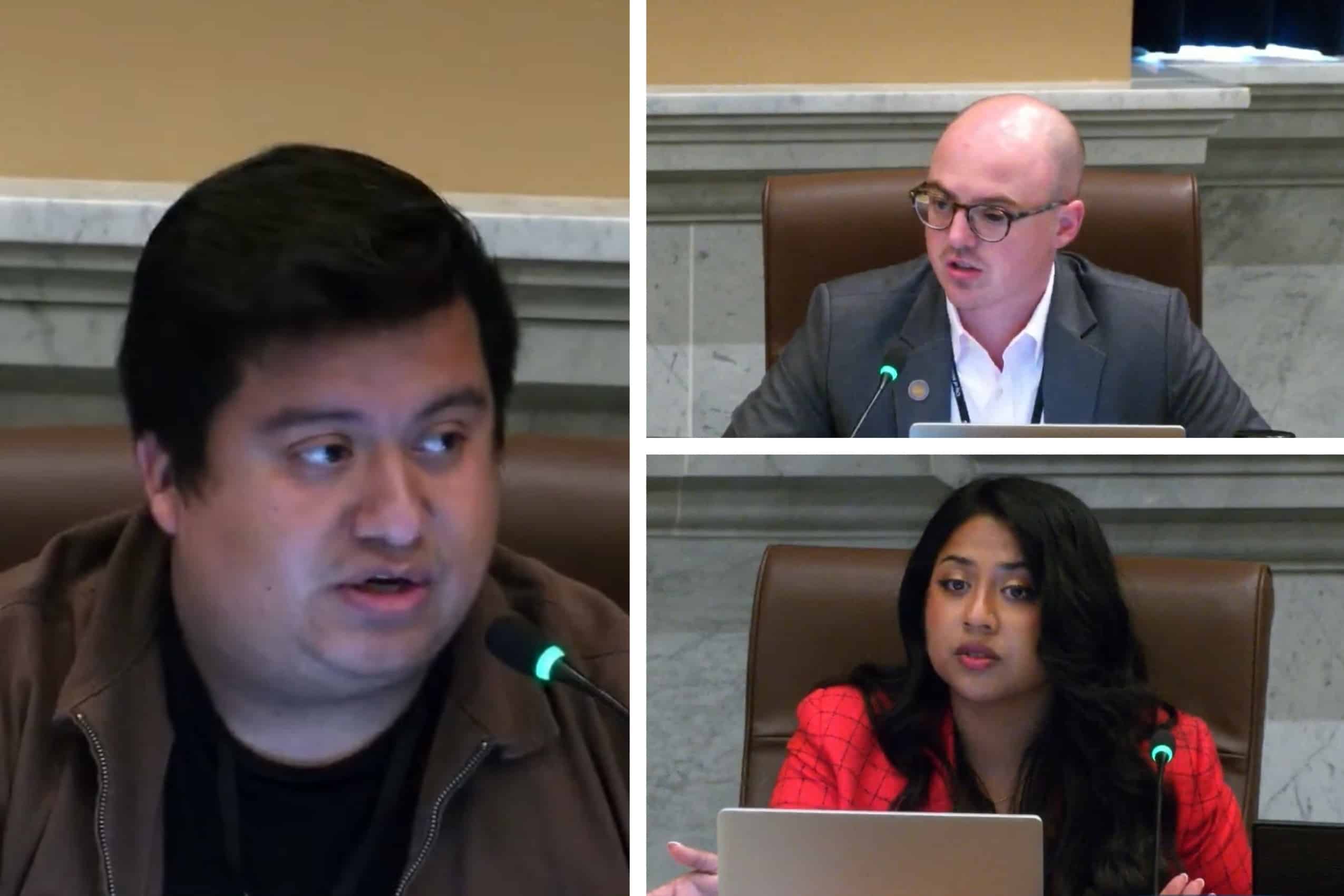
Council Member Jason Chavez, who is aligned with the Democratic Socialists of America (DSA), said, “I do not accept the words in this [invitation]. I do not like the purpose of funding stated in this [invitation] that talks about immigration enforcement.”
Chavez took particular umbrage with the invitation’s use of the words “unlawfully present” and “illegal aliens.” He also took issue with the stated purpose of the funding going toward locating and apprehending “aliens.”
Another city council member, Aurin Chowdhury, said she did not have a problem with the NIBIN system, but said the “purpose” and “language” stated in the federal government’s invitation “is extremely egregious and deplorable.”
“The term ‘illegal alien’ is not just a legal term of art,” she added. “It’s a slur. It is an absolute slur. Calling people ‘illegal aliens’ is dehumanizing, degrading, and it creates a permission structure for violence against them.”
Soren Stevenson, a DSA-aligned council member, said, “We’re here in 2026, in Minneapolis, after the invasion of the federal government and it’s just time for us to say, ‘Hey, we’re not even gonna accept this rhetoric.'”
Multiple council members noted that Minneapolis could modernize its NIBIN technology with alternative sources of funding. Stevenson said, “we can and we will find other money to keep the NIBIN access going; we don’t need this money.”
Conversely, the more moderate Democrats on the council supported the grant application. One of those council members, Elizabeth Shaffer, said, “No one on this body wants to devalue, dehumanize, or demonize anyone because of their immigration status.”
According to Shaffer, city attorneys have said pursuing the grant application would not violate a city ordinance that prohibits MPD from assisting in immigration enforcement.
“MPD will use this grant solely to investigate shootings that occur in Minneapolis,” Shaffer said. “That matters. Because gun violence has become so common in our city I fear we are becoming numb to it.”
In her comments, Shaffer called attention to recent shootings in Minneapolis, one of which occurred earlier this month outside the Reign Event Center.
“NIBIN can help MPD connect a gun to a crime, connect related shootings to one another, identify the person responsible, and prevent that person from doing it again,” Shaffer said. “MPD needs access to NIBIN because we need to get shooters and the guns they use off our streets.”
According to Shaffer, MPD informed the city council that MPD would lose access to NIBIN if the system was not upgraded before the end of the year.
Shaffer also warned that Minneapolis is facing a budget shortfall of $30 million or more. She said, “we cannot afford to turn up our noses to $300,000 because we dislike who occupies the White House or who leads the Department of Justice.”
Ultimately, the Minneapolis City Council voted 7-5 to give MPD authorization to submit the grant application. According to Shaffer, nine affirmative votes from the city council are required in order for the city to accept the $300,000 if it is issued to Minneapolis.

Luke Sprinkel
Luke Sprinkel previously worked as a Legislative Assistant at the Minnesota House of Representatives. He grew up as a Missionary Kid (MK) living in England, Thailand, Tanzania, and the Middle East. Luke graduated from Regent University in 2018.