




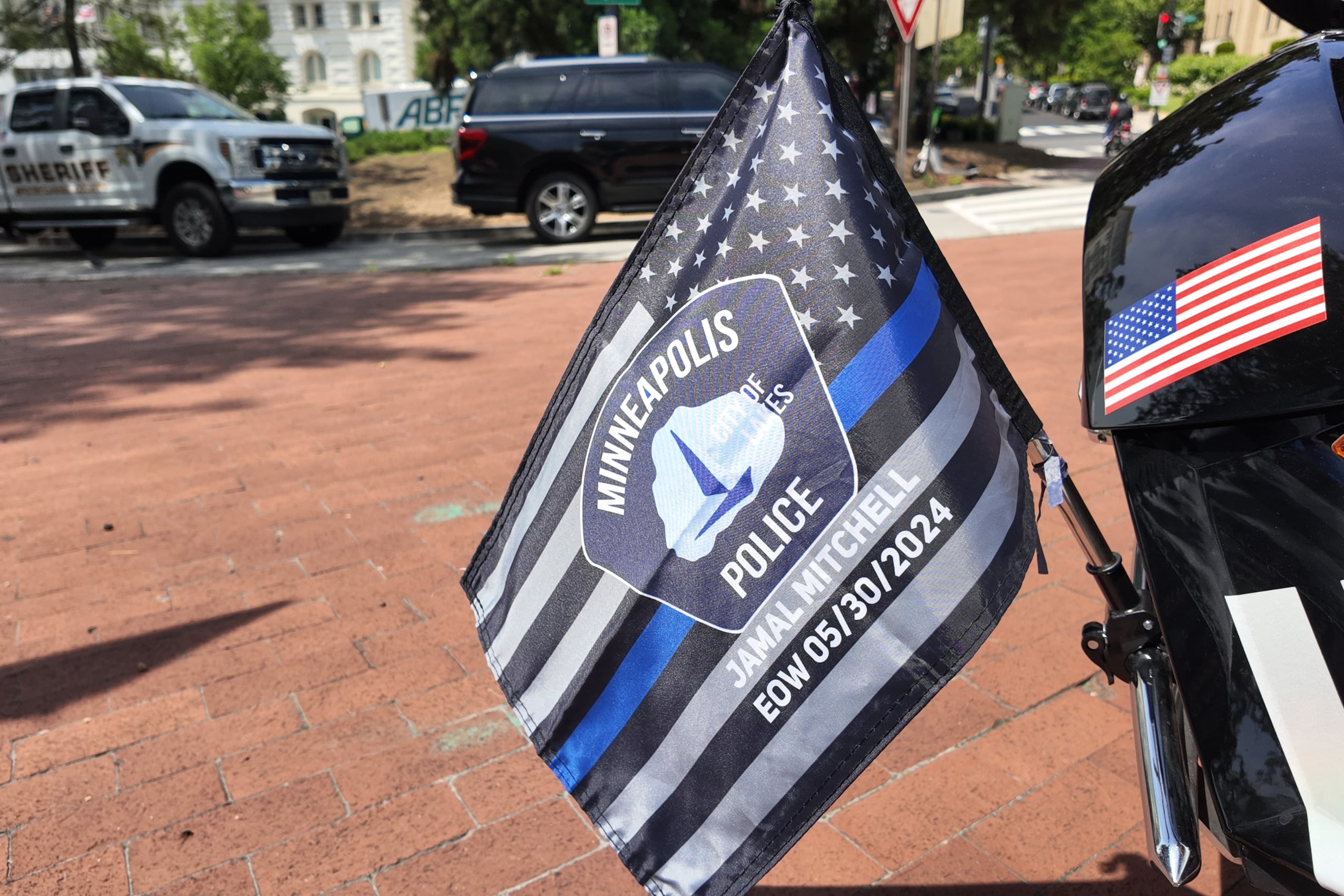
The annual National Police Week that took place earlier this month is a time to reflect and honor the law enforcement officers who made the ultimate sacrifice protecting others in the line of duty.
It is a moment when those who have dedicated themselves to this profession exhale their grief.
However, it is also a moment—one rarely mentioned aloud—when they brace themselves for the inevitable: new names and new memorials and upholding a sacred obligation to remember them.
It’s a sobering reminder of what the men and women behind the badge sacrifice to keep our communities safe.
But elected officials, including those in Minnesota, seem to be doing more to put them in harm’s way than protect them.
I’ll give Gov. Tim Walz credit for not pretending anymore, like he did last year.
Last year, Gov. Walz followed along with the all-but-minimal routines of recognizing National Police Week. But on the final day of Police Week, he compared federal law enforcement to Nazi secret police.
This year, Walz issued no proclamation, no half-mast flag order, and no statement of appreciation for law enforcement professionals.
His silence this year may be the most honest thing he’s ever done.
But his honesty betrays something far more dangerous happening in the Gopher State.
Policing changed dramatically in Minnesota after Memorial Day 2020. Just months after the death of George Floyd, Walz signed the Minnesota Police Accountability Act, on July 23, 2020 to be exact.
In the years that would follow, assaults on law enforcement in Minnesota would increase dramatically at roughly three times the national rate of increase for the same period.
Granted, a few years ago, some mainstream media outlets mentioned how the number of assaults on law enforcement in Minnesota had doubled since 2019.
However, according to data from the Minnesota Bureau of Criminal Apprehension (BCA), there has been a 166% increase in assaults from 2019 through 2024. BCA data indicates that there were 467 assaults on Minnesota law enforcement officers in 2019—yet there were 1,241 assaults in 2024, the last year for which a complete set of data is available.
The fact that there seems to be a correlation between Walz’s attempt to improve accountability—and the staggering increase in assaults—is difficult to overlook.
But making matters worse in Minnesota, when Walz signed the act into law, it basically gutted the deadly force standard that had governed Minnesota law enforcement for 42 years, a standard grounded in the constitutional framework the United States Supreme Court established in Graham v. Connor.
What replaced it is the most dangerous use-of-force standard for officers in the country. The rewrite of Minnesota Statute §609.066 added a three-part “threat” test for deadly force and buried in that test is a sentence fragment that sounds harmless to everyone who has never had to make split-second decisions about life and death.
Deadly force is authorized if it is “reasonably likely to occur absent action by the law enforcement officer.”
That language was enough for law enforcement leaders in North Dakota and Wisconsin to stop crossing the border to assist Minnesota officers. Former Fargo Police Chief David Zibolski put the fear of every Minnesota officer into plain English: “I certainly don’t want to send one of our officers over there who’s involved in a deadly force scenario, and it’s found later, ‘Well, you’re in violation of Minnesota law and now you’re going to be charged with a crime.’ Whereas if the same situation happened in Fargo, they would not be charged with a crime.”
Read that again—and understand why.
The statute means exactly what it says. Unless deadly force would have been justified without an officer being present, an officer who uses deadly force loses the statutory protection that shields them from criminal prosecution.
There are narrow circumstances where the law provides clear justification, an active shooter, someone pointing a gun at a bystander, situations where the threat exists regardless of whether law enforcement is present. But the law creates a catastrophic gap in the most common deadly force scenarios.
If a police officer stops a car or responds to a call and a suspect attacks that officer, the officer must now consider whether the suspect would have done the same thing absent law enforcement action, without police being present at all. In almost every case, the honest answer is no. And that honest answer is what puts the officer in legal jeopardy and makes them hesitant to protect their own life.
Some will argue the assault data has multiple causes. They are right: political rhetoric, reduced accountability for criminals, and depleted staffing all contribute. But no other state rewrote its deadly force standard to require officers to consider a counterfactual universe in which they don’t exist. And no other state has seen its officer assault rate climb at this speed while violent crime simultaneously fell. Something changed the dynamic between Minnesota officers and the people they encounter, and that something has a name.
Gov. Tim Walz and his political cronies know this. They also know that they can’t apply this section of the law to every deadly force case because virtually every officer would be prosecuted so they keep it in their back pocket, waiting for the political winds to shift.
Every Minnesota officer knows it and that is why you’ve seen the assault rates against them explode.
Gov. Walz will not acknowledge any of this.
He will stay silent, as he did for Police Week 2026, while Minnesota law enforcement navigates the most rapidly deteriorating officer safety environment in the country. No proclamation, no flag, no answer for what his signature produced.
Dr. Travis Yates is a 30-year law enforcement veteran and founder of the FOCUS system, a research based framework designed to reduce use of force and officer assaults. He is the author of The Courageous Police Leader and has trained thousands of officers across 46 states.
The views and opinions expressed in this commentary are those of the author and do not represent an official position of Alpha News.

Travis Yates
Dr. Travis Yates is a 30-year law enforcement veteran and founder of the FOCUS system, a research based framework designed to reduce use of force and officer assaults. He is the author of "The Courageous Police Leader" and has trained thousands of officers across 46 states.