



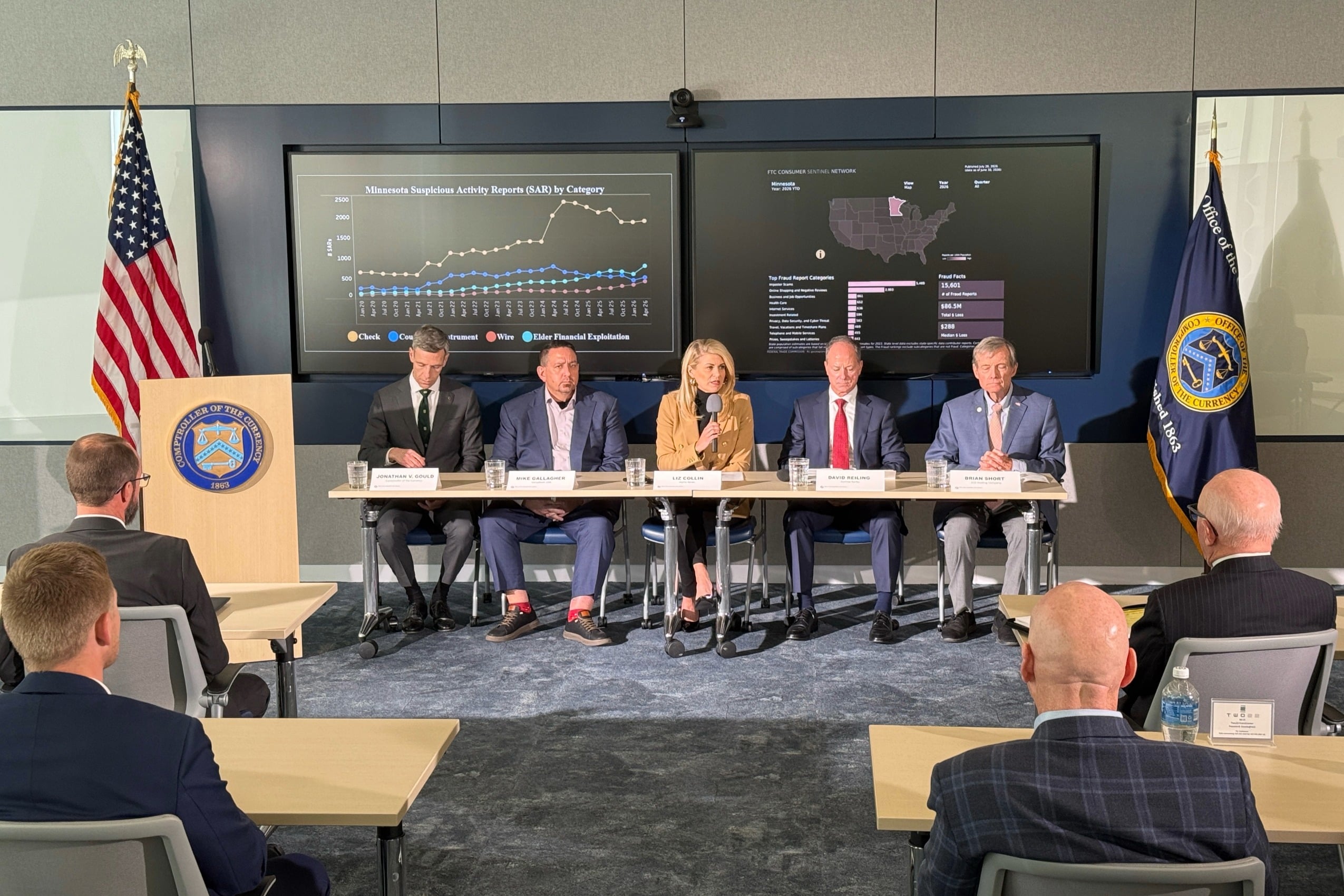
U.S. Comptroller of the Currency (OCC) Jonathan V. Gould convened a roundtable in Minneapolis Tuesday with community bankers to discuss financial fraud in Minnesota and the role banks play in identifying and stopping suspicious activity.
The Oct. 6 event was moderated by Alpha News senior reporter Liz Collin and held at the OCC’s Minneapolis field office, which Gould said serves more than 50 national banks and federal savings associations in Minnesota.
“Minnesota has seen fraud spiral out of control in recent years,” Gould said in his opening remarks. “Across the board, non-mortgage fraud reports in Minnesota more than doubled between 2020 and 2024. We also saw a nearly 300% increase in suspicious activity report filings related to check fraud during that same period, with a whopping 87% jump from 2021 to 2022 and then another 70% jump year-over-year in July 2024.”
Gould also pointed to fraud involving government programs, saying billions of dollars intended for hungry children, housing for disabled seniors and services for children with special needs were diverted by people who cheated the system.
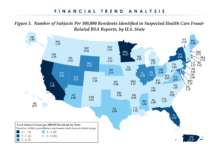
According to Gould, a recent Financial Crimes Enforcement Network analysis identified more than $17 billion in suspicious financial activity potentially connected to healthcare fraud and ranked Minnesota “number one per capita in terms of healthcare-related fraud.”
“The trend is only just now beginning to reverse course, thanks in part to this Administration’s efforts and to all of you who work diligently on behalf of your banks and customers,” he said.
The comptroller also discussed federal investigations into money services businesses accused of sending funds to Somalia. Gould said the Treasury Department launched investigations into four businesses over funds that “could have potentially been diverted to the terrorist organization Al-Shabaab.” Those investigations remain ongoing.
During the roundtable, Gould announced a new tool allowing community bankers to directly notify an OCC fraud taskforce about suspected payments fraud involving OCC-regulated institutions in real time.
The OCC has also promoted updated federal guidance designed to make it easier for banks to share information with one another when they suspect fraud.
“The community bankers gathered here today … are truly the frontline of defense against fraud,” Gould said. “You are the first to see suspicious activity, making you key partners in furthering economic security, which is inextricably linked with national security.”
Information sharing was also a focus of the discussion. For instance, Sunrise Bank identified and closed accounts linked to Feeding Our Future, but individuals connected to those accounts later attempted to use other banks, highlighting the need for greater communication between financial institutions.
David Reiling, president and CEO of Sunrise Banks, said the bank detected unusual activity involving Feeding Our Future-linked accounts and ultimately closed dozens of them.
“They weren’t just a couple accounts. They were dozens of accounts,” Reiling said.
Mike Gallagher, chief Bank Secrecy Act officer at Versa Bank, explained how he discovered some of the fraudulent activity connected to Feeding Our Future accounts.
“As we started to look at the customer, the accounts, the transactions, we started to see a lot of higher-risk transactions that did not match the customer’s intended use. It wasn’t like they were buying styrofoam containers. They were buying things that made no sense,” he said.
“We started to get information from these businesses where they started to talk about how many meals they were providing and there was just no way. It did not fit. It did not even come close,” Gallagher continued. “It was just a lot of activity that, from a red flag to a red flag to a red flag, didn’t add up.”
Bankers also discussed common fraud schemes, including check washing and online scams, and emphasized the importance of knowing customers well enough to identify unusual behavior.
Brian Short, whose company owns several community banks, said attempted fraud has become a daily occurrence.
“We are getting reports of attempted fraud every day in our company. Every day,” Short said.
Short described one case in which a customer attempted to deposit a check after selling cattle to an out-of-state buyer. A bank employee thought something seemed wrong and contacted the bank the check was drawn on, discovering it was fraudulent before the customer shipped the cattle.
Gould said the OCC’s new reporting tool will help centralize incoming fraud complaints, particularly from smaller community banks, and help them reach the appropriate contacts at larger institutions more quickly.
He closed the discussion by thanking community bankers for being “on the front lines in the fight against fraud” and protecting their customers and communities.

Symone Harms
Symone Harms is a Media Production and Business Marketing student at Bethel University. She is actively involved in The Royals Investment Fund, The 25, theatre, and other leadership positions. She also cohosts Rooted, a podcast dedicated to being rooted in truth, growing in freedom, and prospering in life. A Minnesota native with a passion for storytelling and digital media, she aspires to a career in broadcasting as a news anchor and reporter.