




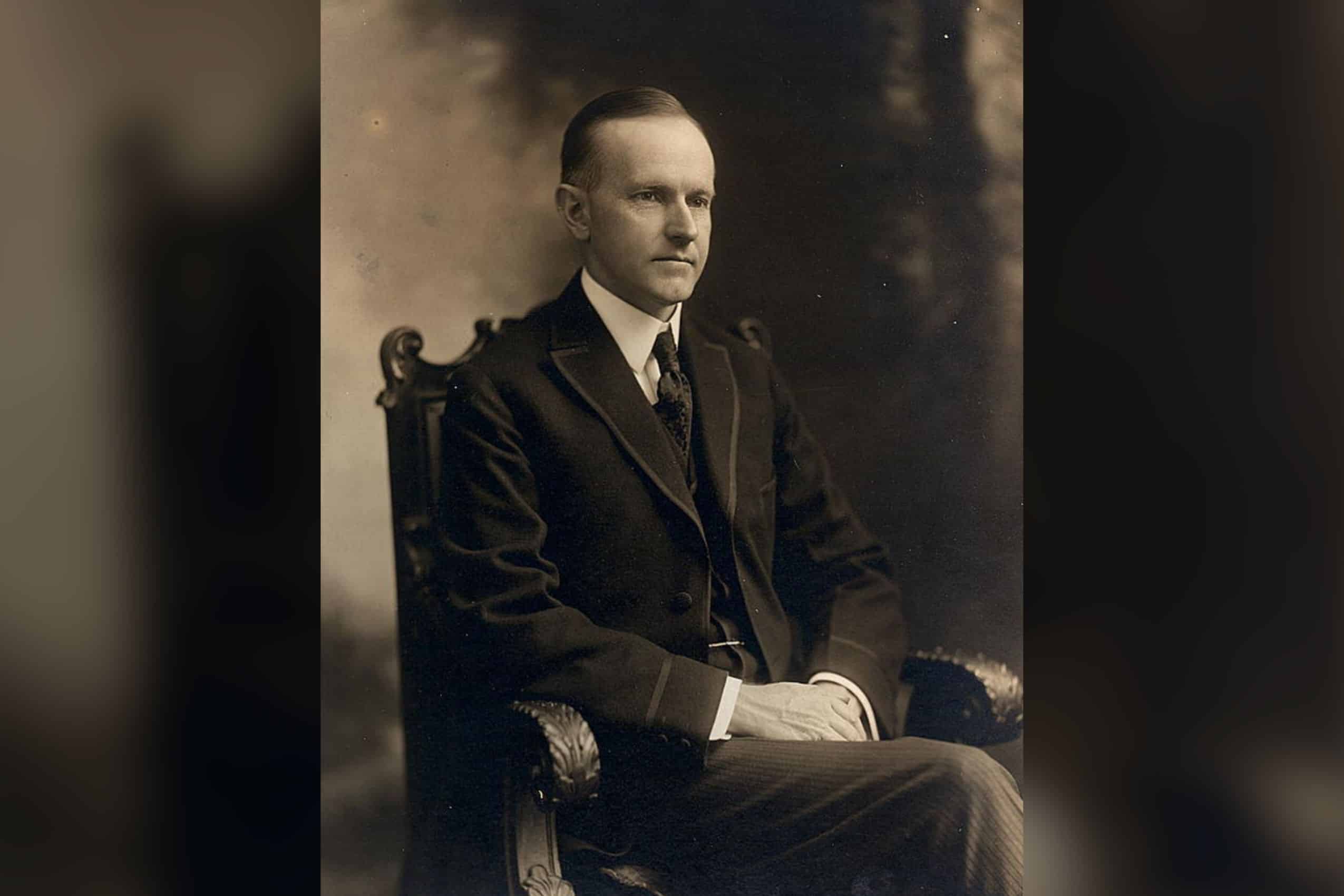
This summer we are not only celebrating the 250th anniversary of the Declaration of Independence, but the 100th anniversary of a somewhat surprising event that also took place in Philadelphia.
On July 4, 1926, President Calvin Coolidge journeyed to the City of Brotherly Love to deliver a speech honoring Thomas Jefferson’s handiwork. Often dismissed as “Silent Cal,” his speech on that day is very much worth both recalling and celebrating–and pondering.
The president who once retorted “you lose” to a dinner guest who had bet that she could coax him into speaking at least three words is perhaps best remembered for uttering these six words: “The business of America is business.” Actually, the complete Coolidge sentence was a bit longer: “The chief business of the American people is business.”
Those nine words had been uttered a year earlier by Coolidge while addressing the American Society of Newspaper Editors. Titled “The Press Under a Free Government,” the speech actually praised American idealism. In fact, the New York Times’ story headlined the speech just that way: “Coolidge Declares Press Must Foster America’s Idealism.”
Here are a few more Coolidge words from that speech: “We make no concealment of the fact that we want wealth, but there are many other things that we want much more . . . America is a nation of idealists (and) no newspaper can be a success which fails to appeal to that element of our national life.”
Now let’s fast forward to a few words that he reserved for the celebration of America’s 150th birthday. Coolidge began by reminding his listeners that the celebration of July 4th should never be about the business of “proclaiming new theories and principles,” but rather to “rereaffirm and re-establish old theories and principles . . .”
Coolidge, however, was quick to add that the Declaration had proclaimed that a “new civilization” had come into being. More than that, a “new spirit had arisen on this side of the Atlantic,” a spirit “more advanced and more developed for the rights of the individual than that which characterized the Old World.”
Here people would not be judged by one’s background or inheritance or social standing. The only yardstick might be money — or as one of Jefferson’s compatriots put it, “ah, wealth, the great leveller.” And he likely wasn’t joking.
To be sure, while the Declaration ”represented the movement of a people,” it was “in no sense a rising of the oppressed and downtrodden. It brought no scum to the surface, for the reason that colonial society had developed no scum.” In a few more Coolidge words, the decision to break from England reflected the “informed and mature convictions of an . . . independent, liberty-loving, God-fearing people.” There was “nothing about it of the lawless and disordered nature of a riotous insurrection.”
The result of their efforts was a new nation based on “new principles.” Three in number, Coolidge made sure to repeat them: 1) “All men are created equal”; 2) They are “endowed with certain inalienable rights”; 3) “Therefore the just powers of the government must be derived from the consent of the governed.” Paradoxically, the actions of the founders were at once “conservative” (to keep rights that were being transgressed) and “profoundly revolutionary.”
Far from finished, the normally “silent Cal” was just warming up. After a few more history lessons he pronounced it to be “but natural that (Jefferson’s) first paragraph should open with a reference to Nature’s God (and) close with an appeal to the Supreme Judge of the world . . .” Jefferson and the founders “preached equality because they believed in the fatherhood of God and the brotherhood of man, (since) we are all created in the divine image, all partakers of the divine spirit.”
Do those words mark Coolidge, and Jefferson for that matter, as little more than budding Christian nationalists? Hardly. But both did believe in the transcendent, whether that be the Christian God or “nature’s God,” because both knew that without a sense of transcendence there really is no reason — or way — to believe in human equality. Do we have God-given rights or state-bestowed rights?
For Coolidge, the Declaration was “a great spiritual document.” Echoing his speech to those newspaper editors, the president persisted that the rights of man “are not elements that we can see and touch. They are ideals (that) have their roots in religious convictions (and) belong to the unseen world.”
He then worried out loud that we are “too prone to overlook another conclusion,” namely that “governments do not make ideals, but ideals make governments.” That finally might have been that, except that it wasn’t. With the progressive movement of Woodrow Wilson very much on his mind, Coolidge wanted it to be known that there remains a “finality” about the Declaration that “is exceedingly restful.” Not just right, mind you, but restful, as in, well, as in final, or as in he finally rests his case.
Coolidge’s close to final words were these: “If all men are created equal, that is final. If they are endowed with inalienable rights, that is final. If governments derive their powers from the consent of the governed, that is final.”
Clearly, Coolidge was taking direct aim at the main thrust of the progressive movement and its emphasis on government by experts. More than that, he was challenging the beguiling progressive notion that we ought to progress beyond outmoded notions of the late 18th century. If anything, he turned that very notion on its head by insisting that we ought to return to them. In other words, he had serious differences with Woodrow Wilson and his Darwinian-like commitment to a “living constitution.”
As far as Calvin Coolidge was concerned, such progressives were actually reactionaries. How so? “No progress can be made beyond these propositions” (of the Declaration). If anyone wishes to deny their truth or their soundness, the only direction in which he can proceed historically is not forward, but backward.” That would be backward to the “time when there was no equality, no rights of the individual, no rule of the people.”
This was the much-ridiculed Calvin Coolidge who did “not choose to run” in 1928. A progressive conservative, he served between two progressive reactionaries, Wilson and Franklin Roosevelt, both of whom routinely appear near the top of any list of our great presidents. If only Coolidge had run and won in 1928, maybe he would have achieved presidential greatness on the scale of an FDR. Then again, maybe not.
Had Coolidge served another four years there might have been a brief 19th century-style “panic,” but not a twelve year depression. Of course, we’ll never know. But what can be known — and celebrated — are the eternally wise words that he spoke on the 150th anniversary of America’s founding.
John C. “Chuck” Chalberg taught American history at Normandale Community College.
The views and opinions expressed in this commentary are those of the author and do not represent an official position of Alpha News.

Chuck Chalberg
John C. "Chuck" Chalberg taught American history at Normandale Community College.